Tuesday of the Second week in Lent
Matthew 23:1-12
“But whoever has exalted himself, shall be humbled. And whoever has humbled himself, shall be exalted.”
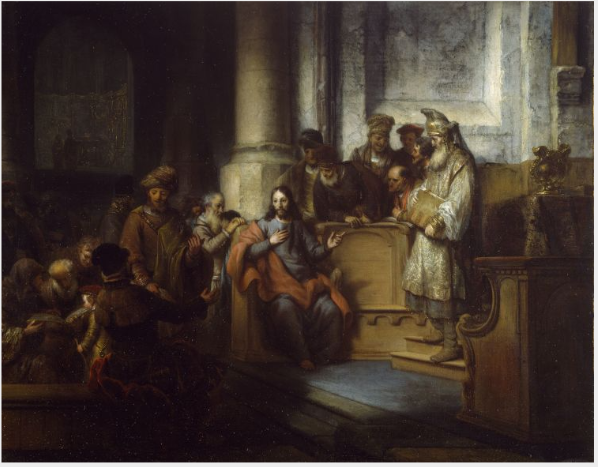
Ex Wikimedia Commons
Then Jesus spoke to the crowds, and to his disciples, saying: “The scribes and the Pharisees have sat down in the chair of Moses. Therefore, all things whatsoever that they shall say to you, observe and do.
Yet truly, do not choose to act according to their works. For they say, but they do not do.
For they bind up heavy and unbearable burdens, and they impose them on men’s shoulders. But they are not willing to move them with even a finger of their own.
Truly, they do all their works so that they may be seen by men. For they enlarge their phylacteries and glorify their hems. And they love the first places at feasts, and the first chairs in the synagogues, and greetings in the marketplace, and to be called Master by men.
But you must not be called Master. For One is your Master, and you are all brothers. And do not choose to call anyone on earth your father. For One is your Father, who is in heaven.
Neither should you be called teachers. For One is your Teacher, the Christ. Whoever is greater among you shall be your minister. But whoever has exalted himself, shall be humbled. And whoever has humbled himself, shall be exalted.
What do the Fathers say?
St John CHRYSOSTOM. But so that no one should say, For this cause am I slack to practise, because my instructor is evil, He removes every such excuse, saying, whatsoever they say unto you, that observe and do, for they speak not of their own, but of the things which God taught through Moses in the Law.
Look with what He begins His reproof of them, For they say, and do not. Every one who transgresses the Law is deserving of blame, but especially he who has the post of instruction. And this for a threefold cause; first, because he is a transgressor; secondly, because when he ought to set others right, be himself halts; thirdly, because, being in the rank of a teacher, his influence is more corrupting.
Again, He brings a further charge against them, that they oppress those that are put under them; They bind heavy burdens; in this He shews a double evil in them; that they exacted without any allowance the utmost rigour of life from those that were put under them, while they allowed themselves large licence herein.
But a good ruler should do the contrary of this, to be to himself a severe judge, to others a merciful one.
Not only does the Lord forbid us to seek supremacy, but would lead His hearer to the very opposite; He that is greatest among you shall be your servant.
PSEUDO-CHRYSOSTOM. But regard must be had to this, how does each man fill his seat; for it is not the seat makes the Priest, but the Priest makes the seat; the place does not consecrate the man, but the man the place.
Such also are they who lay a heavy burden upon those who come to penitence, so that while men would avoid present punishment, they overlook that which is to come. For if you lay upon a boy’s shoulders a burden more than he can bear, he must needs either cast it off, or be broken down by it; so the man on whom you lay too grievous a burden of penance must either wholly refuse it, or if he submit himself to it will find himself unable to bear it, and so be offended, and sin worse. Also, if we should be wrong in imposing too light a penance, is it not better to have to answer for mercy than for severity?
Every substance breeds in itself that which destroys it, as wood the worm, and garments the moth; so the Devil strives to corrupt the ministry of the Priests, who are ordained for the edification of holiness, endeavouring that this good, while it is done to be seen of men, should be turned into evil.
For He rebukes not those who recline in the highest place, but those who love such places, blaming the will not the deed. For some vain men hearing that it was a commendable thing to seat himself in the lowest place, chooses so to do; and thus not only does not put away the vanity of his heart, but adds this additional vain ostentation of his humility, as one who would be thought righteous and humble.
St RABANUS. It should be noted, that He does not forbid those to whom this belongs by right of rank to be saluted in the forum, or to sit or recline in the highest room; but those who unduly desire these things, whether they obtain them or not, these He enjoins the believers to shun as wicked.
PSEUDO-CHRYSOSTOM. And call no man your Father upon earth; because in this world though man begets man, yet there is one Father who created all men. For we have not beginning of life from our parents, but we have our life transmitted through them.