
St. Cyril of Alexandria (c. 376–444 AD) was one of the most powerful and intellectually formidable figures in early Christianity. He was the central architect of the Church’s definition of how Jesus Christ can be both fully God and fully man.
According to Pope Benedict XVI “Cyril was later defined as “the guardian of exactitude” – to be understood as guardian of the true faith – and even the “seal of the Fathers”. These ancient descriptions express clearly a characteristic feature of Cyril: the Bishop of Alexandria’s constant reference to earlier ecclesiastical authors (including, in particular, Athanasius), for the purpose of showing the continuity with tradition of theology itself. He deliberately, explicitly inserted himself into the Church’s tradition, which he recognized as guaranteeing continuity with the Apostles and with Christ himself.”
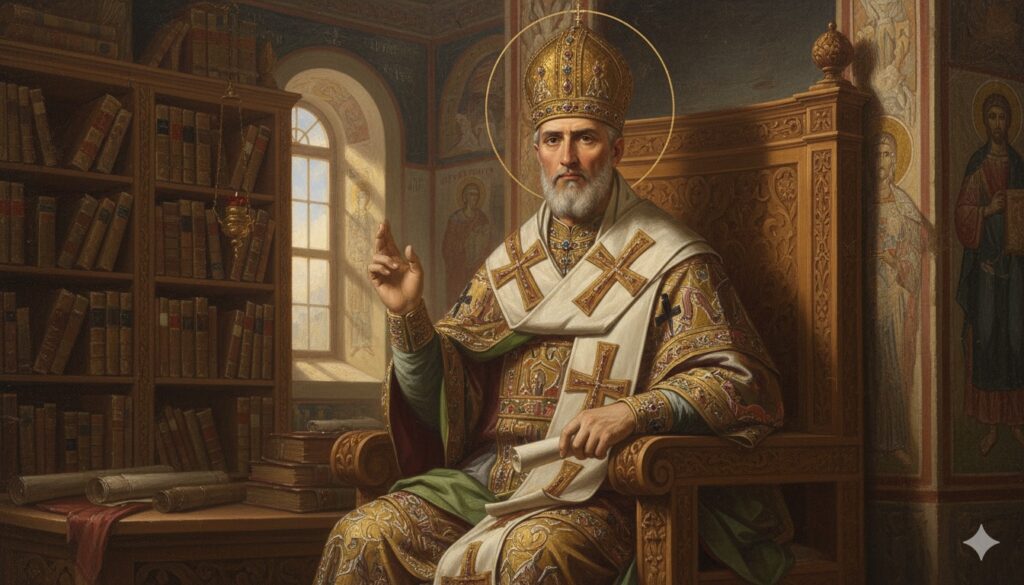
Rise to Power
Cyril was born in Egypt between 370 and 380 A.D. He was the nephew of Theophilus, the powerful Patriarch of Alexandria and was initiated into ecclesiastical life from a very young age. He received a good education, both culturally and theologically.
- The Mentee: In 403, in the retinue of his powerful uncle. he went to Constantinople to take part in the so-called “Synod of the Oak” which deposed the Bishop of that city, John (later known as “Chrysostom”), on a series of largely unfounded, politically motivated charges.and thereby marked the triumph of the Alexandrian See over its traditional rival, the See of Constantinople.
When Chrysostom died in exile in 407 AD, his memory was vindicated by Rome and the wider Church. Churches across Christendom began restoring Chrysostom’s name to the diptychs—the official liturgical lists of living and departed Christians commemorated during the Eucharistic liturgy. However, Cyril, when he succeeded his uncle as Patriarch of Alexandria, steadfastly refused to add Chrysostom to Alexandria’s diptychs until the time of his vision. (see below) - The Succession (412 AD): After his uncle’s death, Cyril’s election to the Patriarchate was not peaceful; it involved a literal riot in the streets between his supporters and those of his rival,Archdeacon Timothy (also referred to as Timotheus). The election divided the city, leading to three days of violent street riots and clashes between the supporters of Cyril and those of Timothy. Ultimately, Cyril’s faction prevailed, and he was consecrated as patriarch on October 18, 412.
- The parabalani: In Alexandria, the Patriarch held more than religious power—he was a civic leader with his own paramilitary force (the parabalani). Cyril used this power to shut down churches of heretical sects and to expel certain Jewish populations from the city following a series of violent ethnic clashes.
- The vision: According to Church tradition and historical accounts, Cyril’s heart eventually changed through a profound mystical experience. He is said to have had a vision of a magnificent temple where the Virgin Mary was surrounded by angels and saints, including John Chrysostom.
When Cyril attempted to approach the Mother of God, Chrysostom barred his path. Mary then interceded, asking Chrysostom to forgive Cyril for acting out of ignorance, noting how hard Cyril had fought for her honour. Chrysostom consented, and the two saints embraced in the vision.
Cyril completely repented of his hostility. Around 417 or 418 AD, he formally restored John Chrysostom’s name to the diptychs of Alexandria, establishing a public feast day in his honor and firmly cementing Chrysostom’s place as an orthodox Father of the Church.
The Nestorian Controversy
Cyril’s greatest historical legacy is his battle with Nestorius, the Patriarch of Constantinople.
- The Conflict: Nestorius argued that Mary should not be called Theotokos (“God-bearer”), but only Christotokos (“Christ-bearer”). He feared that calling her “God-bearer” implied that God had a beginning or that the divine nature had suffered.
- Cyril’s Response: Cyril saw this as a “surgical” separation of Christ into two persons—a divine son and a human son living in one body. Cyril famously argued for the “Hypostatic Union”: that the divine and human natures are joined in one single, indivisible Person.
- In a letter to Nestorius – a letter which later, in 451, was to be approved by the Council of Chalcedon, the Fourth Ecumenical Council – Cyril described his Christological faith clearly:
“Thus, we affirm that the natures are different that are united in one true unity, but from both has come only one Christ and Son; not because, due to their unity, the difference in their natures has been eliminated, but rather, because divinity and humanity, reunited in an ineffable and indescribable union, have produced for us one Lord and Christ and Son”. And this is important: true humanity and true divinity are really united in only one Person, Our Lord Jesus Christ. Therefore,we will profess only one Christ and Lord, not in the sense that we worship the man together with the Logos, in order not to suggest the idea of separation by saying “together’, but in the sense that we worship only one and the same, because he is not extraneous to the Logos, his body, with which he also sits at his Father’s side, not as if “two sons” are sitting beside him but only one, united with his own flesh”.
The Council of Ephesus (431 AD)
Cyril’s political maneuvering reached its peak at the Third Ecumenical Council.
- The Bold Move: Cyril arrived early, opened the council before Nestorius’s supporters from Antioch could arrive, and successfully had Nestorius deposed and his teachings condemned.
- The Aftermath: Though the Emperor initially arrested both Cyril and Nestorius to stop the fighting, Cyril’s theological brilliance eventually secured his victory and his return to Alexandria as a hero of the faith.
- It is at this assembly which ended with the first great triumph of devotion to Mary and with the exile of the Bishop of Constantinople, who had been reluctant to recognize the Blessed Virgin’s right to the title of “Mother of God” because of an erroneous Christology that brought division to Christ himself.
Theological Legacy
Cyril’s writings are considered the gold standard for Christology in both the Catholic and Orthodox traditions.
- The Twelve Anathemas: A series of theological “lines in the sand” that defined the boundaries of orthodox belief regarding the nature of Christ.
- Against Julian: to respond to the work Against the Galileans, composed in 363 by the Emperor known as the “Apostate” for having abandoned the Christianity in which he was raised.
- in 433 in his first letter to Bishop Succensus he wrote :
“Only one is the Son, only one the Lord Jesus Christ, both before the Incarnation and after the Incarnation. Indeed, the Logos born of God the Father was not one Son and the one born of the Blessed Virgin another; but we believe that the very One who was born before the ages was also born according to the flesh and of a woman”. - Eucharistic Theology: He emphasized that because Christ is truly God and Man in one person, the Eucharist is not just a symbol, but the “Life-Giving Word” that transforms the believer.
He died on the 27th June 444.
Sources :
- Socrates Scholasticus, Ecclesiastical History (Book VII): A contemporary account of Cyril’s early years in Alexandria.
- St. Cyril, The Christological Controversy: A collection of his letters to Nestorius.
- Pope Benedict XVI : General Audience 3 October 2007