
St. Remigius (Remi) of Reims (c. 437 – c. 533 AD)
Unlike many saints who came from obscure backgrounds, Remigius was born into the Gallo-Roman aristocracy, the elite class that maintained Roman culture and administrative power even as the Roman Empire was collapsing in the West.
St. Remigius (known in French as Saint Remi) was a highly influential Bishop of Reims during the crucial period when the Western Roman Empire collapsed and the foundation of the medieval Frankish kingdom was being laid. He is most famous for baptizing Clovis I, the first King of the Franks, making him central to the history of Catholic France.
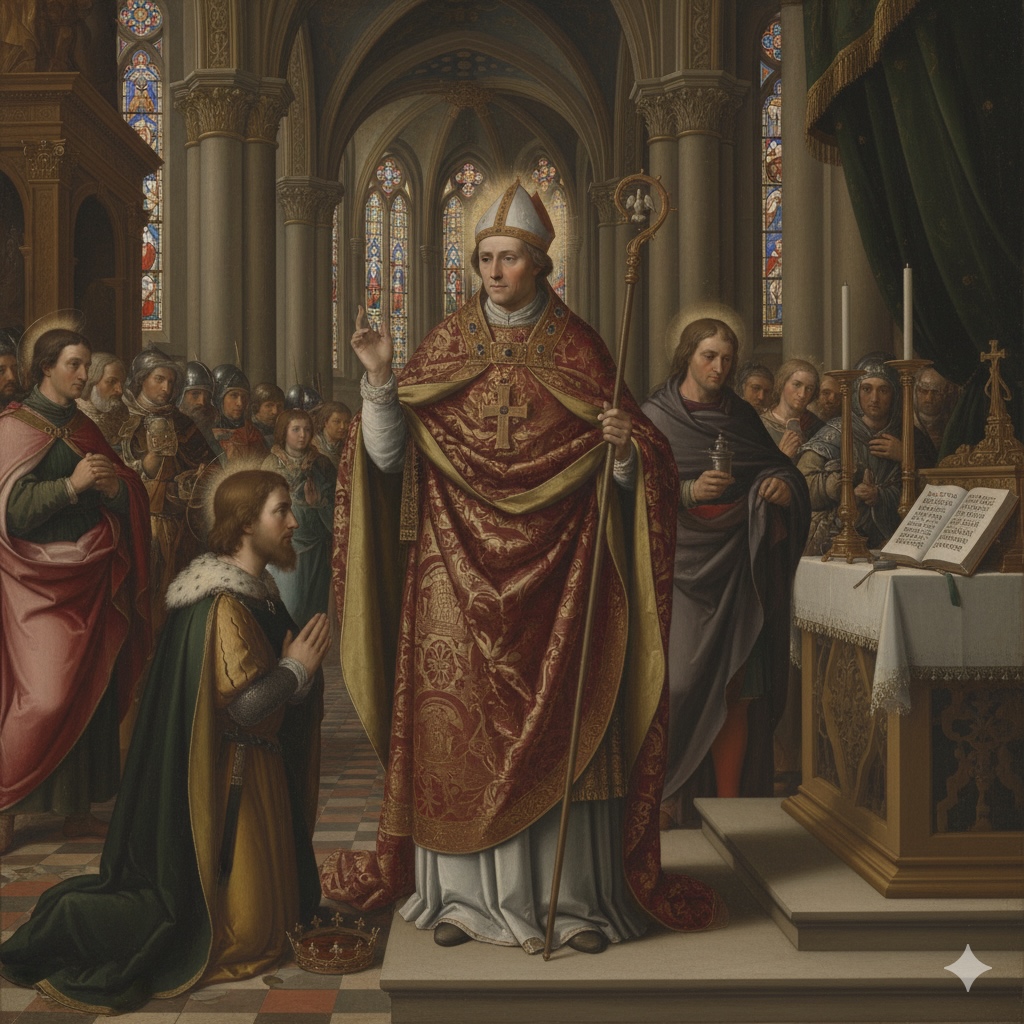
Early Life
- Birth: Remigius was born around 437 AD, likely near Laon, in what was then the Roman province of Belgica Secunda (Northern Gaul). His family was part of the “senatorial” class—meaning they were the highest-ranking Roman citizens in Gaul.
- His Father: Count Emilius of Laon. Emilius was a high-ranking Gallo-Roman official. His status meant that Remigius grew up in an environment of law, governance, and classical education.
- His Mother: Saint Celine (Cilina). She is a canonized saint in her own right. Tradition holds that she was quite elderly when she gave birth to Remigius.
- Because of his father’s status, Remigius received the finest classical Roman and religious education available in Gaul.He was trained in the traditional Roman “Seven Liberal Arts.” He was so skilled in rhetoric (public speaking) that even as a young man, he was considered one of the most eloquent speakers of his age.
Election
- Bishop at a Young Age: Due to his deep piety, learning, and eloquence, he was chosen as the Bishop of Reims (Reims became the capital of Belgica Secunda, a Roman province) at the remarkably young age of 22, around 459 AD. He served as bishop for over 70 years, witnessing the profound political and social transformation of Gaul.
The Conversion of Clovis
The defining event of Remigius’s life was the conversion and baptism of Clovis I, the pagan King of the Salian Franks.His childhood in a Gallo-Roman noble house prepared him for this most famous act. Remigius was the bridge between the old Roman world of his parents and the new “French” world of the Franks. He used the diplomatic skills he learned at his father’s estate to convince the fierce warrior Clovis to adopt Christianity.
- Marriage and Influence: Clovis had married the Catholic Princess Clotilde (later St. Clotilde). Remigius had maintained correspondence with both the King and the Queen, encouraging Clovis toward the Christian faith.
- The Vow at Tolbiac (496 AD): During a critical battle against the Alamanni at Tolbiac, Clovis’s troops were facing defeat. Clovis is said to have prayed to the Christian God, vowing that if he won, he would convert. The tide of the battle turned, and the Franks won a decisive victory. The Battle of Tolbiac is considered the “Milvian Bridge” of French history—the moment where a pagan king’s desperate battlefield prayer changed the course of Western Europe.
The Context: The Alamanni Threat
- The Alamanni were a confederation of Germanic tribes (their name literally means “All Men”) who were pushing into Frankish territory. If Clovis lost this battle, the Frankish kingdom would likely have collapsed before it truly began.
The “Turning Point” Prayer
- According to the chronicler Gregory of Tours, Clovis was watching his army be slaughtered. His own gods—Odin and Thor—seemed silent. In a moment of crisis, he remembered the words of his Christian wife, Clotilde, who had been trying to convert him for years.
He looked toward heaven and allegedly cried out:
“Jesus Christ, whom Clotilde asserts to be the Son of the Living God… I beseech the glory of Thy aid. If Thou shalt grant me victory over these enemies… I will believe in Thee and be baptized in Thy name. For I have called upon my own gods, but they are far from my help.”
The Aftermath: The “Miracle”
- As the story goes, the moment Clovis finished his prayer, the King of the Alamanni was struck down. Seeing their leader fall, the Alamanni panicked and fled. Clovis didn’t just win; he saw it as a divine judicial ruling. In the medieval mind, victory in battle was the ultimate proof of whose God was stronger.
- The Baptism: Remigius subsequently baptized Clovis and approximately 3,000 of his soldiers on Christmas Day, likely in 496 AD, at Reims. Remigius’s legendary words to Clovis during the baptism—”Bow your head, proud Sicambrian (Frank), adore what you have burned, and burn what you have adored”—have become famous.
Legacy for France
When Remigius met King Clovis, he wasn’t just a “holy man”; he was a technocrat of Roman culture. *
- Legal Expertise: Because of his training in Rhetoric and Logic, he helped the Franks codify their laws (the Salic Law), blending Germanic custom with Roman structure
- Orthodox Christianity: By converting Clovis, Remigius brought the powerful Frankish kingdom into the fold of Orthodox (Nicene) Christianity, rather than the Arian form practiced by other Germanic tribes like the Visigoths and Vandals. This cemented the long-term relationship between the Frankish monarchy and the Roman Catholic Church.
- Apostle of the Franks: Remigius spent the rest of his long life working to solidify Christianity throughout his vast diocese, founding many churches and establishing new bishoprics. He is historically referred to as the “Apostle of the Franks.”
Death and Veneration
- Death: St. Remigius died around 533 AD and was buried in the church of St. Christopher in Reims (later renamed the Basilica of St. Remi).
- Patronage: He is the patron saint of Reims. His basilica held the Holy Ampulla (a sacred oil) used to anoint the French kings from the time of Henry I (1027) until the French Revolution, further cementing Reims as the traditional place for the coronation of the Kings of France.
Sources:
Hincmar of Reims, Vita Remigii
Gregory of Tours, History of the Franks