
St. Thomas Aquinas (c. 1225–1274)
The “Angelic Doctor” and Patron Saint of Students and Universities
St. Thomas Aquinas was a Dominican friar, philosopher, and theologian who is widely considered one of the greatest thinkers in Western history. He famously bridged the gap between faith and reason, proving that the two could exist in harmony.
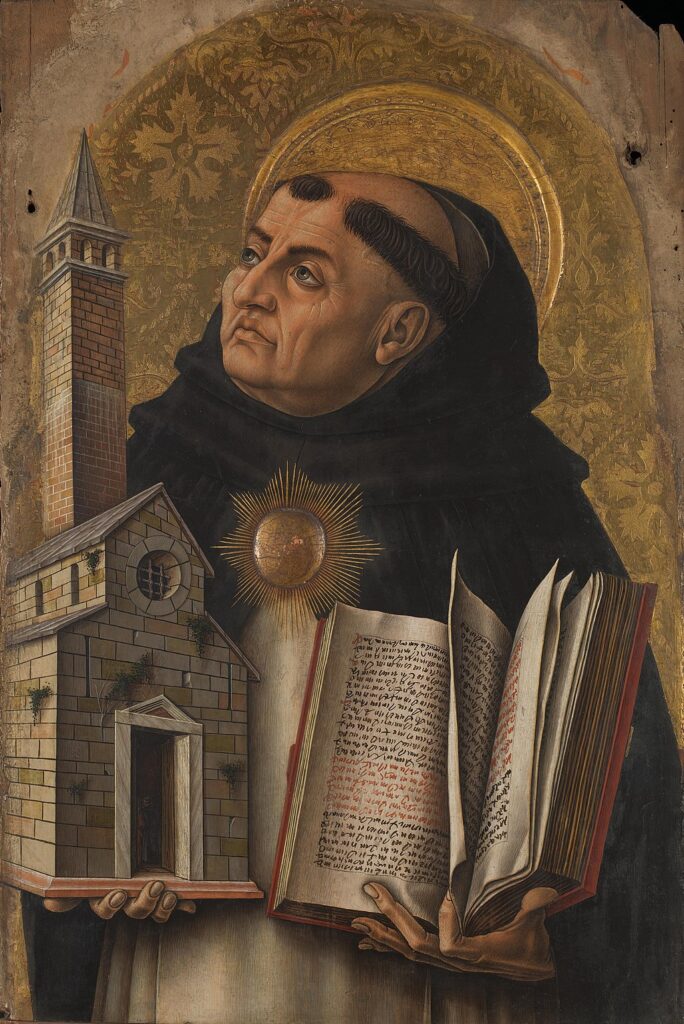
Early Life and “The Dumb Ox”
Born into a noble family in Roccasecca, Italy, Thomas was expected to follow a prestigious path—ideally becoming the Abbot of the wealthy Monastery of Monte Cassino. However, while studying in Naples, he discovered the works of Aristotle and the newly formed Dominican Order, which focused on poverty and preaching rather than political power.
His family was so horrified by his choice to join a “beggar order” that they kidnapped him and held him prisoner in a family castle for over a year to change his mind. He didn’t budge. He eventually escaped (or was released) and went to Paris to study under St. Albert the Great.
Because Thomas was large, quiet, and humble, his classmates nicknamed him “The Dumb Ox.” Albert the Great famously defended him, saying:
“You call him a dumb ox, but I tell you that this ox will one day bellow so loud that his roar will be heard throughout the whole world.”
The Synthesis of Faith and Reason
At the time, many Christians were suspicious of Greek philosophy (like Aristotle), fearing it would contradict the Bible. Thomas argued that since all truth comes from God, there can be no ultimate conflict between what we learn through reason (science and philosophy) and what we learn through revelation (faith and scripture).
His Major Works:
- Summa Theologica: A massive, systematic summary of all the main theological teachings of the Catholic Church. It covers everything from the existence of God to the nature of man and the virtues.
- Catena Aurea – is a continuous commentary on the four Gospels woven entirely out of quotes from the Early Church Fathers.
- The Five Ways (Quinque Viae): His famous logical arguments for the existence of God based on the physical world (e.g., the “Unmoved Mover”).
- Eucharistic Hymns: Despite being a rigorous intellectual, he was deeply mystical. He composed the Pange Lingua (containing the Tantum Ergo) and the Adoro Te Devote.
The Final Vision
Toward the end of his life, while celebrating Mass in 1273, Thomas had a profound mystical experience. Afterward, he stopped writing entirely. When his secretary, Reginald, urged him to finish the Summa, Thomas replied:
“All that I have written appears to be as so much straw after the things that have been revealed to me.”
He died a few months later at the age of 49 while on his way to the Council of Lyon.
Legacy
Aquinas’s work, known as Thomism, became the foundational philosophy of the Catholic Church.
He was canonized in 1323 and declared a Doctor of the Church in 1567.
Sources:
G K Chesterton – The Dumb Ox