
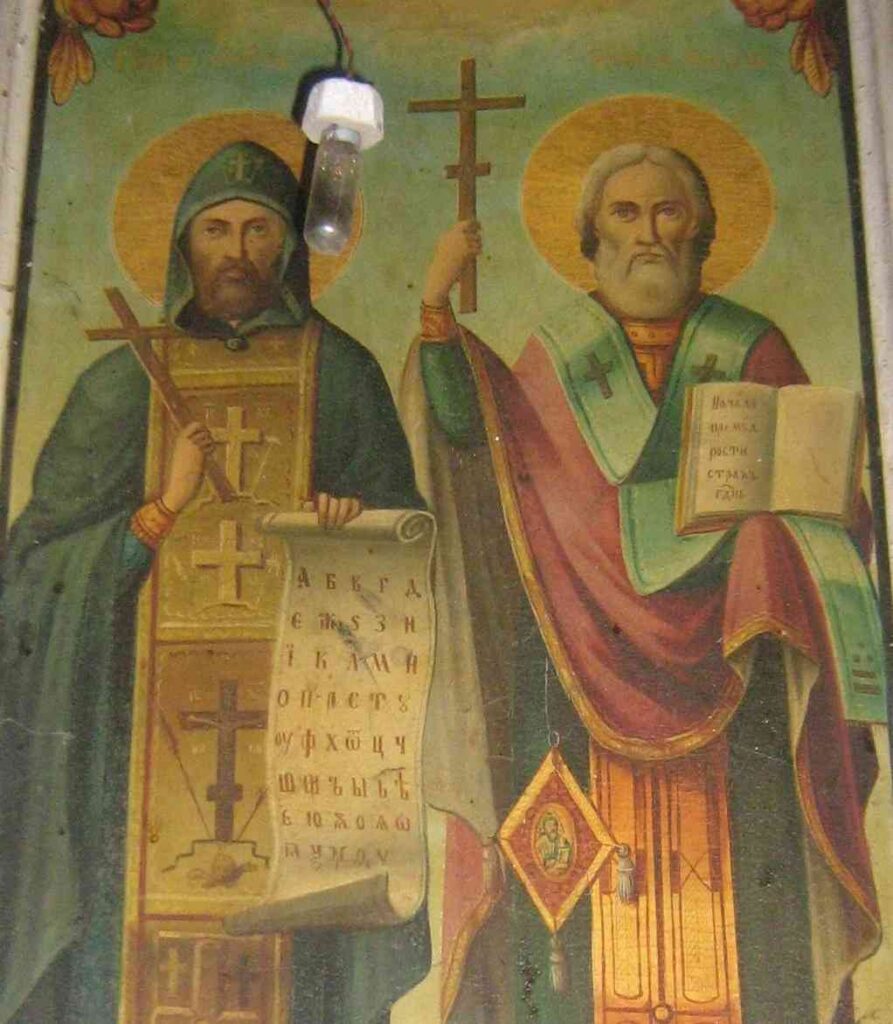
Saints Cyril (827-869) and Methodius (815-885) were two Byzantine brothers from Thessalonica (modern-day Greece) who became known as the “Apostles to the Slavs.”
Early Life and Careers
They were born into a prominent family, their father was a high-ranking military officer.
- Methodius (born Michael) initially followed in his father’s footsteps, serving as a provincial governor in a Slavic-populated district before retiring to a monastery on Mount Olympus.
- Cyril (born Constantine) was a brilliant scholar nicknamed “The Philosopher.” He studied in Constantinople under the future Patriarch Photius and served as a priest and professor before joining his brother in monastic life.
The Great Mission to Moravia
In 862, Prince Rostislav of Great Moravia (modern Czech Republic and Slovakia) asked the Byzantine Emperor for missionaries who could teach his people in their own language. He wanted to reduce the political influence of German missionaries who used Latin.
The brothers were chosen for this task because they were fluent in Slavic dialects. To prepare for the mission, they achieved two historic feats:
- The Alphabet: Cyril invented the Glagolitic alphabet, the first script specifically designed to capture the unique sounds of the Slavic language. This eventually evolved into the Cyrillic alphabet used today in Russia, Bulgaria, Serbia, and Ukraine.
- The Liturgy: They translated the Bible and the Divine Liturgy into what is now called Old Church Slavonic.
Conflict and Rome
Their use of the “vernacular” (the language of the people) instead of Latin or Greek caused a massive backlash from German bishops, who believed the liturgy should only be in Hebrew, Greek, or Latin.
To defend their work, the brothers traveled to Rome in 867 They carried the relics of Saint Clement (an early Pope) with them. Pope Adrian II was so impressed that he officially sanctioned the Slavic liturgy and ordained the brothers’ disciples.
- Cyril’s Death: While in Rome, Cyril fell ill. He took the monastic name “Cyril” on his deathbed and died on February 14, 869 He is buried in the Basilica of San Clemente in Rome.
- Methodius’s Struggle: Methodius returned to Moravia as an Archbishop. He was later imprisoned for three years by German bishops until the Pope intervened. He spent the rest of his life finishing the translation of the Bible before dying in 885.
Legacy
- Alphabet & Culture: They are considered the fathers of Slavic literature. The Cyrillic script remains one of the world’s most widely used writing systems.
- Patrons of Europe: In 1980, Pope John Paul II named them co-patron saints of Europe (alongside St. Benedict) to symbolize the bridge between the Eastern and Western traditions.
- Feast Days: * February 14: Observed by the Catholic and Anglican Churches.
- May 11 (or 24): Observed by the Eastern Orthodox Church, often celebrated as a day of “Slavic Literacy and Culture.”