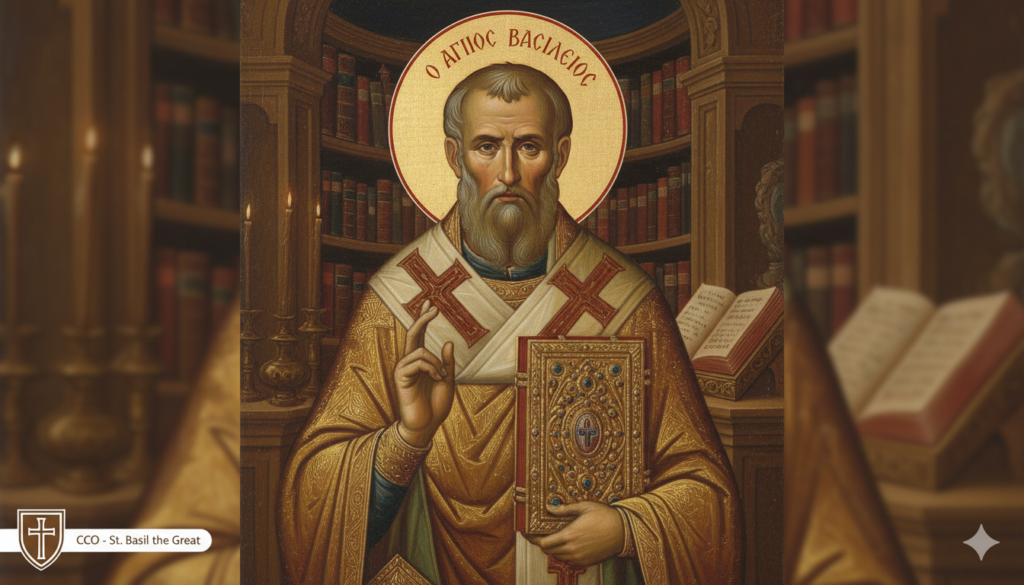
St. Basil the Great (c. 330 – 379 AD)
St. Basil the Great (Basileios ho Megas) was one of the most important figures in early Christianity. He was a highly influential bishop, theologian, and writer who, along with his brother, Gregory of Nyssa, and his close friend, Gregory of Nazianzus, is known as one of the Three Cappadocian Fathers. He played a critical role in defining Nicene orthodoxy and establishing the basic structure of Eastern monasticism.
Early Life and Education
- Birth and Background: Basil was born around 330 AD in Caesarea, Cappadocia (in modern Turkey), into a wealthy and devout Christian family. His family produced many saints, including his mother, Emmelia, his sister, Macrina the Younger, and his two younger brothers, Gregory of Nyssa and Peter of Sebaste.
- Classical Education: He received the finest education available at the time, studying rhetoric and philosophy first in Caesarea, then in Constantinople, and finally in Athens (c. 351–356 AD). In Athens, he befriended Gregory of Nazianzus, and they dreamed of pursuing an ascetic life together.
- Conversion: After completing his studies, he initially taught rhetoric in Caesarea. He was convinced by his sister Macrina to abandon his secular career and dedicate himself fully to God. He was baptized around 357 AD.
Asceticism and Monastic Rule
- Journey and Rule: Basil undertook a journey to Egypt, Palestine, and Syria to study the lives of famous hermits and monks. Returning home, he devoted himself to an ascetic life on his family’s estate near the river Iris.
- The Basilian Rule: Basil recognized the need for organization and community in the monastic movement, which often emphasized radical individualism. He wrote a Rule for monks that stressed communal life (cenobitism), obedience to a superior, and social charity (service to the poor and sick) alongside prayer and work. This Basilian Rule became the foundational model for monasticism throughout the Eastern Orthodox Church, comparable in influence to St. Benedict’s Rule in the West.
Defense of Nicene Orthodoxy
- Priesthood and Bishopric: Basil was ordained a priest in 364 AD and became Bishop of Caesarea and Metropolitan of Cappadocia in 370 AD.
- Arian Conflict: His episcopate coincided with the intense final struggle against Arianism (which denied Christ’s divinity) and the Pneumatomachian heresy (which denied the divinity of the Holy Spirit).
- Theological Definition: Basil was a brilliant theologian who helped unify and articulate the orthodox position. He established the clear distinction between ousia (substance or essence) and hypostasis (person or individual reality), which provided the precise philosophical language necessary to explain the doctrine of the Trinity as “one substance in three persons.”
Major Works and Legacy
- On the Holy Spirit (c. 375 AD): This systematic work was crucial in proving the divinity of the Holy Spirit against the Pneumatomachians, ensuring the full Nicene definition of the Trinity was accepted.
- Hexaemeron (Nine Homilies on the Six Days of Creation): A series of sermons explaining the creation account in Genesis, which was enormously popular and influential throughout the Middle Ages.
- Social Work: Basil established the Basiliad, a vast complex of buildings outside Caesarea that served as a hospital, hospice, and poorhouse. This institution became famous as a pioneering model of Christian charity and social service.
Basil died on January 1, 379 AD, exhausted by his labors and ill health. He is one of the most universally venerated saints in Christianity and is honoured as one of the chief Doctors of the Church.