
Saint Jerome (347-420)
Saint Jerome, whose full name was Eusebius Sophronius Hieronymus, was one of the most important scholars and theologians of the early Christian Church. He is traditionally regarded as the most learned of the Latin Fathers and is a Doctor of the Church.
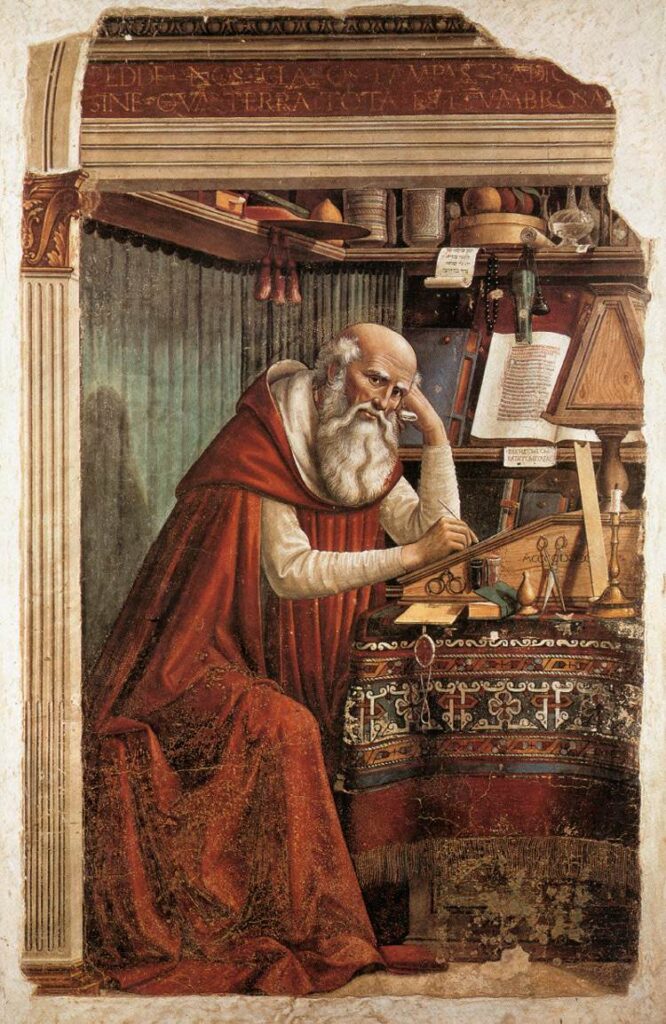
Born: c. 347 AD, in Stridon, Dalmatia (near the border of modern Slovenia and Croatia).
Died: September 30, 420 AD, in Bethlehem, Israel
Feast Day: September 30.
Early Life and Education
Jerome was born to well-to-do Christian parents and was sent to Rome around age 12 to complete his education. He became a serious scholar, mastering Latin and Greek and developing a profound love for classical Roman literature and philosophy, particularly the works of Cicero. Though he initially indulged in a worldly, pleasure-seeking lifestyle, he was baptized around 366 AD, marking a serious commitment to the Christian faith.
Conversion and Hermit Life
After his baptism, Jerome traveled widely in Gaul and Italy. He became intensely drawn to the ascetic life and, in 375 AD, had a celebrated, life-altering dream.
In this vision, he was dragged before God and accused of being a “Ciceronian, not a Christian.” This led him to abandon his study of classical literature for a time, retreat to the Desert of Chalcis (near Antioch), and live as a hermit for about five years.
During his time as a hermit, despite the hardships, he dedicated himself to scholarship. Crucially, he learned Hebrew from a Jewish convert, a rare and difficult undertaking for a Latin scholar of his time.
Secretary in Rome and the Vulgate Commission
Jerome was ordained a priest in Antioch around 379 AD, though he did not take on a diocese. He later traveled to Constantinople and studied under St. Gregory of Nazianzus.
In 382 AD, he returned to Rome. Here, acquainted with his fame as an ascetic and his ability as a scholar, Pope Damasus I engaged him as secretary and counsellor; It was the Pope who commissioned him to produce a standard, authoritative Latin translation of the Bible—a project of immense pastoral and cultural significance.
Several members of the Roman aristocracy, especially noblewomen such as Paula, Marcella, Asella, Lea and others, desirous of committing themselves to the way of Christian perfection and of deepening their knowledge of the Word of God, chose him as their spiritual guide and teacher in the methodical approach to the sacred texts. These noblewomen also learned Greek and Hebrew.
Life in Bethlehem
After the death of Pope Damasus, Jerome faced considerable hostility from the Roman clergy due to his harsh criticisms of their lax morals and his promotion of monasticism among Roman noblewomen. He left Rome in 385 AD, traveling to the Holy Land.
He ultimately settled in Bethlehem, where the noble Roman matron Paula (one of his spiritual disciples) funded the establishment of a monastery for men and three cloisters for women.
He lived in Bethlehem for the remaining 34 years of his life, producing the bulk of his monumental work:
The Works
The Vulgate: He completed the Latin translation of the entire Bible, working from the original Hebrew text for the Old Testament (a highly controversial choice at the time) and revising the existing Latin versions of the New Testament against the original Greek. The Vulgate became the standard Latin Bible for the Catholic Church for over a thousand years.
It is interesting to point out the criteria which he abided by in his work as a translator. He himself reveals them when he says that he respects even the order of the words of the Sacred Scriptures, for in them, he says, “the order of the words is also a mystery” that is, a revelation. Furthermore, he reaffirms the need to refer to the original texts: “Should an argument on the New Testament arise between Latins because of interpretations of the manuscripts that fail to agree, let us turn to the original, that is, to the Greek text in which the New Testament was written. “Likewise, with regard to the Old Testament, if there are divergences between the Greek and Latin texts we should have recourse to the original Hebrew text; thus, “we shall be able to find in the streams all that flows from the source”
Commentaries and Polemics: He wrote extensive commentaries on nearly all books of the Bible, as well as biographies of monks and fierce polemical treatises against theological opponents and heretics.
Saint Jerome’s legacy is defined by his brilliant scholarship, his fiery temperament, and his single-minded dedication to making the Scriptures accessible to the Western Church.
__________________________SAINT JEROME – PRAY FOR US_________________________________
Sources :
Catholic Encyclopaedia
Pope Benedict XVI’s Weekly audience
Wikipedia