
St. Hilary of Poitiers: The Athanasius of the West (c. 315 – 367 AD)
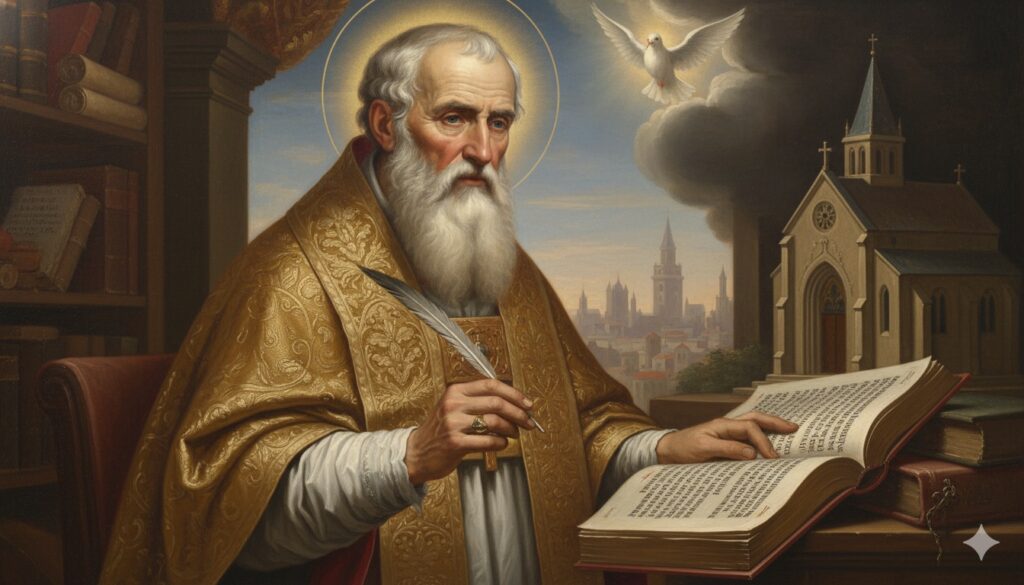
St. Hilary of Poitiers was a highly influential Latin Church Father, Bishop of Poitiers, and a courageous defender of Nicene orthodoxy against Arianism during the 4th century. He earned the title “The Athanasius of the West” for his efforts against this dominant heresy.
Early Life and Conversion
- Birth and Background: Hilary was born around 315 AD in Poitiers, Gaul (modern France), into a wealthy and distinguished pagan Roman family. He received an excellent classical education.
- Intellectual Conversion: His conversion to Christianity was primarily intellectual. Through his study of philosophy and the Scriptures, particularly the Gospel of John, he was profoundly convinced of the unity and eternal nature of God, which led him to accept the Christian faith. He was baptized with his wife and daughter, Abra, around 345 AD.
Bishop and Defender of Nicene Orthodoxy
- Bishop of Poitiers: Due to his high moral character and learning, he was unanimously elected Bishop of Poitiers by the people around 350 AD, despite being married. It was not uncommon for a man to be married when he was selected as a bishop in the 4th century, provided he ceased marital relations thereafter.
- The Arian Crisis: His episcopate coincided with the height of the Arian controversy, which centered on the nature of Christ. Arianism, which taught that Jesus was a created being subordinate to God the Father, had gained significant political support from the Roman Emperor Constantius II.
- Council of Béziers (356 AD): Hilary became the leading orthodox voice in Gaul. He refused to condemn St. Athanasius of Alexandria, the foremost opponent of Arianism in the East, and instead condemned the Arian bishops.
Exile and Literary Work
- Exile: For his staunch defense of the Nicene Creed (which affirmed the Father and Son are consubstantial or homoousios), Emperor Constantius II exiled Hilary to Phrygia (in Asia Minor) in 356 AD.
- Theological Synthesis: His four years in exile were the most productive of his life. He immersed himself in the Greek theological writings of the Eastern Fathers (which were largely unknown in the West). His most important work, De Trinitate (On the Trinity), was written during this time.
- De Trinitate: This 12-book treatise systematically and clearly defended the orthodox doctrine of the Trinity against Arian arguments, becoming the first great theological masterpiece of the Latin West.
- Synod of Seleucia (359 AD): Hilary attended this synod in the East, using his profound knowledge of both Latin and Greek theology to challenge the Arian bishops, confusing them with their own arguments.
Return and Legacy
- Return to Poitiers: By 360 AD, the Arians convinced the Emperor to send Hilary back to Gaul, hoping he would cause less trouble there than he was causing in the East. He was welcomed back to Poitiers as a triumphant hero.
- Apostle of Gaul: Upon his return, he spent his remaining years successfully working to eradicate Arianism in Gaul and consolidate Nicene orthodoxy across Western Europe. He died in 367 AD.
- Doctor of the Church: Hilary was declared a Doctor of the Church in 1851 by Pope Pius IX, recognizing his profound contributions to theology and his tireless defense of the fundamental Christian doctrine of the Trinity.
What happened to his wife and daughter after he was elected Bishop of Poitiers
The biographical details concerning his wife after he became a bishop are scarce, but the most widely accepted view among scholars is that she took on a traditional role fitting for the wife of a man elevated to the priesthood or episcopacy in that era:
- Continence and Separation: She is believed to have followed the growing custom of a “Josephite marriage” or a “spiritual marriage,” where the couple continued to live together but ceased all physical relations.
- She would have dedicated herself entirely to a pious, ascetical life, essentially becoming a deaconess or a devout woman within the ecclesiastical community, though likely retaining her title and position as domina (mistress) of the household.
Abra’s fate is known with greater certainty because of the letter Hilary wrote to her, often cited by St. Jerome:
- Hilary ensured his daughter was raised in deep piety
- Hilary wrote a letter to Abra—likely before his exile to the East (356 AD)—urging her to embrace the consecrated life of virginity (a highly esteemed path for women at the time). He urged her to adopt the monastic discipline.
- Consecrated Life: It is widely accepted that Abra followed her father’s counsel and lived a life of consecrated virginity, likely remaining in Poitiers while her father was in exile. Her life was defined by piety and learning, likely overseen by the Christian community he founded.