
James Tissot (1836–1902)
James Tissot (born Jacques Joseph Tissot) was a highly successful French painter and illustrator whose career was marked by dramatic shifts in both style and subject matter. He is celebrated for two distinct bodies of work: his sharp, detailed depictions of fashionable high society in Victorian London and Belle Époque Paris, and his later, profoundly detailed series of watercolor illustrations depicting the life of Christ and the Old Testament.
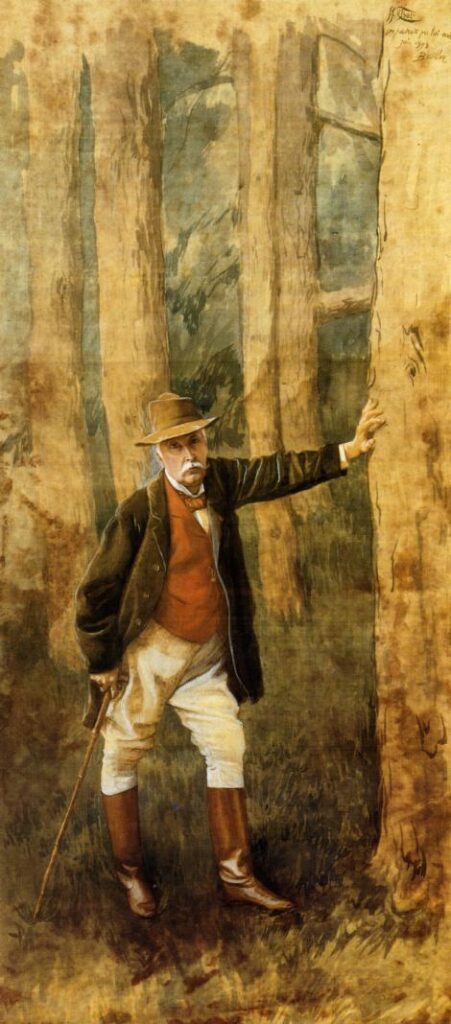
Early Life and Education (1836–1870)
- Origin: Tissot was born on October 15, 1836, in the busy port city of Nantes, France. His family background was significant to his art: his father was a prosperous linen draper, and his mother was a milliner . This upbringing gave him an intimate, lifelong understanding of fabrics and women’s fashion.
- Education and Training: Raised in a devoutly Catholic household, he attended Jesuit boarding schools. At age 17, he decided to pursue art, despite his father’s initial opposition. In 1856, he moved to Paris to study at the École des Beaux-Arts, where he trained under traditional masters like Louis Lamothe and Hippolyte Flandrin.
- Early Career in Paris: During this period, Tissot anglicized his first name to “James” to reflect his admiration for English culture. His early works were primarily historical costume pieces. However, by the mid-1860s, he turned to painting contemporary Parisian life. He achieved rapid success, exhibiting regularly at the Paris Salon and becoming independently wealthy. During this time, he became a close friend of Edgar Degas and James Abbott McNeill Whistler.
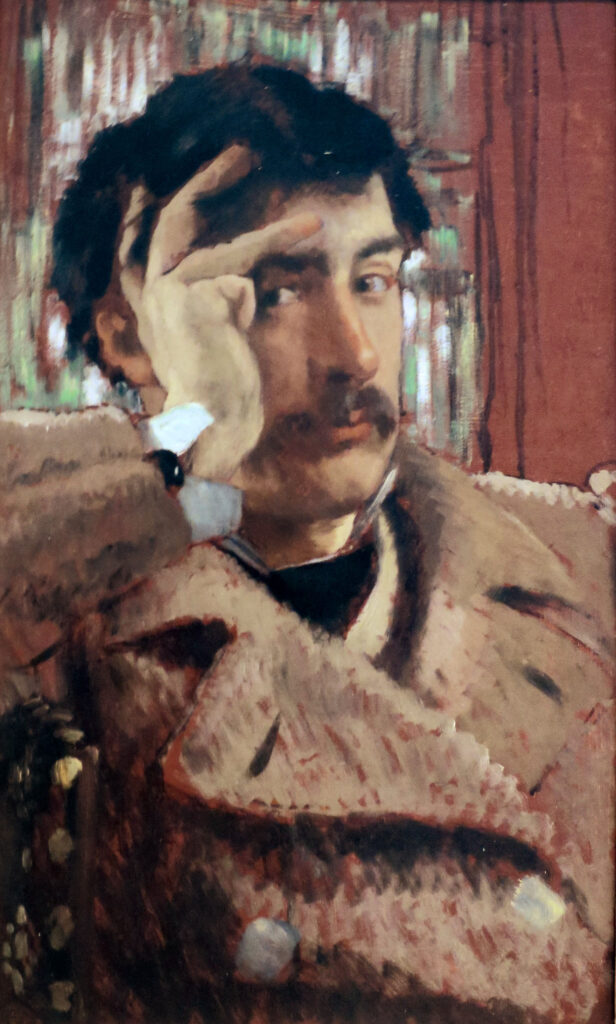
The London Years: Success and Scandal (1871–1882)
- Exile to England: Following the devastating Franco-Prussian War (in which Tissot fought) and his subsequent alleged involvement with the radical Paris Commune in 1871, Tissot fled Paris for London.
- The Society Painter: In London, Tissot quickly established himself as a leading painter of the Gilded Age. He specialized in narrative genre scenes of the British upper classes at leisure—on ships, at garden parties, and in ballrooms. His paintings from this period are renowned for their incredible, photorealistic rendering of Victorian dress and polite social tension. His shrewd business sense made him one of the most financially successful artists in England.
Kathleen Newton: Tissot’s life changed dramatically in the mid-1870s when he met Kathleen Newton, an Irish divorcee. She became his constant companion and the archetypal model for countless of his paintings, infusing his work with an intimate,domestic serenity. However, because she was a divorcee with children, their relationship was considered a major social scandal, causing them to live a quiet, increasingly secluded life in his villa in St. John’s Wood. Kathleen died of consumption (tuberculosis) in 1882 at the age of 28. Devastated by her death, Tissot sold his London house and immediately returned to Paris.
Later Life: Spiritual Conversion and Biblical Art (1883–1902)
Return to France: Back in Paris, Tissot initially resumed painting society women. However, in 1885, while inside the Church of Saint-Sulpice researching a painting, he experienced a profound religious conversion.
The “Life of Christ” Series: Tissot abandoned his career as a society painter to dedicate the rest of his life to illustrating the Bible. To ensure absolute authenticity, he made several extensive research trips to Egypt, Syria, and Palestine (in 1886-7 and 1889).
Technique and Accuracy: He worked primarily in watercolour (gouache), producing over 365 meticulous illustrations for The Life of Our Lord Jesus Christ (also known as the “Tissot Bible”). He focused on unprecedented historical verism—painting the actual landscapes, architecture, and costumes of the Holy Land. These works were wildly popular when exhibited in Paris and London, and in 1900, the Brooklyn Museum purchased the entire set through public subscription.
Tissot died suddenly on August 8, 1902, at his family’s château in Besançon, France, while working on a subsequent series of illustrations for the Old Testament (which remained unfinished).
The Unfinished Work
- He had intended to create nearly 500 illustrations. He personally finished about 80 to 95 watercolours and several hundred pen-and-ink sketches.
- His art publisher, Maurice de Brunoff, hired six other artists (including Michel Simonidy and Charles Hoffbauer) to finish the remaining pieces. These artists worked from Tissot’s sketches or imitated his style to complete the 400 images required for the final publication.
- The completed “Tissot Bible” (Old Testament) was published in two massive volumes in 1904, two years after his death.
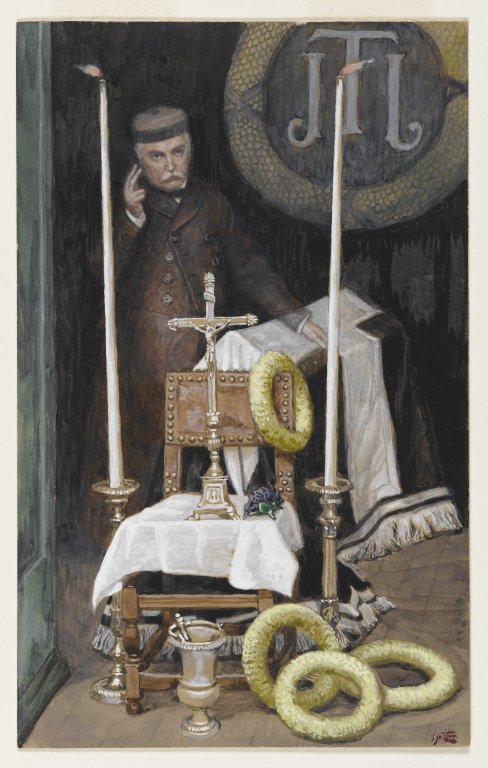
“You who have read these volumes will be my witnesses that I have striven to the best of my ability to capture not merely the form, but the very soul, of the sacred characters, of their environments, and of the unique light of the Holy Land. I have been driven by a conviction that has become my whole life, and I have found my greatest happiness in the attempt to make others see the divine truth that I myself have been permitted to gaze upon.” James Tissot