
| Latin Original | English Translation |
| Victimae paschali laudes | To the Paschal Victim |
| immolent Christiani. | let Christians offer sacrificial praises. |
| Agnus redemit oves: | The Lamb has redeemed the sheep: |
| Christus innocens Patri | the innocent Christ to the Father |
| reconciliavit peccatores. | has reconciled sinners. |
| Mors et vita duello | Death and life in a duel |
| conflixere mirando: | have fought a wondrous combat: |
| dux vitae mortuus, | the Prince of Life, though dead, |
| regnat vivus. | reigns alive. |
| Dic nobis Maria, | Tell us, Mary, |
| quid vidisti in via? | what did you see on the way? |
| Sepulcrum Christi viventis, | “The tomb of the living Christ, |
| et gloriam vidi resurgentis: | and the glory I saw of His rising:” |
| Angelicos testes, | “The angelic witnesses, |
| sudarium, et vestes. | the shroud, and the clothes.” |
| Surrexit Christus spes mea: | “Christ my hope has arisen: |
| praecedet suos in Galilaeam. | He goes before His own into Galilee.” |
| [Credendum est magis soli] | [Better to believe the truthful] |
| [Mariae veraci] | [Mary alone] |
| [Quam Judaeorum] | [Than the deceitful crowd] |
| [Turbae fallaci.] | [Of the Jews.] |
| Scimus Christum surrexisse | We know that Christ has risen |
| a mortuis vere: | from the dead in truth: |
| tu nobis, victor Rex, miserere. | do Thou, O Victorious King, have mercy on us. |
(The highlighted portion was removed by the Church in 1570 during the Council of Trent while the balance of the Sequence was retained, along with four others. This verse was removed because the language was considered too pejorative and harsh.)
Wipo of Burgundy (c.995-1048)
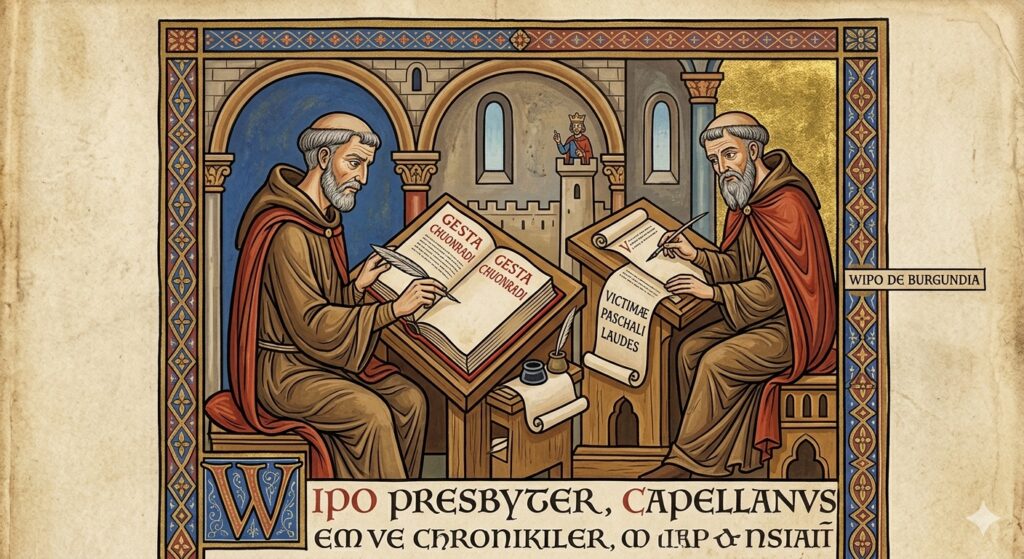
Most scholars point to one man: Wipo of Burgundy (also known as Wipo the Chaplain) as the author of the Victimae Paschali Laudes.
He was a priest who lived in the early 11th century (c. 995–1048) and served as the chaplain to the Holy Roman Emperors Conrad II and Henry III.
- This wasn’t just a religious role; in the 11th century, the court chaplain was a mix of a modern-day Chief of Staff and a Press Secretary.
- He was responsible for the education of the future Emperor (Henry III), which explains why his Latin was so sophisticated and rhythmic.
The Burgundian Origins
His exact birthplace is not known, but his name and dialect tell us he was from the Arelat (the Kingdom of Burgundy, covering parts of modern-day SE France and Switzerland).
- Education: He was clearly a product of the finest cathedral schools. His Latin wasn’t just functional; it was “high-style” and rhythmic.
- Entry to Court: He didn’t stay a local priest for long. His talent for both poetry and administration caught the eye of the royal house.
The Emperor’s Shadow (1024-1039)
He became the trusted chaplain to Conrad II, the first Salian Emperor.
- Wipo traveled with the Emperor on his arduous campaigns to Italy and Burgundy. He was in the room for the secret negotiations and the grand coronations.
- During this time, he began writing the Gesta Chuonradi II (The Deeds of Conrad II).
His Masterpiece:
Historians know him for the “Gesta Chuonradi II imperatoris.” (The Deeds of Conrad II). It is considered one of the most important historical sources of the 11th century.
- Unlike many chroniclers who wrote centuries after the fact, Wipo was an eyewitness to the events he described. He had a surprisingly “modern” eye for detail, describing the personality and temperament of the Emperor rather than just a list of dates.
- He didn’t write it like a dry textbook; he wrote it with a “personality,” describing the Emperor’s physical strength and his legendary temper.
His Poetic Style: The Bridge to the Middle Ages
Wipo is a “bridge” figure in music and literature. – Before him, church hymns were often very rigid and followed strict Greek-style meters.
Wipo helped popularize the Sequence—a more lyrical, “prose-rhythm” style that felt more like a song. The Victimae Paschali is the perfect example: it’s dramatic, it has “characters” (the narrator, Mary, the Chorus), and it builds tension like a miniature play.
His Personal Philosophy: “The Proverbs”
He wrote a collection called the Proverbia, a series of rhyming maxims intended to teach the young Emperor Henry III how to be a “just” king. He famously wrote:
“Decet regem discere legem” > (“It becomes a king to learn the law.”)
This reveals Wipo as a man who believed in the rule of law and moral integrity. He was obsessed with the idea of Truth vs. Falsehood in politics and religion.
Retirement:
After Henry III took the throne, Wipo seems to have retired to a more quiet life, likely as a hermit or in a monastery in the foothills of the Alps (near the border of modern-day France and Switzerland.
He died around 1048.