Divine Mercy Sunday
John 20:19-31
“My Lord and my God.”
Then, when it was late on the same day, on the first of the Sabbaths, and the doors were closed where the disciples were gathered, for fear of the Jews, Jesus came and stood in their midst, and he said to them: “Peace to you.”
And when he had said this, he showed them his hands and side. And the disciples were gladdened when they saw the Lord. Therefore, he said to them again: “Peace to you. As the Father has sent me, so I send you.” When he had said this, he breathed on them. And he said to them: “Receive the Holy Spirit. Those whose sins you shall forgive, they areforgiven them, and those whose sins you shall retain, they are retained.” Now Thomas, one of the twelve, who is called the Twin, was not with them when Jesus arrived. Therefore, the other disciples said to him, “We have seen the Lord.” But he said to them, “Unless I will see in his hands the mark of the nails and place my finger into the place of the nails, and place my hand into his side, I will not believe.”
And after eight days, again his disciples were within, and Thomas was with them. Jesus arrived, though the doors had been closed, and he stood in their midst and said, “Peace to you.”
Next, he said to Thomas: “Look at my hands, and place your finger here; and bring your hand close, and place it at my side. And do not choose to be unbelieving, but believe.”
Thomas responded and said to him, “My Lord and my God.”
Jesus said to him: “You have seen me, Thomas, so you have believed. Blessed are those who have not seen and yet have believed.”
Jesus also accomplished many other signs in the sight of his disciples. These have not been written in this book. But these things have been written, so that you may believe that Jesus is the Christ, the Son of God, and so that, in believing, you may have life in his name.
What so the Fathers say?
St John Chrysostom
Extracts from his Homily on the Gospel of John
The disciples, when they heard what Mary told them, were obliged either to disbelieve, or, if they believed, to grieve that He did not count them worthy to have the sight of Him. He did not let them however pass a whole day in such reflections, but in the midst of their longing trembling desires to see Him, presented Himself to them.
It is wonderful that they did not think him a phantom. But Mary had provided against this, by the faith she had wrought in them. And He Himself too showed Himself so openly, and strengthened their wavering minds by His voice: And says to them, Peace to you.
And what He had promised before the crucifixion, I shall see you again, and your heart shall rejoice, is now fulfilled: Then were the disciples glad when they saw the Lord.
Therefore, he said to them again: “Peace to you. As the Father has sent me, so I send you.” When he had said this, he breathed on them. And he said to them: “Receive the Holy Spirit. Those whose sins you shall forgive, they are forgiven them, and those whose sins you shall retain, they are retained.”
Some say that by breathing He did not give them the Spirit, but made them meet to receive the Spirit. For if Daniel’s senses were so overpowered by the sight of the Angel, how would they have been overwhelmed in receiving that unutterable gift, if He had not first prepared them for it!
A priest though he may have ordered well his own life, yet, if he have not exercised proper vigilance over others, is sent to hell with the evil doers. Wherefore, knowing the greatness of their danger, pay them all respect, even though they be not men of notable goodness. For they who are in rule, should not be judged by those who are under them. And their incorrectness of life will not at all invalidate what they do by commission from God. For not only cannot a priest, but not even angel or archangel, do any thing of themselves; the Father, Son, and Holy Ghost do all. The priest only furnishes the tongue, and the hand. For it were not just that the salvation of those who come to the Sacraments in faith, should be endangered by another’s wickedness.
When the Apostle said, We have seen the Lord, Thomas did not believe, not because he discredited them, but from an idea of the impossibility of the thing itself: So he said to them, Except I shall see in His hands the print of the nails, and put my finger into the print of the nails, and thrust my hand into His side, I will not believe. He required the evidence of the grossest sense, viz. the touch, and would not even believe his eyes: for he does not say only, Except I shall see, but adds, and put my finger into the print of the nails, and thrust my hand into His side.
Consider the mercy of the Lord, how for the sake of one soul, He exhibits His wounds. Because one person, Thomas, wanted to examine Him, Christ allowed him. But He did not appear to him immediately, but waited till the eighth day, in order that the admonition being given in the presence of the disciples, might kindle in him greater desire, and strengthen his faith for the future.
And to show that He had heard what Thomas had said to the disciples, He uses the same words. And first He rebukes him; “Look at my hands, and place your finger here; and bring your hand close, and place it at my side. : secondly, He admonishes him; And do not choose to be unbelieving, but believe.”
Note how that before they receive the Holy Spirit faith wavers, but afterward is firm.
We may also wonder how an incorruptible body could retain the marks of the nails. But it was done in condescension; in order that they might be sure that it was the very person Who was crucified.
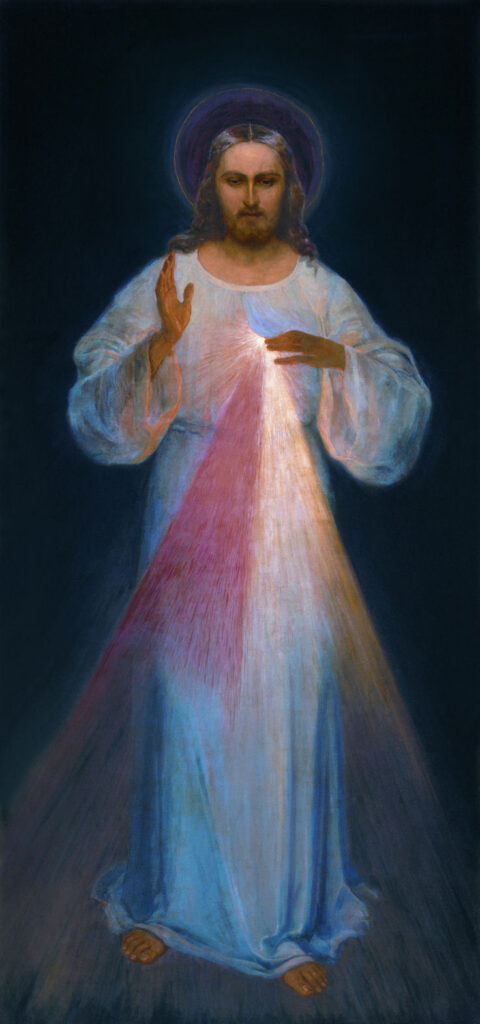
The Image of the Merciful Jesus. Its pattern was revealed in the vision St. Faustina had on February 22, 1931, in her convent cell.
Jesus said to me, “Paint an image according to the pattern you see, with the signature: ‘Jesus, I trust in You‟‟‟ (Diary, 47).
Consequently, this image represents the Saviour risen from the dead who brings peace to people by means of the forgiveness of sins at the price of His passion and death on the cross.
The two rays are a distinctive feature of this image of Christ. The Lord Jesus, when asked about their meaning, explained: “The pale ray stands for the Water which makes souls righteous. The red ray stands for the Blood which is the life of souls. … Happy is the one who will dwell in their shelter” (Diary, 299). – DIARY of Saint Maria Faustina Kowalska