
St. Ambrose of Milan (c. 339 – 397 AD)
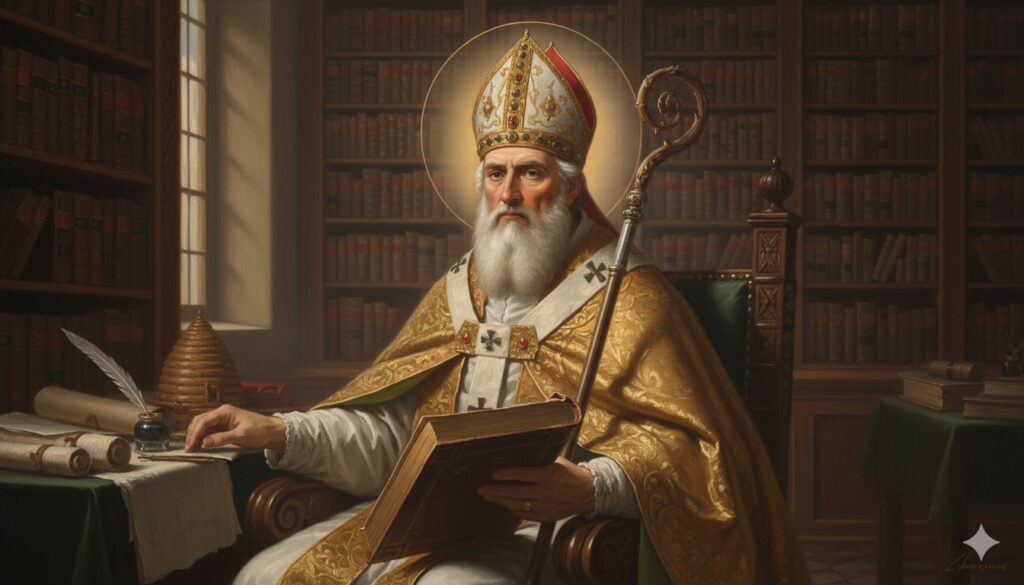
St. Ambrose (Aurelius Ambrosius) was one of the most influential figures of the 4th-century Roman Empire. He served as the Bishop of Milan and was a key voice in defining Christian doctrine, famously clashing with—and ultimately guiding—Roman emperors. He is counted as one of the four original Latin Doctors of the Church,(along with St Jerome, St Augustine and Pope St Gregory the Great)
Early Life and Civil Career
- Birth: Ambrose was born around 339 AD into a noble Roman Christian family, likely in Trier (in modern Germany), where his father served as the Praetorian Prefect (a high-ranking governor) of Gaul.
- Education: After his father’s death, in around 350 AD, Ambrose moved to Rome, where he received an excellent education in law, rhetoric, and classical literature.
- Governor of Milan: Ambrose pursued a legal career and achieved great political success. By 370 AD, he had been appointed Governor (Consular) of the province of Aemilia-Liguria, with his seat in Milan, which was then the capital of the Western Roman Empire.
Unexpected Call to the Bishopric (374 AD)
Ambrose’s elevation to the bishopric is one of the most famous stories of his life:
- Arian Dispute: When the Arian Bishop of Milan died in 374 AD, the city’s Christians were divided between Nicene (orthodox) and Arian factions. Ambrose, as governor, went to the church to maintain civil order during the election proceedings.
- “Ambrose, Bishop!”: While he was addressing the crowd, a child’s voice (according to tradition) shouted, “Ambrose, Bishop!” The entire crowd, both Nicene and Arian, took this as a sign of divine will and unanimously acclaimed the popular governor as their new bishop.
- Consecration: Though still only a catechumen (an unbaptized Christian preparing for the faith) and a layman, Ambrose quickly submitted. He was baptized, rushed through the necessary ecclesiastical ranks, and consecrated Bishop of Milan just eight days later, in December 374 AD.
Theologian and Defender of the Church
As bishop, Ambrose devoted himself to intense theological study. He became a strong defender of the Nicene Creed, upholding the divinity of Christ against the lingering power of Arianism within the imperial court.
- Mentor to Augustine: Ambrose’s preaching profoundly influenced the young North African rhetorician, Augustine of Hippo. Ambrose’s allegorical interpretations of scripture helped Augustine overcome his intellectual barriers to Christianity. Ambrose famously baptized Augustine in 387 AD.
- Liturgical and Musical Contributions: Ambrose greatly influenced the liturgy of Milan (known as the Ambrosian Rite) and is credited with promoting the use of congregational hymn singing, known as Ambrosian chant.
Clashes with Imperial Authority
Ambrose is best known for asserting the moral authority of the Church over the civil power of the Emperor.
- The Altar of Victory (384 AD): Ambrose successfully led the opposition against restoring the Altar of Victory in the Roman Senate, arguing against the revival of pagan state religion.
- Thessalonica Massacre (390 AD): After Emperor Theodosius I ordered a brutal massacre of citizens in Thessalonica, Ambrose demanded that the Emperor perform public penance. He refused to celebrate Mass in the Emperor’s presence or admit him to Communion until Theodosius repented. This confrontation forced the most powerful man in the world to submit to the spiritual authority of the Bishop.
Death and Legacy
St. Ambrose died on April 4, 397 AD. His legacy rests on his role as:
- A Doctor of the Church whose writings shaped moral theology.
- A decisive figure in establishing the authority of the episcopacy (bishopric) over the state.
- The spiritual father and baptizer of St. Augustine.
Sources:
The Catholic Encyclopedia on newadvent.org