
Theophylact of Ohrid (c. 1055 – c. 1107 AD)
Theophylact was a distinguished Byzantine Greek scholar and cleric who served as the Archbishop of Ohrid (in the region of modern North Macedonia) during the height of the Byzantine Empire. He is primarily remembered for his accessible and widely influential biblical commentaries.
Early Life and Education
- Birth: Theophylact was born around 1055 AD in Euboea, a large island off the eastern coast of mainland Greece.
- Constantinople: He received a rigorous education in Constantinople, the capital of the Byzantine Empire. He studied under the famed scholar Michael Psellos, who significantly influenced Theophylact’s rhetorical style and classical learning.
- Patronage: He quickly rose to prominence in the imperial court. He became a deacon at the Hagia Sophia and was tasked with tutoring Constantine Doukas, the son of Emperor Michael VII Doukas. This gave him direct access to the highest circles of Byzantine power.
Archbishop in the Balkans
- Appointment to Ohrid: Around 1088 AD, Theophylact was appointed Archbishop of Ohrid (then known as the Bulgarian Archbishopric, established by Emperor Basil II). This was a crucial and politically sensitive post in the Balkans.
- A Challenging Role: As a highly educated Greek from the capital, his appointment was initially met with resistance from the local clergy and the Bulgarian population, who viewed him as a foreign imposition.
- Effective Administrator: Despite initial opposition, he became an effective and empathetic administrator. He learned to defend the interests of his see and became known for his defense of the Bulgarian traditions and liturgy. He wrote a significant work, the Defense of the Bulgarians, which argued for the historical legitimacy of the Bulgarian Archbishopric.
- Defense Against Invasions: His time in Ohrid was marked by political turmoil, including the invasion of the Normans in 1082–1083. Theophylact played a courageous role in defending the city and securing its well-being.
The Norman invasion of the Byzantine Empire in the 1080s was a critical event, and Theophylact’s involvement highlights his administrative courage and political skill beyond his theological work.
Theophylact and the Norman Invasion (1082–1083)
The invasion was led by Robert Guiscard, the Duke of Apulia and Calabria, who launched a massive campaign against the Byzantine Empire’s western provinces, beginning with a major siege of Dyrrhachium (modern Durrës, Albania).
1. Context of the Invasion
- Target: The Normans aimed to capture the major Adriatic ports to establish a beachhead and eventually march on Thessalonica and Constantinople. The lands around Ohrid and the former Bulgarian Archbishopric were directly in the path of the Norman advance inland after their initial successes on the coast.
- Military Failure: The Byzantine army, led by Emperor Alexios I Komnenos, suffered a catastrophic defeat at the Battle of Dyrrhachium in October 1081. This loss opened the entire Balkan interior to Norman forces.
2. Theophylact’s Direct Action
Theophylact, as the Archbishop and highest-ranking civilian official in Ohrid, was forced to step into a leadership vacuum created by the retreat of the Byzantine administration and military.
- Securing the City: When the Normans approached the city and region of Ohrid, Theophylact did not flee. He took charge of the city’s defenses and administration, often acting as the de facto civil governor.
- Negotiation and Diplomacy: Theophylact’s most courageous and practical role was in negotiating with the invaders. He was skilled in rhetoric and diplomacy, which he used to manage the situation and mitigate the potential for mass destruction and civilian atrocities.
- Financial Burden: To protect the citizens and the Church’s property from being looted, he often had to manage the payment of heavy ransoms or tribute demanded by the Norman commanders. This required him to mobilize the remaining resources of the city and region.
3. Aftermath and Controversy
Theophylact’s actions, while successful in saving his community, later drew criticism.
- Accusations of Collaboration: After the Normans were eventually driven out, Theophylact faced accusations from jealous rivals in Constantinople and local officials that he had been too cooperative with the enemy and had mishandled Church funds (the payments made for ransom).
- Self-Defense: Theophylact wrote letters defending his conduct, arguing that his actions were necessary to save the population from certain death and enslavement. He successfully argued that his decisions were made out of pastoral duty (oikonomia) when the Imperial government had failed to protect them.
His courageous tenure during the crisis demonstrated his transition from a court-educated scholar to a tough, practical, and highly dedicated spiritual and political leader of the Byzantine frontier.
Literary and Theological Legacy
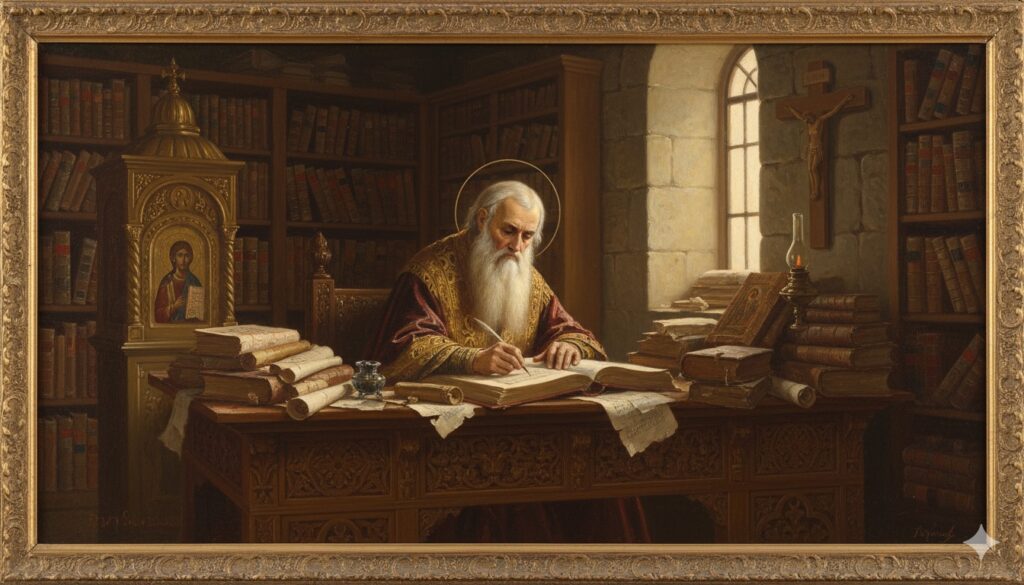
Theophylact’s most enduring contribution is his voluminous body of scriptural commentary.
- Exegetical Commentaries: He wrote commentaries on nearly all the books of the New Testament (the Gospels, Acts, Epistles, and Revelation), and many books of the Old Testament.
- Simplified Style: His commentaries are famous for their clarity, brevity, and practical application. They were written to be accessible to a wide audience of laypeople and less educated priests, not just theologians.
- Source Usage: His works were not always original; he brilliantly and efficiently synthesized the teachings of earlier, more verbose Church Fathers, such as St. John Chrysostom and Theodore of Mopsuestia. This made the complex theological tradition accessible to later generations.
Theophylact’s commentaries were widely circulated and translated, making him one of the most influential biblical exegetes in both the Eastern Orthodox Church and later in the Western Church, where his works were valued by Latin scholars during the Middle Ages.
Theophylact of Ohrid is not formally recognized as a saint in the Roman Catholic Church. However, he is venerated as a saint in the Eastern Orthodox Church and is commemorated on December 31st.