
Matthew 28:8-15
They drew near and took hold of his feet, and they adored him.
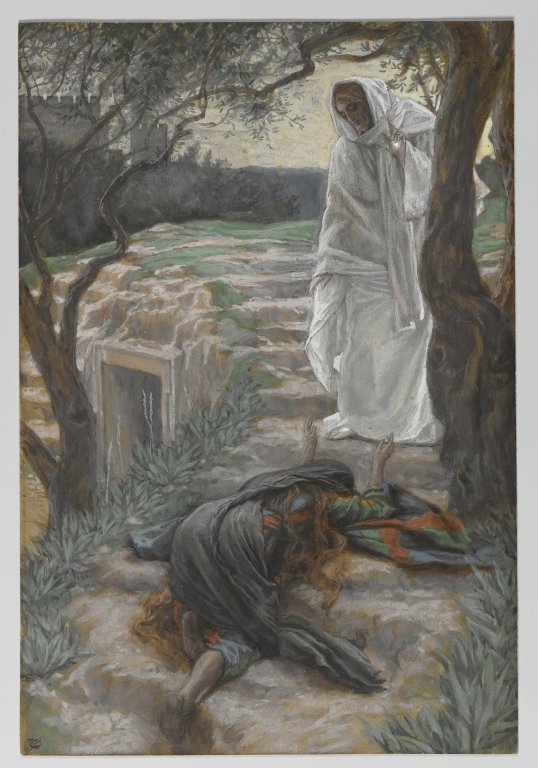
And they went out of the tomb quickly, with fear and in great joy, running to announce it to his disciples.
And behold, Jesus met them, saying, “Hail.” But they drew near and took hold of his feet, and they adored him.
Then Jesus said to them: “Do not be afraid. Go, announce it to my brothers, so that they may go to Galilee. There they shall see me.”
And when they had departed, behold, some of the guards went into the city, and they reported to the leaders of the priests all that had happened. And gathering together with the elders, having taken counsel, they gave an abundant sum of money to the soldiers, saying: “Say that his disciples arrived at night and stole him away, while we were sleeping. And if the procurator hears about this, we will persuade him, and we will protect you.” Then, having accepted the money, they did as they were instructed. And this word has been spread among the Jews, even to this day.
What do the Fathers say?
St JEROME. This may be always observed, both in the Old and New Testament, that when there is an appearance of any majestic person, the first thing done is to banish fear, that the mind being tranquillized may receive the things that are said.
The Chief Priests, who ought to have been by this turned to penitence, and to seek Jesus risen, persevere in their wickedness, and convert the money which was given for the use of the Temple to the purchase of a lie, as before they had given thirty pieces of silver to the traitor Judas.
All who abuse to other purposes the money of the Temple, and the contributions for the use of the Church, purchasing with them their own pleasure, are like the Scribes and Priests who bought this lie, and the blood of the Saviour.
St John CHRYSOSTOM. How could the disciples carry Him away by stealth, men poor, and of no station, and who scarcely dared to show themselves?
They fled when they saw Christ alive, how, when He was dead, would they not have feared so great a multitude of soldiers? How were they to remove the door of the sepulchre? One might have done it unperceived by the guard. But a large stone was rolled to the mouth requiring many hands. And was there not the seal thereon? And why did they not attempt it the first night, when there was none at the sepulchre? Moreover, what is the meaning of the napkins which Peter sees laid here? Had the disciples stolen the Body, they would never have stripped it, both because it might so receive hurt, and cause unnecessary delay to themselves, and so expose them to be taken by the watch; especially since the Body and clothes were covered with myrrh, a glutinous spice, which would cause them to adhere.
The allegation of the theft then is improbable and So make their endeavours to conceal the Resurrection more manifest. For when they say, His disciples stole the body, they confess that it is not in the sepulchre. And as they thus confess that they had not the Body, and as the watch, the sealing, and the fears of the disciples, make the theft improbable, there is seen evidence of the Resurrection that cannot be refuted.
See how all are corrupted; Pilate persuaded; the people stirred up; the soldiers bribed. If money prevailed with a disciple so far as to make him become the betrayer of his Master, what wonder that the soldiers are overcome by it.
St HILARY. The concealment of the Resurrection, and the false allegation of theft, is purchased by money; because by the honour of this world, which consists in money and desire, Christ’s glory is denied.