
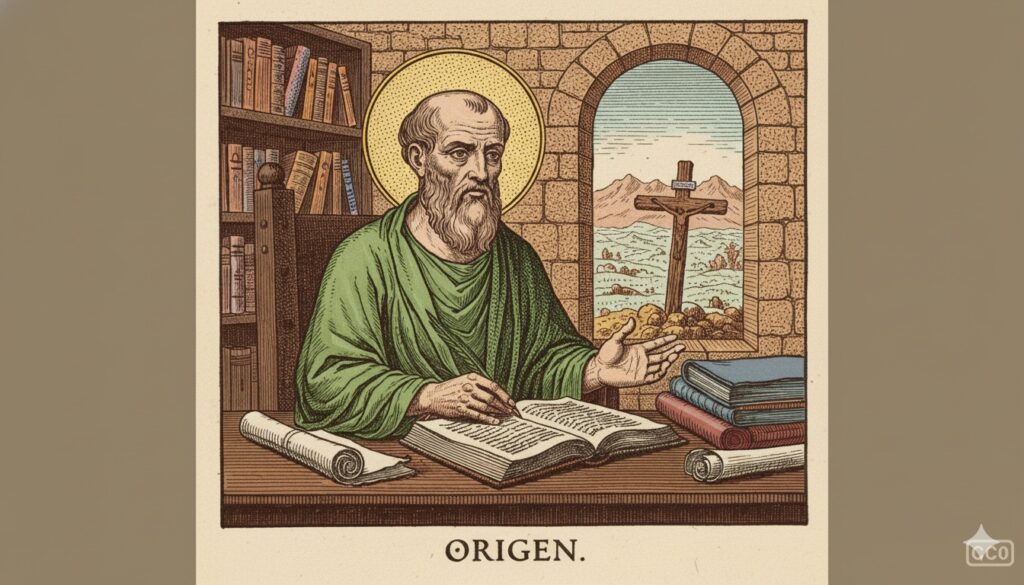
Origen of Alexandria (c. 185 – c. 253 AD) was one of the most prolific, innovative, and controversial figures in early Christian history.
He is often referred to as a “Church Father,” though he was never canonized as a saint due to later controversies regarding his theology.
1. Early Life and Education
Born in Alexandria, Egypt, around 185 AD, Origen grew up in a devout Christian family.
- Family: He was the eldest of seven children. His father, Leonides, taught him the Scriptures and Greek literature.
- Tragedy: In 202 AD, during the persecution under Emperor Septimius Severus, Leonides was martyred. Legend holds that the young Origen wanted to join his father in martyrdom, but his mother hid his clothes to prevent him from leaving the house.
- Education: After his father’s property was confiscated, Origen supported his family by teaching grammar. He studied under Clement of Alexandria and possibly Ammonius Saccas (the founder of Neoplatonism), gaining a massive intellect that bridged Christian scripture with Greek philosophy.
2. The Catechetical School and Asceticism
At the remarkably young age of 18, Bishop Demetrius appointed Origen as the head of the Catechetical School of Alexandria.
- lifestyle: He adopted a rigorous lifestyle of asceticism (self-denial), fasting, sleeping on the floor, and going barefoot.
- The Castration Controversy: A famous story (reported by the historian Eusebius) claims that Origen, taking Matthew 19:12 literally (“there are eunuchs who have made themselves eunuchs for the sake of the kingdom of heaven”), castrated himself.
3. Conflict and Relocation to Caesarea
Origen’s fame grew, but so did tensions with his bishop, Demetrius.
- The Conflict: The tension peaked when Origen traveled to Palestine and was ordained as a priest by the bishops of Jerusalem and Caesarea without Demetrius’s permission. Demetrius considered this a breach of jurisdiction (and theoretically, if the castration story were true, eunuchs were barred from ordination).
- Exile: Demetrius banished Origen from Alexandria around 231 AD. Origen relocated to Caesarea Maritima in Roman Judaea,, where he established a new school and continued his massive literary output.
4. Major Works
Origen was a writing machine; Epiphanius estimates he wrote 6,000 rolls of text. His work founded the discipline of biblical theology.
| Work | Description |
| The Hexapla | A massive feat of textual criticism. It compared the Hebrew Old Testament with four different Greek translations in parallel columns. |
| On First Principles (De Principiis) | The first systematic exposition of Christian theology, covering God, the world, freedom, and scripture. |
| Contra Celsum (Against Celsus) | A detailed apologetic defense of Christianity against pagan attacks by the philosopher Celsus. |
| Commentaries & Homilies | He wrote commentaries on almost every book of the Bible, popularizing the allegorical method of interpretation (looking for spiritual meaning beneath the literal text). |
5. Key Theological Concepts
Origen’s theology was speculative and daring, which eventually led to trouble.
- Pre-existence of Souls: He theorized that souls existed before they were born into bodies and fell away from God, leading to their current physical existence.
- Apokatastasis (Universal Restoration): Perhaps his most controversial idea. He hoped that eventually, all spirits (including Satan) might be purged of evil and reunited with God, meaning hell would not be eternal.
- The Trinity: While he contributed to the development of Trinitarian theology, he used language that suggested the Son was subordinate to the Father (Subordinationism), which later Arian heretics used to support their arguments.
6. Persecution and Death
In 250 AD, Emperor Decius launched a brutal persecution of Christians.
- Origen was arrested and tortured specifically because of his fame; the Romans hoped that breaking such a prominent scholar would dishearten the Christian community.
- He was stretched on the rack and threatened with fire but refused to renounce his faith.
- Although he survived the torture and was released after Decius died, his health was shattered. He died shortly after, around 253 AD, likely in Tyre (modern-day Lebanon).
7. Legacy and The “Origenist Crises”
Origen’s legacy is a “tale of two cities.”
- The Master: For centuries after his death, he was revered as the greatest teacher of the Church. The Cappadocian Fathers (St. Basil and St. Gregory) compiled his works.
- The Heretic: In the centuries following, hardliners attacked his speculative ideas (specifically pre-existence and universal salvation).
- Condemnation: In 553 AD, at the Second Council of Constantinople, 15 anathemas were issued against Origen’s teachings (though scholars debate if Origen himself was condemned or just his extreme followers).
Despite the condemnation, his influence on Christian mysticism, exegesis, and theology is undeniable. He is widely considered the father of the homily and the first great systematic theologian.