
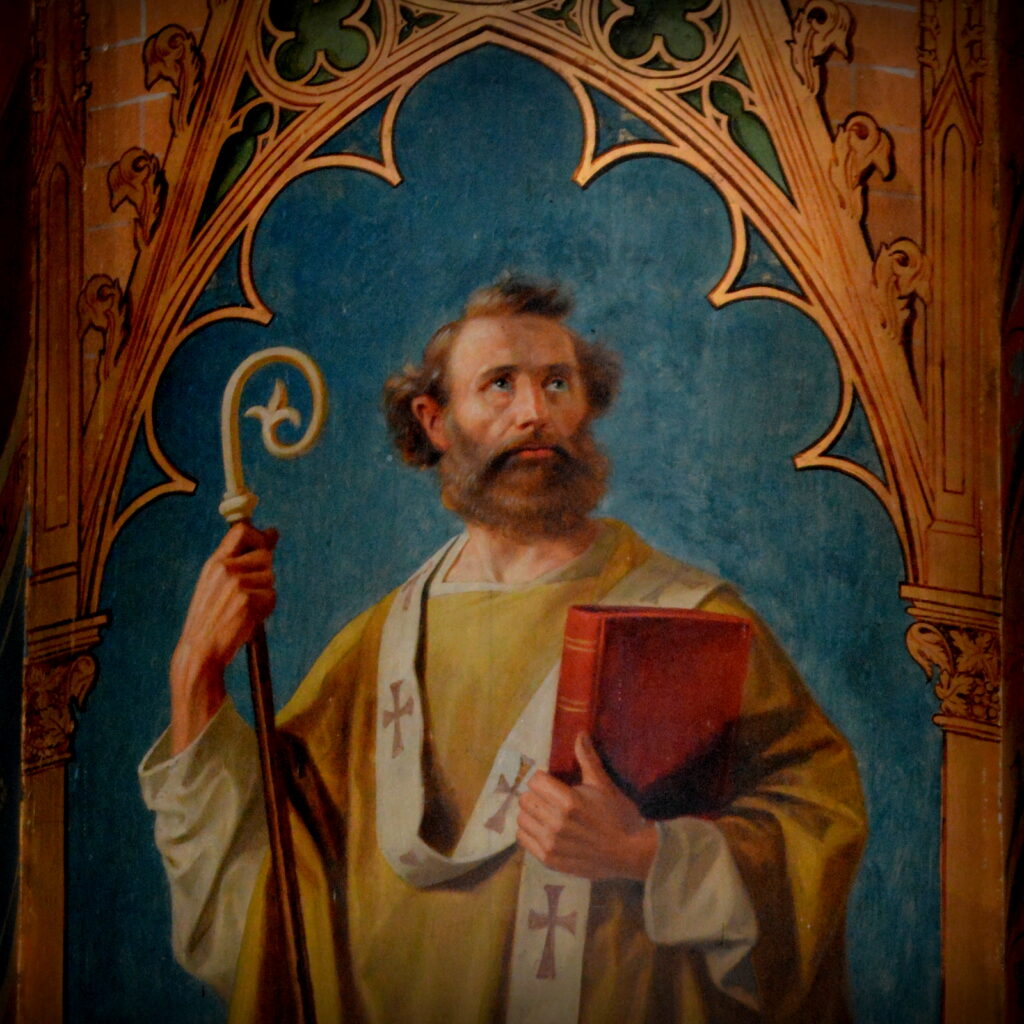
St. Cyril of Jerusalem (c. 313 – 386) was a pivotal 4th-century bishop, theologian, and Doctor of the Church. He is most famous for his Catechetical Lectures, which remain some of the most important surviving documents regarding early Christian liturgy and the instruction of new believers.
1. Parentage and Social Status
Historians have pieced together a profile of his early years based on his education and the context of 4th-century Jerusalem.
While their names are lost to history, we can infer several things about his parents:
- Christian Background: It is highly probable that Cyril was born to Christian parents. He was born around 313 AD (the year of the Edict of Milan), a time when Christianity was transitioning from a persecuted sect to a state-favoured religion.
- Wealth and Standing: His parents were likely of the upper-middle class or “curial” rank. We know this because Cyril received a classical Greek education. In the 4th century, this was expensive and reserved for the children of the social elite.
2. Education
Cyril’s childhood would have been dominated by his studies. His writings reveal he was a product of the rigorous Hellenistic educational system:
- Grammar and Rhetoric: He was clearly trained in Greek literature, philosophy, and the art of public speaking. You can see this in his Catechetical Lectures, which are masterfully organized and persuasive.
- Biblical Immersion: Beyond secular studies, his childhood was defined by the Bible. He had a near-encyclopaedic knowledge of both the Old and New Testaments.
3. Growing Up in “The Holy City”
Cyril’s childhood coincided with a massive physical transformation of his hometown:
- The “New” Jerusalem: While he was a young boy, the Emperor Constantine and his mother, St. Helena, began excavating the holy sites.
- Construction of the Holy Sepulchre: Cyril would have grown up watching the pagan temple of Venus being torn down and the massive Basilica of the Resurrection (the Holy Sepulchre) being built in its place.
- Pilgrim Culture: He grew up in a city that was rapidly becoming the center of the Christian world, surrounded by monks, scholars, and pilgrims from all over the Roman Empire.
4. Ordination
- Ordination: He was ordained a deacon around 335 and a priest about eight years later by Bishop Maximus.
- Bishop of Jerusalem: He succeeded Maximus as bishop around 350 AD. His appointment was initially controversial because he was consecrated by Acacius of Caesarea, a supporter of Arianism (the heresy denying Christ’s full divinity). However, Cyril quickly proved his orthodoxy, leading to a lifelong conflict with Acacius.
5. The Miracle of the Luminous Cross of Jerusalem
This is one of the most striking events in 4th-century history, documented primarily by Cyril himself in a letter to the Emperor Constantius II.
The event took place on May 7, 351 AD, around nine o’clock in the morning, shortly after Cyril had become Bishop of Jerusalem.
The Nature of the Apparition
According to Cyril’s account, a massive, brilliant cross appeared in the sky, stretching from Mount Golgotha to the Mount of Olives.
- Scale: It was not a small or fleeting sign; it was described as being vast enough to be seen by the entire population of the city.
- Brightness: Cyril noted that the light of the cross far outshone the sun, making it clearly visible even in the middle of the day.
- Duration: The apparition lasted for several hours, providing ample time for the citizens of Jerusalem to witness it.
The Impact on the People
The effect on the city was immediate and profound. Cyril describes a scene of both awe and religious fervour:
- Mass Gathering: People of all ages and backgrounds rushed into the churches—specifically the Church of the Holy Sepulchre—to praise God.
- Unity: Both Christians and non-Christians witnessed the event. Many who had previously been skeptical or pagan were said to have converted to Christianity on the spot, moved by the sheer scale of the phenomenon.
- Spiritual Validation: For the Christians of Jerusalem, it was seen as a divine “seal of approval” for their faith and a reminder of the victory of Christ over death.
The Political and Theological Context
The miracle carried much weight beyond just a “religious sign”:
- Arianism: At the time, the Arian heresy (which denied that Jesus was fully God) was a major threat to church unity. Cyril used this event to argue that God was confirming the orthodox Nicene faith.
- Legitimacy: In his letter to Emperor Constantius (who was known to favour Arianism), Cyril subtly used the miracle to remind the Emperor that the true source of power was Christ, not political decrees.
- The “Second Constantine”: Just as Constantine had seen a cross in the sky before the Battle of the Milvian Bridge, Cyril suggested that this new sign was a sign of God’s favour specifically for Jerusalem.
From Cyril’s Letter to Emperor Constantius:
On the Appearance: “For in these very days of the holy season of Pentecost, on the Nones of May, about the third hour, a giant cross, formed of light, appeared in the heavens above holy Golgotha and stretching as far as the holy Mount of Olives.”
On the Reaction of the People: “It was not seen by just one or two, but most clearly by the whole population of the city. It was not, as one might have thought, a mere fancy of the imagination passing quickly away, but it was visible to the eyes above the earth for several hours together, outshining the rays of the sun with its brilliant light.”
On the Conversion of the Witnesses: “The whole city, filled at once with fear and joy at the divine vision, ran to the holy Church… all with one voice giving praise to our Lord Jesus Christ, the Only-begotten Son of God.”
This was a direct jab at the Arian heresy (favoured by the Emperor), which argued that Jesus was a created being rather than eternally begotten.
6. The Struggle Against Arianism
Cyril’s tenure as bishop was defined by his steadfast defense of the divinity of Christ. This pitted him against powerful Arian-leaning political and religious leaders, resulting in three separate exiles totaling roughly 16 years:
- First Exile (357): Deposed by a synod led by Acacius over jurisdictional disputes and Cyril’s selling of church property to feed the poor during a famine.
- Second Exile (360): Banished again by Acacius. He was restored by Emperor Julian but later faced renewed opposition.
- Third Exile (367–378): Banished by the Arian Emperor Valens, this was his longest exile, lasting 11 years.
He finally returned permanently in 378 and participated in the Council of Constantinople (381), where the Nicene Creed was reaffirmed and the divinity of the Holy Spirit was clarified.
7. Key Theological Contributions
Cyril is recognized as the Patron Saint of Catechists. His primary legacy is a collection of 23 Catechetical Lectures:
- The First 18: Delivered during Lent to “illuminandi” (those preparing for baptism). They explain the Creed, the nature of sin, and the necessity of faith.
- The Final 5 (“Mystagogical Catecheses”): Delivered during Easter week to the newly baptized. These provide a rare, detailed look at the 4th-century rites of Baptism, Confirmation, and the Eucharist.
St Cyril of Jerusalem died on March 18 386AD
He has been venerated as a saint by both the Eastern and Western Churches since at least the 5th century.
He was declared a Doctor of the Church in 1883 by Pope Leo XIII
SOURCES:
Catholic Encyclopaedia on Newadvent.org
St Jerome – Illustrious Men