
St. John Chrysostom (c. 347–407 AD) is one of the most celebrated figures in Christian history, renowned as the greatest preacher of the Early Church. His name, Chrysostom (Chrysostomos in Greek), literally means “Golden-Mouthed,” a title he earned due to the exceptional eloquence and moral clarity of his sermons.
He is revered as one of the Three Holy Hierarchs in the Eastern Orthodox Church and a Doctor of the Church in the Catholic Church.
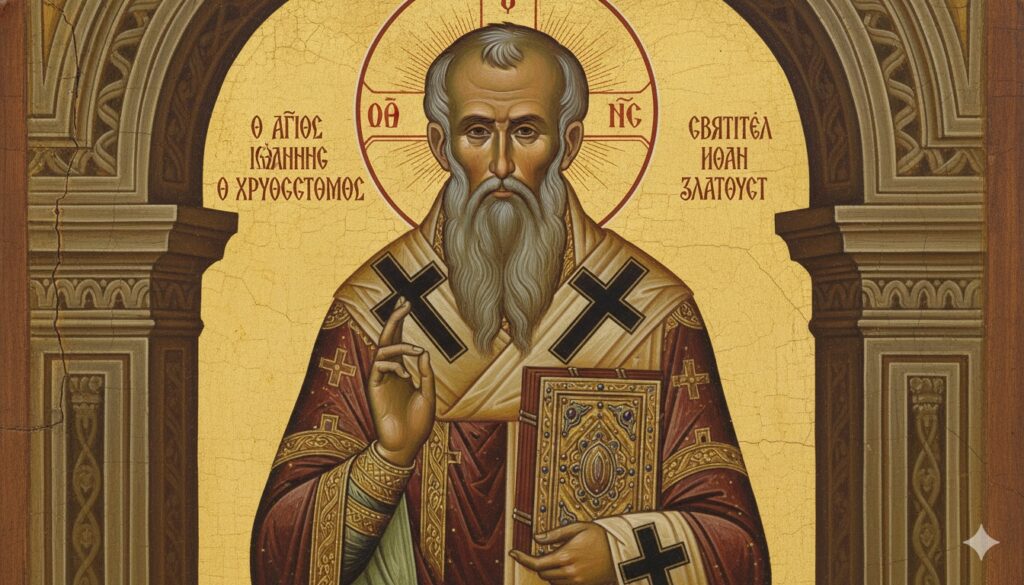
Biography of St. John Chrysostom
Early Life and Education (Antioch, c. 347–370 AD)
- Birth and Family: John was born into an aristocratic family in Antioch, Syria (a major city in the Eastern Roman Empire). His father was a high-ranking military officer who died soon after John’s birth.
- The Mother’s Influence: He was raised by his devout Christian mother, Anthusa, who refused to remarry and dedicated herself entirely to his education and religious upbringing, providing him with a strong moral and intellectual foundation.
- Secular Training: He received the finest secular education available, studying rhetoric under Libanius, the most famous pagan orator of the time. John excelled so greatly that Libanius allegedly said on his deathbed that John would have been his successor “if the Christians had not stolen him from us.” John initially trained for a career in law.
Asceticism and Priesthood (Antioch, 370–398 AD)
- Spiritual Turn: Despite his success in rhetoric, John became increasingly drawn to the spiritual life. He was baptized around 370 AD and dedicated himself to Christian study and asceticism.
- Monastic Life: He spent several years as a hermit-monk in the mountains near Antioch, living a life of extreme austerity and memorizing large portions of the Bible. The harsh discipline, however, permanently damaged his stomach and kidneys, leaving him in frail health for the rest of his life.
- The Golden Mouth: He returned to Antioch and was ordained a deacon (381 AD) and then a priest (386 AD). For the next twelve years, he served as the leading preacher in the city’s cathedral. During this time, he delivered the majority of his famous homilies and scriptural commentaries, earning the title “Chrysostom.” His preaching focused on the literal meaning of Scripture and its practical application to daily life, forcefully denouncing the abuse of wealth and social injustice.
Archbishop of Constantinople (398–404 AD)
- Forced Appointment: Against his will, John was taken from Antioch to become the Archbishop of Constantinople, the capital of the Eastern Roman Empire, in 398 AD.
- Radical Reform: As Archbishop, John immediately applied his moral convictions to the imperial court and the corrupt clergy. He lived a severely simple, ascetic lifestyle, funneled the luxurious ecclesiastical finances into hospitals and poor relief, and deposed corrupt bishops.
- Clash with Power: His unwavering sermons, which often contrasted the gospel ideals with the city’s opulence and moral laxity, enraged the powerful elite, including Empress Eudoxia. She took his criticisms of extravagance as a direct personal attack.
Exile and Death (404–407 AD)
- The Synods of the Oak (403 AD): John’s rivals, including the powerful Archbishop Theophilus of Alexandria, conspired with Empress Eudoxia. They convened an illegal synod which fabricated charges against him and deposed him.
- Exile: John was exiled twice. Though briefly recalled after the first banishment due to popular outrage, he was soon exiled again in 404 AD.
- Martyrdom in Exile: He was sent on a brutal, forced march to a remote location near the Black Sea. His already fragile health could not endure the journey. He died in exile in Comana, Pontus, on September 14, 407 AD. His last recorded words were: “Glory to God for all things.”
Enduring Legacy
- The Divine Liturgy: The liturgy most widely celebrated in Eastern Orthodoxy is named the Divine Liturgy of St. John Chrysostom.
- Writings: His immense body of work, consisting of hundreds of sermons, homilies, and letters (such as his letters from exile to the deaconess Olympias), provides a crucial source for studying early Christian life, ethics, and theology.
- Rehabilitation: In 438 AD, his relics were brought back to Constantinople in triumph by the Emperor Theodosius II, the son of Eudoxia, who publicly asked for forgiveness for his mother’s treatment of the saint.