St Patrick – (373-493) The Patron Saint of Ireland
Early Life and Captivity
Patrick (or Maewyn Succat, as was his birth-name) was born in the late 4th century (roughly 373 AD) in Kilpatrick, near Dumbarton, in Scotland,. He grew up in a Christian family—his father Calphurnius.was a deacon and his grandfather a priest. His mother, Conchessa, was a near relative of the great patron of Gaul, St. Martin of Tours. However, Patrick admitted that in his youth, he “did not know the true God.”
Everything changed at age 16 when Irish raiders attacked his family’s estate. Patrick was kidnapped and transported to Ireland and sold as a slave to a chieftan named Milchu in Dalriada in the present county Antrim. He spent six years working as a shepherd on a mountain (traditionally identified as Slemish in County Antrim).
It was during this period of isolation, hunger, and cold that he turned toward prayer, as he relates in his spiritual autobiography, Confessio ……”in a single day, I have said as many as a hundred prayers, and in the night nearly the same, so that whilst in the woods and on the mountain, even before the dawn, I was roused to prayer”.
The Escape and Calling
According to his Confessio, Patrick heard a voice in a dream telling him, “Your ship is ready.” He fled his masters, traveled 200 miles to the coast, and managed to find passage back to Britain.
After returning home, he went to study at St. Martin’s monastery at Tours, and again at the island sanctuary of Lérins which was acquiring widespread renown for learning and piety. Thereafter he joined St. Germain on his great mission at Auxerre.
It was St Germain who ordained him a priest. When Germain was commissioned by the Holy See to go to Britain to combat the erroneous teachings of Pelagius, he chose Patrick as one of his companions.
Here, he had visions of the children from Focluth, by the Western sea, who cried to him: “O holy youth, come back to Erin, and walk once more amongst us.”
The writer of St. Germain’s Life in the ninth century, Heric of Auxerre, tells us “Since the glory of the father shines in the training of the children, of the many sons in Christ whom St. Germain is believed to have had as disciples in religion, let it suffice to make mention here, very briefly, of one most famous, Patrick, the special Apostle of the Irish nation. Germain sent him, accompanied by Segetius, his priest, to Celestine, Pope of Rome, approved of by whose judgement, supported by whose authority, and strengthened by whose blessing, he went on his way to Ireland.”
It was only shortly before his death that Celestine gave this mission to Ireland’s apostle and on that occasion bestowed on him many relics and other spiritual gifts, and gave him the name “Patercius” or “Patritius”(meaning Nobleman ; Patrician or Father of his people) not as an honorary title, but as a foreshadowing of the fruitfulness and merit of his apostolate whereby he would become pater civium (the father of his people).
Mission to Ireland
Patrick arrived back in Ireland around 432 AD. The Druids were at once in arms against him. But Patrick was not disheartened.
He decided to first proceed towards Dalriada, where he had been a slave, to repay his former master, with the blessings and freedom of God’s children in exchange for the servitude and cruelty endured at his hands. However, he was struck with horror on seeing at a distance the fort of his old master Milchu enveloped in flames. Milchu,hearing of the miracles performed by Patrick, and according to an ancient record – “His pride could not endure the thought of being vanquished by his former slave”- he gathered all his treasures and himself into his mansion and set it on fire.
– Unlike previous missionaries who focused on the small pockets of existing Christians, Patrick targeted the pagan tribes and their leaders.
– He was a master of “inculturation.” Instead of trying to erase Irish culture, he incorporated local symbols into Christian practice. He famously superimposed the sun (a pagan symbol) onto the Christian cross, creating what we now know as the Celtic Cross.
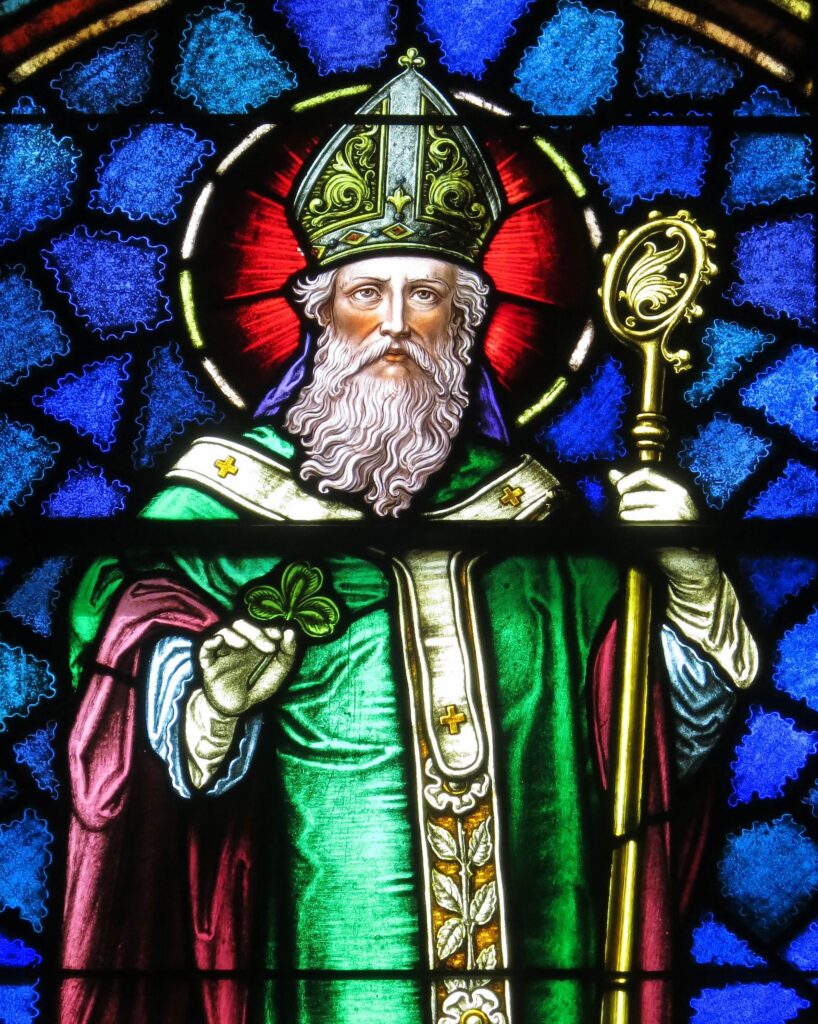
– The Shamrock: While not mentioned in his own writings, legend says he used the three-leafed shamrock to explain the concept of the Holy Trinity (the Father, Son, and Holy Spirit).
– St Patrick’s Breastplate. By far the most famous prayer attributed to St Patrick – A “breastplate” (or lorica) was a type of prayer in the early Irish church intended for spiritual protection.
I arise today, Through a mighty strength, the invocation of the Trinity,
Through belief in the threeness.
Through confession of the Oneness
Towards the creator. I arise today,
Through the strength of Christ with his baptism,
Through the strength of his crucifixion with his burial,
Through the strength of his resurrection with his ascension,
Through the strength of his descent for the Judgement of doom.
I arise today,
Through the strength of the love of Cherubim,
In obedience to the Angels,
In the service of the Archangels,
In hope of resurrection to meet with reward,
In prayers of patriarchs,
In predictions of prophets,
In preaching of Apostles,
In faiths of confessors,
In innocence of Holy Virgins,
In deeds of righteous men. I arise today,
Through the strength of heaven:
Light of sun Brilliance of moon,
Splendour of fire,
Speed of lightning,
Swiftness of wind,
Depth of sea,
Stability of earth,
Firmness of rock.
I arise today,
Through God’s strength to pilot me:
God’s might to uphold me,
God’s wisdom to guide me,
God’s eye to look before me,
God’s ear to hear me,
God’s word to speak for me,
God’s hand to guard me,
God’s way to lie before me,
God’s host to secure me,
against snares of devils,
against temptations of vices,
against inclinations of nature,
against everyone who shall wish me ill,
afar and anear, alone and in a crowd.
I summon today all these powers, between me and these evils:
Against every cruel and merciless power, that may oppose my body and my soul,
Against incantations of false prophets,
Against black laws of heathenry,
Against false laws of heretics,
Against craft of idolatry,
Against spells of women and smiths and wizards,
Against every knowledge that endangers man’s body and soul.
Christ to protect me today against poison,
against burning,
against drowning,
against wounding,
so that there may come abundance of reward.
Christ with me,
Christ before me,
Christ behind me,
Christ in me,
Christ beneath me,
Christ above me,
Christ on my right,
Christ on my left
Christ where I lie,
Christ where I sit,
Christ where I arise,
Christ in the heart of every man who thinks of me,
Christ in the mouth of every man who speaks of me,
Christ in every eye that sees me,
Christ in every ear that hears me.
I arise today, Through a mighty strength,
the invocation of the Trinity, Through belief in the Thrones,
Through confession of the Oneness
Towards the Creator.
Salvation is of the Lord. Salvation is of the Lord.
Salvation is of Christ.
May thy salvation, O Lord, be ever with us.
Amen.
The Legend: Tradition says Patrick sang this while he and his followers were being pursued by King Lóegaire. To the king’s assassins, Patrick and his men appeared not as people, but as a herd of wild deer, allowing them to escape.
Ethne and Fedelm, daughters of the king of Connaught asked the saint these questions:
“Who is God?”
“And where is God?”
“Where is His dwelling?”
“Has He sons and daughters?”
“Is He rich in silver and gold?”
“Is He everlasting? is He beautiful?”
“Are His daughters dear and lovely to the men of this world?”
“Is He on the heavens or on earth?”
“In the sea, in rivers, in mountains, in valleys?”
“Make Him known to us. How is He to be seen?”
“How is He to be loved? How is He to be found?”
“Is it in youth or is it in old age that He may be found?”
And St. Patrick, filled with the Holy Spirit, made answer:
“God, whom we announce to you, is the Ruler of all things.”
“The God of heaven and earth, of the sea and the rivers.”
“The God of the sun, and the moon, and all the stars.”
“The God of the high mountains and of the low-lying valleys.”
“The God who is above heaven, and in heaven, and under heaven.”
“His dwelling is in heaven and earth, and the sea, and all therein.”
“He gives breath to all.”
“He gives life to all.”
“He is over all.”
“He upholds all.”
“He gives light to the sun.”
“He imparts splendour to the moon.”
“He has made wells in the dry land, and islands in the ocean.”
“He has appointed the stars to serve the greater lights.”
“His Son is co-eternal and co-equal with Himself.”
“The Son is not younger than the Father.”
“And the Father is not older than the Son.”
“And the Holy Ghost proceeds from them.”
“The Father and the Son and the Holy Ghost are undivided.”
“But I desire by Faith to unite you to the Heavenly King, as you are daughters of an earthly king.
Challenges and Death
Patrick’s mission was not easy. He was frequently harassed by Druids, taken prisoner by local chieftains, and even criticized by his superiors in the British Church for his “lack of education” and his unconventional methods.
St. Patrick, until his death, continued to visit and watch over the churches which he had founded in Ireland and he appointed pastors to continue his work among them. He consecrated at least 350 bishops including St. Guasach, son of his former master, Milchu, who became Bishop of Granard, while Milchu’s two daughters founded, at Clonbroney, a convent of pious virgins.
In the Annals of Ulster we read that “Patritius the arch-apostle of the Scoti (or Irish) rested on the 16th day of the calends of April (17th March) in the 120th year of his age, and also, the 60th year after he had come to Ireland to baptise the Scoti.” He died on March 17th 493 in Saul, County Down, where he had built his first church. He is believed to be buried at Down Cathedral.
Sources:
The Catholic Encyclopedia on Newadvent.org
St Patrick’s Confessio
THE LIFE AND WRITINGS OF SAINT PATRICK BY THE MOST REV. DR. HEALY, ARCHBISHOP OF TUAM on https://www.ecatholic2000.com/