St. Rabanus Maurus (c. 780–856)
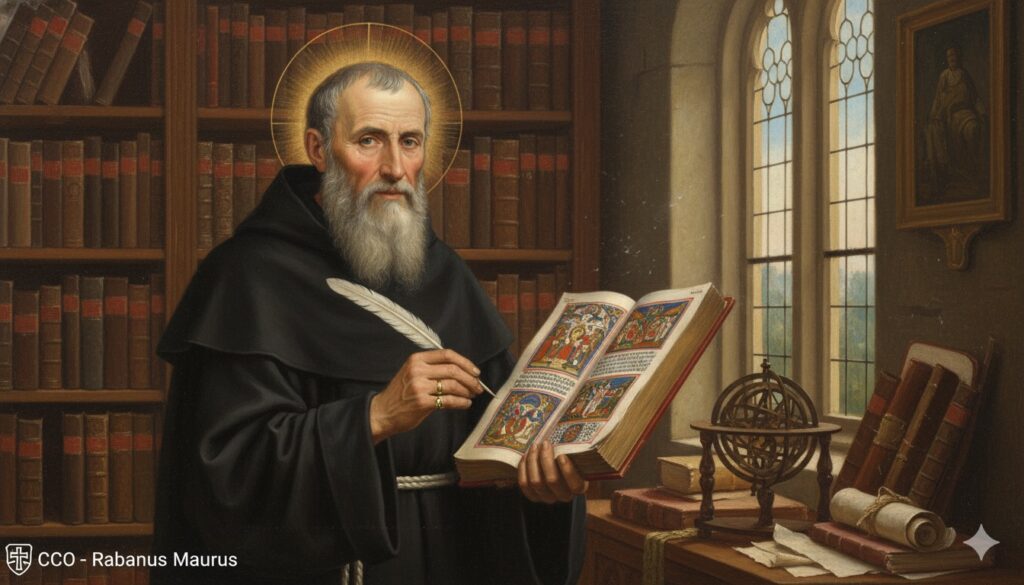
St. Rabanus Maurus (c. 780–856), also known as Hrabanus, was one of the most towering intellectual figures of the Carolingian Renaissance. He was a monk, teacher, abbot, and archbishop who earned the title Praeceptor Germaniae (“The Teacher of Germany”) for his role in preserving and synthesizing ancient knowledge for the medieval world.
Early Life Hrabanus was born around 780 AD into a noble Frankish family in Mainz (Mogontiacum), which was one of the most important Roman-founded cities in the Rhineland.
To understand his early life, we have to look at the world of the Carolingian Empire—a time when noble families were the primary supporters of both the Crown (Charlemagne) and the Church. His parents were high-ranking Frankish nobles. While their specific names are not recorded with the same certainty as royal lineages, we know they were part of the landed elite who helped stabilize the eastern frontier of Charlemagne’s empire.
His family were fierce loyalists to the Carolingian Dynasty. This is why Rabanus later became so involved in the politics of Charlemagne’s grandsons—he wasn’t just a monk; he was a member of the ruling class.
At the very young age of nine (c. 789 AD), Rabanus’s life took a dramatic turn. His parents “offered” him as a child “oblate” (a young monk-in-training) to the Abbey of Fulda.
In the modern world, this might seem like “giving a child away,” but in the 8th century, it was the highest honor for a noble family. This was called Oblation (from the Latin oblatus, meaning “offered”).
Fulda was the most famous monastery in Germany, founded by St. Boniface. By sending him there, his family ensured he received the finest education available in the Western world.
Because he left his biological family so young, Rabanus’s “ancestry” is often discussed in terms of his intellectual lineage:
- St. Boniface (The Grandfather): The founder of Fulda. Rabanus saw himself as the protector of Boniface’s mission to convert the Germans.
- Alcuin of York (The Father): Alcuin was the “Prime Minister of Education” for Charlemagne. When Rabanus went to study with him in Tours, Alcuin treated him like a son. This connection gave Rabanus “academic nobility”—making him the heir to the greatest library of knowledge in Europe.
Rabanus never forgot his noble roots. Even as a monk, he spoke with the authority of a nobleman. He used his family’s wealth and influence to build up the library at Fulda, turning a frontier outpost into the “Athens of Germany.”
Education
- The Influence of Alcuin: Around 802, he was sent to Tours to study under Alcuin of York, the greatest scholar of the age and Charlemagne’s advisor. Alcuin gave him the nickname “Maurus” after St. Benedict’s favorite disciple, recognizing Rabanus’s incredible focus and piety.
- Academic Pioneer: Rabanus returned to Fulda and was put in charge of the monastery school. Under his leadership, it became the most prestigious center of learning in Europe, producing famous pupils like Walafrid Strabo.
The Abbot and Archbishop
Rabanus’s life was a mix of quiet study and high-stakes political leadership. His noble blood was both his greatest asset and his heaviest burden. In the Carolingian world, high-ranking abbots weren’t just monks; they were Princes of the Church who were expected to provide counsel, money, and even soldiers to the King.
As Abbot of Fulda (822–842), he managed over 600 monks and oversaw a massive building program. However, he was caught in the civil wars between the sons of Louis the Pious.
When Charlemagne’s son, Louis the Pious, died in 840 AD, the empire descended into a brutal civil war between his three sons: Lothair I, Louis the German, and Charles the Bald.
Having sided with Lothair I (who lost), he was forced to resign and go into temporary exile at Petersberg.
The Gamble: Choosing the “Wrong” King
Because of his family’s traditional loyalty to the imperial title, Rabanus felt a noble obligation to support the eldest son, Lothair I, who held the title of Emperor.
- The Conflict: Rabanus’s monastery (Fulda) was located in the heart of the territory claimed by the younger brother, Louis the German. By supporting the “outside” Emperor (Lothair), Rabanus was essentially committing treason in the eyes of the local king.
- The Disaster: In 841 AD, Lothair was defeated at the Battle of Fontenoy. Louis the German emerged as the undisputed ruler of the East Frankish Kingdom (Germany).
The Fall: Resignation and Exile
Louis the German was furious with Rabanus. To save the Abbey of Fulda from being destroyed or seized, Rabanus did the “noble thing”—he stepped down.
- The Resignation (842 AD): He gave up his power as Abbot and went into a form of “internal exile” at the nearby Petersberg.
- When Rabanus Maurus resigned as Abbot in 842, he moved to a monastic cell (a small residence for a monk) located at the monastery of St. Peter on the Petersberg.
- In medieval terms, a “cell” wasn’t necessarily a prison-like room, but rather a private dwelling within a smaller monastic complex. Rabanus lived in a dedicated space attached to the Church of St. Peter (which still stands today as the Liobakirche).
- The Building: The church was a mountain sanctuary he himself had helped build and consecrate around 836–838 AD, just a few years before his “exile.”
- The Environment: The Petersberg (then called Mons Sancti Petri) was a basalt hill rising above the Fulda valley. Living there allowed him to be physically separated from the political drama of the main Abbey of Fulda while still being within sight of it.
- The Hardship: For several years, the “Teacher of Germany” was a man without a country. He lived in semi-seclusion, focusing on his writing because his political career was effectively dead.
- The “Workplace”: Despite being in “retirement,” Rabanus turned his residence into a high-speed scriptorium. He lived there with several assistants (monk-secretaries) who helped him research and write.
What he did there
This period in Petersberg (842–847 AD) was the most productive “literary” phase of his life. Living in this quiet cell, he produced:
- De Universo (De rerum naturis): His massive 22-book encyclopedia was largely compiled and finalized here.
- Biblical Commentaries: He spent his days surrounded by manuscripts, writing detailed explanations of the Old and New Testaments.
- Ascetic Life: According to early biographies, Rabanus followed a strict diet in his cell, allegedly eating no meat and drinking no wine, dedicating his remaining energy entirely to prayer and scholarship.
The “Intellectual” Peace Treaty
Rabanus used his greatest weapon—his mind—to win his way back into favour. He knew that Louis the German, despite his anger, deeply respected scholarship and the Carolingian tradition of learning.
The Dedication: Rabanus completed his massive encyclopedia, De Universo, and strategically dedicated it to Louis the German.
Archbishop of Mainz (847–856): After reconciling with King Louis the German, he was appointed Archbishop. He spent his final years as a pastor, famously feeding over 300 poor people daily during the famine of 850.
Legacy: The “Teacher of Germany”
Rabanus Maurus is celebrated as a saint in both the Catholic and Eastern Orthodox churches (Feast Day: February 4).
His legacy isn’t found in a single new theory, but in his role as a bridge. At a time when Europe could have fallen into total illiteracy, he gathered the fragments of Greek and Roman wisdom and “Christianized” them, ensuring that the next 1,000 years of European education had a solid foundation.
“A teacher should be like a mirror… reflecting the light of the Truth to those who stand in the dark.” — Rabanus Maurus
Sources:
The Catholic Encyclopedia (1911)
Rudolf of Fulda, Vita Leobae and Miracula Sanctorum
The Annales Fuldenses:
Rabanus Maurus, De Universo and In honorem sanctae crucis,