
Monday of the Fourth week in Lent
John 4:43-54
“A Prophet has no honour in his own country.”
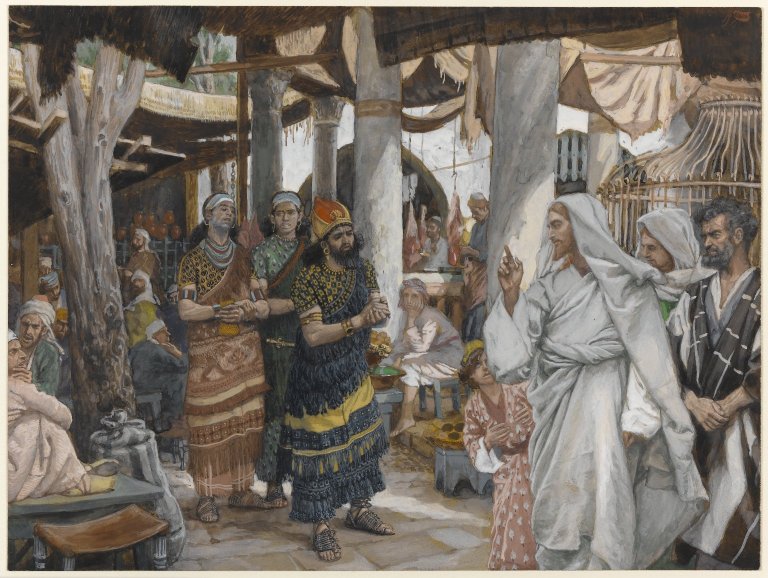
Then, after two days, he departed from there, and he traveled into Galilee. For Jesus himself offered testimony that a Prophet has no honour in his own country.
And so, when he had arrived in Galilee, the Galileans received him, because they had seen all that he had done at Jerusalem, on the day of the feast. For they also went to the feast day.
Then he went again into Cana of Galilee, where he made water into wine. And there was a certain ruler, whose son was sick at Capernaum. Since he had heard that Jesus came to Galilee from Judea, he sent to him and begged him to come down and heal his son. For he was beginning to die. Therefore, Jesus said to him, “Unless you have seen signs and wonders, you do not believe.” The ruler said to him, “Lord, come down before my son dies.” Jesus said to him, “Go, your son lives.” The man believed the word that Jesus spoke to him, and so he went away.
Then, as he was going down, his servants met him. And they reported to him, saying that his son was alive. Therefore, he asked them at which hour he had become better. And they said to him, “Yesterday, at the seventh hour, the fever left him.” Then the father realized that it was at the same hour that Jesus said to him, “Your son lives.” And both he and his entire household believed. This next sign was the second that Jesus accomplished, after he had arrived in Galilee from Judea.
What do the Fathers say?
St THEOPHYLACT. Our Lord on leaving Samaria for Galilee, explains why He was not always in Galilee: viz. because of the little honour He received there. A prophet has no honour in his own country.
ORIGEN. The country of the prophets was Judæa, and every one knows how little honour they received from the Jews, as we read, Whom of the prophets have not your fathers persecuted? One cannot but wonder at the truth of this saying, exemplified not only in the contempt cast upon the holy prophets and our Lord Himself, but also in the case of other teachers of wisdom who have been despised by their fellow-citizens and put to death.
St John CHRYSOSTOM. On a former occasion our Lord attended a marriage in Cana of Galilee, now He goes there to convert the people, and confirm by His presence the faith which His miracle had produced. He goes there in preference to His own country.
St AUGUSTINE. There, we are told, His disciples believed on Him. Though the house was crowded with guests, the only persons who believed in consequence of this great miracle, were His disciples. He therefore visits the city again, in order to try a second time to convert them.
St THEOPHYLACT. The Evangelist reminds us of the miracle in order to express the praise due to the Samaritans. For the Galileans in receiving Him were influenced as well by the miracle He had wrought with them, as by those they had seen at Jerusalem. The nobleman certainly believed in consequence of the miracle performed at Cana, though he did not yet understand Christ’s full greatness.
ORIGEN. Some think that this was an officer of King Herod’s; others, that he was one of Cæsar’s household, then employed on some commission in Judæa. It is not said that He was a Jew.
St John CHRYSOSTOM. And mark his earthly mind, shown in hurrying Christ along with him; as if our Lord could not raise his son after death. Indeed it is very possible that he may have asked in unbelief. For fathers often are so carried away by their affection, as to consult not only those they depend upon, but even those they do not depend upon at all: not wishing to leave any means untried, which might save their children.
Pope St GREGORY the Great. Our Lord in His answer implies that He is in a certain sense present where He is invited. He saves by His command simply, even as by His will He created all things:
Jesus said to him, “Go your son lives.”
Here is a blow to that pride which honours human wealth and greatness. Our Redeemer, to show that things made much of among men, were to be despised by Saints, did not go to the nobleman’s son, but was ready to go to the centurion’s servant.
St John CHRYSOSTOM. For In the centurion there was confirmed faith and true devotion, and therefore our Lord was ready to go. But the nobleman’s faith was still imperfect, as he thought our Lord could not heal in the absence of the sick person.
They met him, to announce what had happened, and prevent Christ from coming, as He was no longer wanted. That the nobleman did not fully believe, is shown by what follows: Then enquired he of them at what hour he began to get better. He wished to find out whether the recovery was accidental, or owing to our Lord’s word.
How obvious is the miracle? His recovery did not take place in an ordinary way, but all at once; in order that it might be seen to be Christ’s doing, and not the result of nature: So the father himself believed, and his whole house.