
St. Augustine of Hippo (354 – 430 AD)
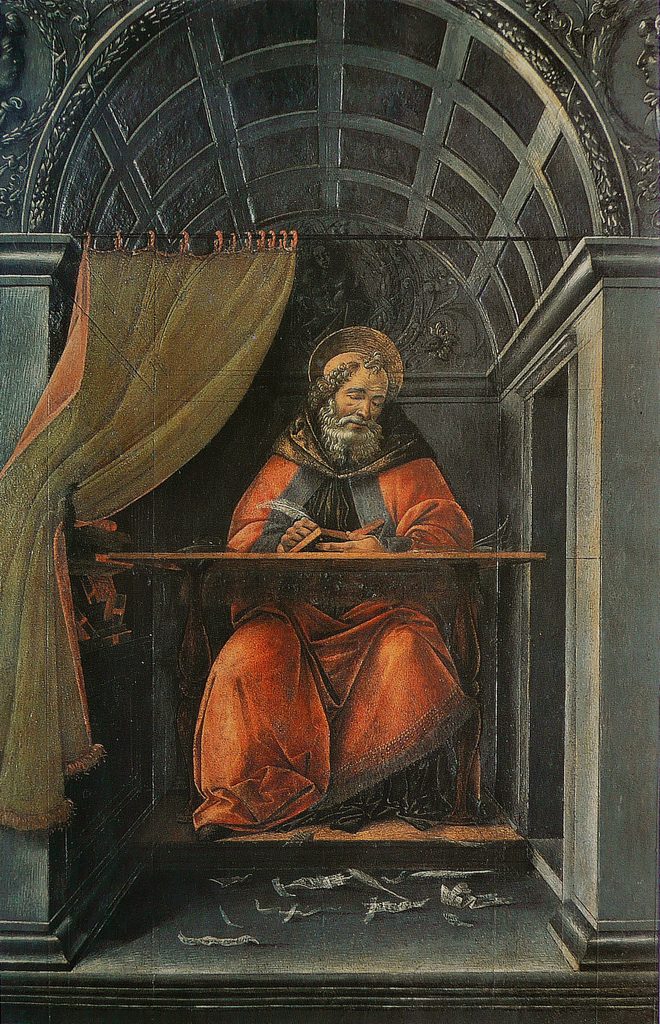
Saint Augustine of Hippo (Aurelius Augustinus) was a Roman African philosopher and theologian. He is one of the most significant figures in the development of Western Christianity and Western philosophy, whose writings profoundly shaped Christian doctrine, theology, and philosophy for over a thousand years. He is recognized as a Doctor of the Church.
This man of passion and faith, of the highest intelligence and tireless in his pastoral care, a great Saint and Doctor of the Church is often known, at least by hearsay, even by those who ignore Christianity or who are not familiar with it, because he left a very deep mark on the cultural life of the West and on the whole world. – Pope Benedict XVI
Family Matters:
He was born on November 13, 354 AD, in Thagaste, Numidia (modern Souk Ahras, Algeria) to Monica, a fervent Christian and Patricius, a pagan.
His Mother: .Saint Monica (c. 331–387 AD) is revered as a model of Christian perseverance and motherhood.who prayed constantly for his conversion
- Background: She was a Berber woman and a devout Christian, born in Tagaste, Numidia (modern Algeria).
- Marriage and Faith: She was married to Patricius, a pagan Roman official who was known for his temper and infidelity. Monica endured these hardships with patience and faith, praying for years for his conversion, which finally occurred shortly before his death.
- The Burden of Augustine: Her life became dominated by concern for her brilliant but wayward eldest son, Augustine. She was heartbroken by his association with Manichaeism and his cohabitation with an unnamed woman.
- Relentless Prayer: Monica followed Augustine to Carthage, Rome, and eventually Milan, praying, weeping, and fasting for his conversion for over 17 years. She famously received guidance from a bishop who assured her, “It is impossible that the son of so many tears should perish.”
- Influence of Ambrose: In Milan, she benefited from the spiritual guidance of St. Ambrose. Her prayers were answered when Augustine finally converted and was baptized in 387 AD.
- Death: Monica died shortly after Augustine’s conversion in Ostia, near Rome, while they were waiting for a ship back to Africa. Her final, peaceful deathbed conversation with Augustine about eternal life is one of the most moving passages in the Confessions.
- On her deathbed: “Son, for mine own part I have no further delight in any thing in this life. What I do here any longer, and to what I am here, I know not, now that my hopes in this world are accomplished. One thing there was for which I desired to linger for a while in this life, that I might see thee a Catholic Christian before I died. My God hath done this for me more abundantly, that I should now see thee withal, despising earthly happiness, become His servant: what do I here?
Father: Patricius, a pagan who later converted to Christianity.
Siblings: Augustine also had a brother, Navigius, and a sister whose name is unknown to us and who, after being widowed became the head of a monastery for women.
Son: Adeodatus, (c. 372–c. 388 AD) was the son of St. Augustine and his long-time, unnamed concubine (a woman with whom he had a stable, though not legally recognized, relationship).
- Name Meaning: The name Adeodatus is Latin for “Given by God.”
- Early Life: He was born when Augustine was 18, and the three of them lived together as a family for over 15 years. Augustine was heartbroken when he separated from the mother of Adeodatus in Milan (in preparation for a socially advantageous marriage that ultimately never happened).
- Intellectual Brilliance: Augustine describes Adeodatus in the Confessions as a child of extraordinary intellectual talent and spiritual insight, stating that his son surpassed him in intellect. Adeodatus was fully involved in the intellectual community surrounding Augustine and was present for his father’s philosophical dialogues.
- Baptism: Adeodatus was baptized with his father and grandfather, Patricius, (posthumously) by St. Ambrose in Milan in 387 AD.
- Early Death: Tragically, Adeodatus died sometime around 388 AD. His early death profoundly affected Augustine, who viewed it as a sign of God’s providence and mercy, sparing the young man from the sins of the world. In the Confessions (Book IX, Chapter 6), he speaks of his son’s death simply as a loss that was soon healed by the consolation of faith:
“We soon lost him from our life… Yet I remember him without fear, knowing that you have sealed him in your grace.“
Adeodatus’ mother. Augustine does not name Adeodatus’s mother in the Confessions, a lack of detail that has prompted much historical discussion.The core of the speculation revolves around her social standing, as Augustine consistently refers to her using the Latin term concúbina.
- Augustine’s mother, Monica, insisted that Augustine separate from his concúbina in preparation for a formal, legal marriage that would advance his social career.
- The Forced Separation (385 AD): Augustine sent her back to Africa while he was living in Milan, pending his arranged marriage to a wealthy, socially suitable bride (who was two years too young to marry immediately)- a marriage which was never to take place..
- Augustine’s Guilt: Augustine records the heartbreak of the separation, noting that his partner promised to God that she would never sleep with another man. He emphasizes that his heart was wounded by her departure, but he quickly found another temporary concúbina while waiting for his bride.
Early Life and Intellectual Journey
- Education: Augustine received a superior education in rhetoric in Carthage. While intellectually brilliant, he led a hedonistic lifestyle in his youth.
- He co-habited with a woman with whom he had a son, Adeodatus in 372. They lived together as a family for over 15 years until he left to prepare for a socially advantageous marriage that ultimately never happened.
- Manichaeism (c. 373–382 AD): Seeking philosophical truth and troubled by the problem of evil, Augustine joined the Manichaean sect, which offered a dualistic explanation for the world (a struggle between good and evil cosmic forces). He remained a Manichaean “hearer” for nine years.
- He taught rhetoric in Thagaste and Carthage before moving to Rome in 383 AD, hoping to find better prospects.
Milan and Conversion
- Augustine secured a prestigious post as the Professor of Rhetoric in Milan in 384 AD, then the de facto capital of the Western Roman Empire.
- Ambrose: In Milan, he met and was greatly influenced by the powerful Bishop Saint Ambrose, whose allegorical interpretations of Scripture helped resolve Augustine’s intellectual objections to the Bible.
- Neoplatonism: He also encountered Neoplatonic philosophy, which provided him with a conceptual framework to understand God as an immaterial, eternal being, helping him break free from the materialistic teachings of Manichaeism.
- The Garden Scene (386 AD): The definitive moment of his life occurred in a garden where, struggling with his moral failings, he heard a child’s voice chanting, “Tolle, lege” (Take up and read).
Confessions ; Book VIII Chapter XII
“I grasped, opened, and in silence read that paragraph on which my eyes first fell —Not in rioting and drunkenness, not in chambering and wantonness, not in strife and envying; but put on the Lord Jesus Christ, and make not provision for the flesh, to fulfil the lusts thereof. Romans 13:13-14 No further would I read, nor did I need; for instantly, as the sentence ended — by a light, as it were, of security infused into my heart — all the gloom of doubt vanished away.”
- “In Milan, Augustine acquired the habit of listening ,at first for the purpose of enriching his rhetorical baggage, to the eloquent preaching of Bishop Ambrose, who had been a representative of the Emperor for Northern Italy. The African rhetorician was fascinated by the words of the great Milanese Prelate; and not only by his rhetoric. It was above all the content that increasingly touched Augustine’s heart. The great difficulty with the Old Testament, because of its lack of rhetorical beauty and lofty philosophy was resolved in St Ambrose’s preaching through his typological interpretation of the Old Testament: Augustine realized that the whole of the Old Testament was a journey toward Jesus Christ. Thus, he found the key to understanding the beauty and even the philosophical depth of the Old Testament and grasped the whole unity of the mystery of Christ in history, as well as the synthesis between philosophy, rationality and faith in the Logos, in Christ, the Eternal Word who was made flesh.” – Pope Benedict XVI
- Baptism: Augustine was baptized by Ambrose in the Cathedral of Milan on 24 April 387, during the Easter Vigil together with his son and father, Patricius, (posthumously).
Episcopacy in Hippo
- Return to Africa: He returned to North Africa in 388 AD. After a brief period of communal living, he was ordained a priest in Hippo Regius in 391 AD.
- Bishop of Hippo (396 AD): He was consecrated Bishop of Hippo, a post he held until his death. As bishop, he dedicated himself to preaching, writing, and administering the Church.
- Major Conflicts: His episcopal career was dominated by combating two major heresies:
Donatism: A schism that challenged the validity of sacraments administered by sinful priests. Augustine argued that the validity of the sacrament resided in Christ, not the minister (ex opere operato).
Pelagianism: A heresy that denied original sin and claimed humans could achieve salvation purely through their own free will and moral effort. Augustine fiercely defended the doctrine of original sin and the absolute necessity of God’s grace for salvation.
Death
Augustine died in 430 AD during the Vandal siege of Hippo. He spent his final days praying and reading the penitential psalms, leaving behind a legacy that would shape the Middle Ages.
📚 Select Bibliography (Major Works)
Augustine was a prolific writer, producing hundreds of works, letters, and sermons. These three are considered his most important:
1. The Confessions (Confessiones, c. 397–400 AD)
- Genre: A unique autobiography, theology, and philosophy rolled into one.
- Significance: It recounts his youth, his search for truth through different philosophies and heresies, his struggles with lust, and his eventual conversion. It is the first great spiritual autobiography in Western literature.
2. The City of God (De Civitate Dei, c. 413–426 AD)
- Context: Written as a response to the pagan accusation that Christianity was responsible for the Sack of Rome by the Visigoths in 410 AD.
- Theme: Augustine contrasts the Earthly City (Civitas Terrena), driven by self-love and the pursuit of earthly goods, with the City of God (Civitas Dei), driven by the love of God. It is a foundational work of political philosophy and theology, separating the realms of the temporal and the spiritual.
3. On the Trinity (De Trinitate, c. 400–416 AD)
- Theme: A comprehensive theological treatise defending the Nicene doctrine of the Trinity.
- Significance: Augustine developed the crucial Western theological model for understanding the Trinity through psychological analogies, particularly the human mind’s acts of memory, understanding, and will.
Sources:
Catholic Encyclopaedia
Wikipedia
Saint Augustine’s Confession
Life of Saint Augustine – Possidius
Pope Benedict XVI General Audience 9 January 2008