
Gospel Reading : Luke 13:10-17
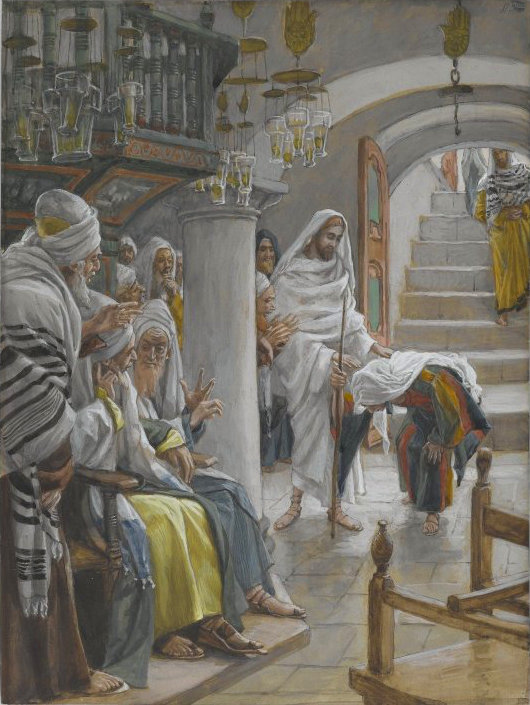
Now he was teaching in one of the synagogues on the sabbath. And there was a woman who had had a spirit of infirmity for eighteen years; she was bent over and could not fully straighten herself.
And when Jesus saw her, he called her and said to her, “Woman, you are freed from your infirmity.” And he laid his hands upon her, and immediately she was made straight, and she praised God.
But the ruler of the synagogue, indignant because Jesus had healed on the sabbath, said to the people, “There are six days on which work ought to be done; come on those days and be healed, and not on the sabbath day.”
Then the Lord answered him, “You hypocrites! Does not each of you on the sabbath untie his ox or his ass from the manger, and lead it away to water it?
And ought not this woman, a daughter of Abraham whom Satan bound for eighteen years, be loosed from this bond on the sabbath day?”
As he said this, all his adversaries were put to shame; and all the people rejoiced at all the glorious things that were done by him.
What do the Fathers say?
St CYRIL OF ALEXANDRIA. the Incarnation of the Word was manifested to destroy corruption and death, and the hatred of the devil against us, is plain from the actual events; for it follows, And there was a woman who had had a spirit of infirmity. He says spirit of infirmity, because the woman suffered from the cruelty of the devil, forsaken by God because of her own crimes or for the transgression of Adam, on account of which the bodies of men incur infirmity and death.
But God gives this power to the Devil, to the end that men when pressed down by the weight of their adversity might betake them to better things. He points out the nature of her infirmity, saying, she was bent over and could not fully straighten herself.
But our Lord, to show that His coming into this world was to be the loosening of human infirmities, healed this woman. Hence it follows, And when Jesus saw her, he called her to him, and said to her, “Woman, you are freed from your infirmity.” A word most suitable to God, full of heavenly majesty; for by His royal assent He dispels the disease.
And he laid his hands upon her, and immediately she was made straight, and she praised God.We should here answer, that the Divine power had put on the sacred flesh. For it was the flesh of God Himself, and of no other,
But the ungrateful ruler of the synagogue, when he saw the woman, who before was creeping on the ground, now by Christ’s single touch made upright, and relating the mighty works of God, sullies his zeal for the glory of the Lord with envy, and condemns the miracle, that he might appear to be jealous for the Sabbath. he said to the people, There are six days in which men ought to work, and not on the sabbath-day. He would have those who are dispersed about on the other days, and engaged in their own works, not come on the Sabbath to see and admire our Lord’s miracles, lest by chance they should believe.
But the law has not forbidden all manual work on the Sabbath-day, and has it forbidden that which is done by a word or the mouth? Cease then both to eat and drink and speak and sing. And if you do not read the law, how is it a Sabbath to you? But supposing the law had forbidden manual works, how is it a manual work to raise a woman upright by a word?
Now the ruler of the synagogue is convicted as a hypocrite, in that he leads his cattle to watering on the Sabbath-day, but this woman, not more by birth than by faith the daughter of Abraham, he thought unworthy to be loosed from the chain of her infirmity.
The ruler preferred that this woman should, like the beasts, rather look upon the earth than receive her natural stature, provided that Christ was not magnified.
But they had nothing to answer; they themselves unanswerably condemned themselves. Hence it follows, And when he had said these things, all his adversaries were ashamed. But the people, reaping great good from His miracles, rejoiced at the signs which they saw, For the glory of His works vanquished every scruple in them who sought Him not with corrupt hearts.
Pope St GREGORY the Great. For every sinner who thinks earthly things, not seeking those that are in heaven, is unable to look up. For while pursuing his baser desires, he declines from the uprightness of his state; or his heart is bent crooked, and he ever looks upon that which he unceasingly thinks about.
The Lord called her and made her upright, for He enlightened her and succoured her. He sometimes calls but does not make upright, for when we are enlightened by grace, we oftentimes see what should be done, but because of sin do not practise it. For habitual sin binds down the mind, so that it cannot rise to uprightness. It makes attempts and fails, because when it has long stood by its own will, when the will is lacking, it falls.
Sources:
Bible readings from the Revised Standard Version of the Bible, Second Catholic Edition, copyright © 2006 National Council of the Churches of Christ in the USA
Quotes of the Fathers from Thomas Aquinas’ Catena Aurea Translated by St John Henry Newman
Artwork ex Wikimedia Commons