
15 October
“We shall never learn to know ourselves except by endeavouring to know God; for, beholding his greatness, we realize our own littleness; his purity shows us our foulness; and by meditating upon his humility we find how very far we are from being humble.” – St Teresa.
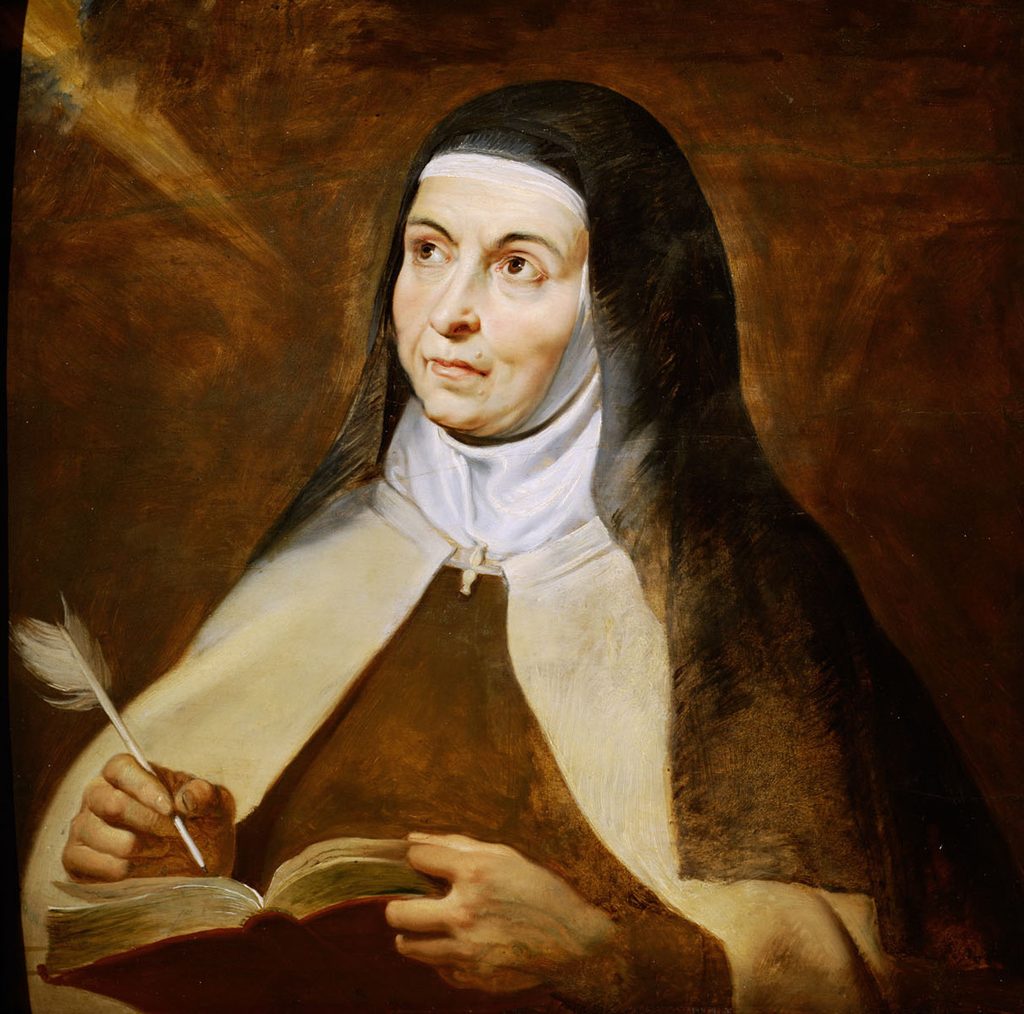
Saint Teresa of Avila
Saint Teresa of Jesus (1515–1582), also known as Saint Teresa of Ávila, was a Spanish Carmelite nun, mystic, author, and monastic reformer. Alongside Saint John of the Cross, she spearheaded the Carmelite Reform and was declared the first female Doctor of the Church by Pope Paul VI in 1970.
Early Life and Youth
- Birth & Background: Born Teresa Sánchez de Cepeda y Ahumada on March 28, 1515, in Ávila, Spain, to a noble Castilian family. Her paternal grandfather was a Jewish merchant who converted to Christianity.
- Early Piety & Reading: As a young child, she displayed a romantic and zealous imagination, captivated by tales of chivalry and stories of Christian martyrs. At age seven, she and her brother Rodrigo attempted to run away from home to seek martyrdom fighting the Moors.
- Adolescence: Following her mother’s death when Teresa was 13, her father sent her to study at the Augustinian convent of Our Lady of Grace in Ávila.
Monastic Entry and Spiritual Crisis
- The Convent of the Incarnation: In 1535, despite her father’s initial resistance, Teresa entered the Carmelite Convent of the Incarnation in Ávila, taking her vows in 1537.
- Illness & Recovery: Shortly after taking her vows, she fell dangerously ill, experiencing a four-day coma and three years of partial paralysis. She attributed her eventual recovery to Saint Joseph.
- Period of Mediocrity: The Convent of the Incarnation practiced a lax, “mitigated” rule. For nearly two decades, Teresa struggled with worldly distractions, social parlor visits, and intermittent prayer, describing this period as a prolonged spiritual stalemate.
The “Second Conversion” and Mystical Experiences
- The Transverberation: Around 1554–1556, Teresa experienced a profound interior conversion while praying before an image of the wounded Christ (Ecce Homo) and reading St. Augustine’s Confessions.
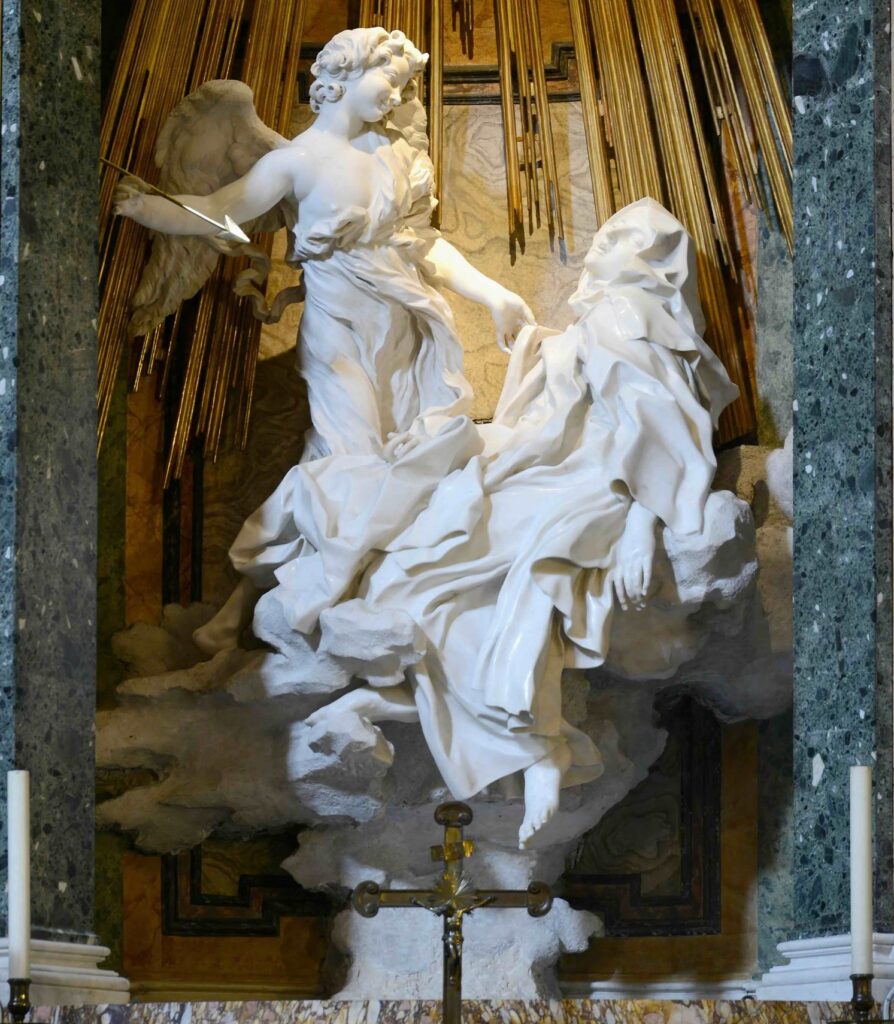
- Mystical Visions: She began experiencing interior locutions, ecstasies, and visions. Most famous among these was the transverberation—a vision in which an angel pierced her heart with a golden lance of divine love, a scene famously sculpted in marble by Gian Lorenzo Bernini (The Ecstasy of Saint Teresa)
- Ecclesiastical Scrutiny: Her visions initially faced skepticism from eccleiastical directors who feared demonic deception, but Jesuit confessors (including St. Francis Borgia) and Franciscan friars (including St. Peter of Alcántara) validated her divine experiences.
The Discalced Carmelite Reform
- Return to the Primitive Rule: Seeking a life of stricter contemplative poverty, silence, and enclosure, Teresa resolved to reform the Carmelite Order to its original “primitive” rule.
- Foundation of St. Joseph’s: In 1562, despite intense local opposition and lawsuits, she founded her first reformed convent, St. Joseph’s in Ávila. The members wore simple robes and hemp sandals, giving them the name Discalced (“barefoot”) Carmelites.
- Expansion Across Spain: Over the next 20 years, Teresa traveled extensively across Spain, establishing 17 reformed convents for women. Partnering with St. John of the Cross, she also established the male branch of Discalced Carmelite friars.
Writings and Theological Legacy
Teresa wrote extensively to instruct her nuns in mental prayer and to document her mystical theology:
- The Book of Her Life (Libro de la Vida): Her spiritual autobiography written under obedience to her confessors.
- The Way of Perfection (Camino de Perfección): A practical guide on prayer, humility, and monastic life written for her sisters.
- The Interior Castle (El Castillo Interior): Her spiritual masterpiece, using the allegory of a castle with seven mansions to outline the soul’s journey from vocal prayer to full mystical union with God.
- The Foundations (Libro de las Fundaciones): An account of her journeys and the establishment of her monasteries.
Death, Canonization, and Doctor of the Church
- Death: Teresa died on the night of October 4, 1582, at Alba de Tormes at the age of 67. Due to the adoption of the Gregorian calendar that exact night, the calendar jumped from October 4 to October 15, which became her official feast day.
- Canonization: She was beatified in 1614 by Pope Paul V and canonized on March 12, 1622, by Pope Gregory XV (alongside St. Ignatius of Loyola and St. Francis Xavier).
- Doctor of the Church: On September 27, 1970, Pope Paul VI declared her a Doctor of the Church, making her the first woman in Catholic Church history to receive this title.
Sources:
Catholic Encyclopaedia
Wikipedia
Saint Teresa of Jesus’ Interior Castle and
The Book of Her Life
Artwork ex Wikimedia Commons