
14 October
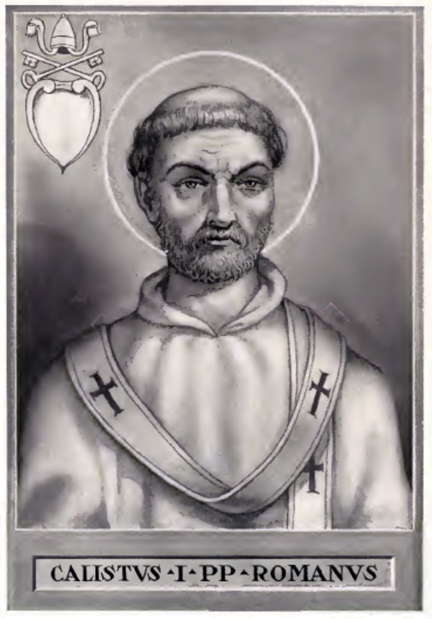
The Lives and Times of the Popes by Chevalier Artaud de Montor, New York: The Catholic Publication Society of America, 1911.
Much of what is known about the early life of Saint Callistus I comes ironically from his bitter rival, Hippolytus of Rome. In his polemical treatise Refutation of All Heresies, Hippolytus attempted to discredit Callistus by detailing his turbulent early life before his election as Pope.
However, Johann Joseph Ignaz von Döllinger,, A historian and theologian,and Giovanni Battista de Rossi, A distinguished Christian archaeologist, best known for his work in connection with the Roman catacombs refute much of the scandal detailed by Hippolytus.
Early Life & Financial Misfortunes
- Slavery: Callistus was born a slave in Rome during the late 2nd century to a master named Carpophorus, who was a Christian of Caesar’s household.
- The Failed Bank: Carpophorus entrusted Callistus with managing a bank or deposit office in the Piscina Publica region of Rome, where fellow Christians and widows deposited their savings. The venture went bankrupt.
- Escape & Capture: Fearing his master’s wrath, Callistus fled to the port of Portus and boarded a ship. When Carpophorus pursued him, Callistus jumped into the sea in desperation, but he was pulled out, arrested, and sentenced to hard labour on a pistrinum (grinding treadmill).
Döllinger and de Rossi: To begin with, Hippolytus does not say that Callistus by his own fault lost the money deposited with him. He evidently jumped from the vessel rather to escape than to commit suicide.
That Carpophorus, a Christian, should commit a Christian slave to the horrible punishment of the pistrinum does not speak well for the master’s character.
Brawling in the Synagogue & the Mines of Sardinia
- The Synagogue Incident: After Christian depositors interceded for his release—hoping he could recover their money—Callistus attempted to collect debts owed to him by local Roman Jews. He went into a synagogue on the Sabbath, created a public disturbance, and was arrested by the city prefect, Fuscianus.
- Sentenced to the Mines: Condemned as a disturber of public peace, Callistus was severely flogged and sentenced to forced labor in the deadly penal mines of Sardinia.
- Amnesty & Freedom: Around 190 AD, Marcia, the Christian concubine of Emperor Commodus, secured the release of many Christian confessors in Sardinia. Although Callistus’ name was not on the original list, he persuaded the governor to release him along with the others.
Return to Rome & Rise in the Church
- Restoration: Recognizing that Callistus was physically broken from years of hard labor, Pope Victor I gave him a monthly pension and sent him to Antium to recover his health.
- Archdeacon of Rome: When St. Zephyrinus became Pope in 199 AD, he recalled Callistus to Rome, ordained him a deacon, and put him in charge of the official Christian burial ground along the Appian Way (now the Catacombs of St. Callixtus). Callistus organized and expanded the catacombs into the Church’s first major corporate property.
- Election to the Papacy: Upon Zephyrinus’ death in 217 AD, Callistus was elected Bishop of Rome.
- The anti-pope: This triggered a schism led by Hippolytus, who opposed Callistus’ lenient penance policies and set himself up as the first anti-pope in history.
Döllinger and de Rossi: Callistus could hardly have raised himself so high without considerable talents, and the vindictive spirit exhibited by Hippolytus and his defective theology explain why Zephyrinus placed his confidence rather in Callistus than in the learned Hippolytus.
It is clear that the Catholic church sides with Callistus against the schismatic Hippolytus. Not a word has been said against the character of Callistus since his promotion, nor against the validity of his election.
Death & Burial
According to early traditions (including the Acts of Saint Callistus), Callistus was killed during a popular anti-Christian riot in the Trastevere district around 222 AD. He was reportedly starved in prison, thrown down a deep well with a stone tied around his neck.
Asterius the Priest: The Acts recount that a Roman priest named Asterius recovered Callistus’s body from the well at night and gave him a secret burial. For this act, Asterius was subsequently arrested by the prefect Alexander and executed by being thrown off a bridge into the Tiber River.
Sources:
Dollinger and de Rossi quotes ex Catholic Encyclopaedia
Wikipedia