
Saturday of the Fifth week in Lent
John 11:45-56
“It is expedient for you that one man should die for the people, and that the entire nation should not perish.”
Therefore, many of the Jews, who had come to Mary and Martha, and who had seen the things that Jesus did, believed in him.
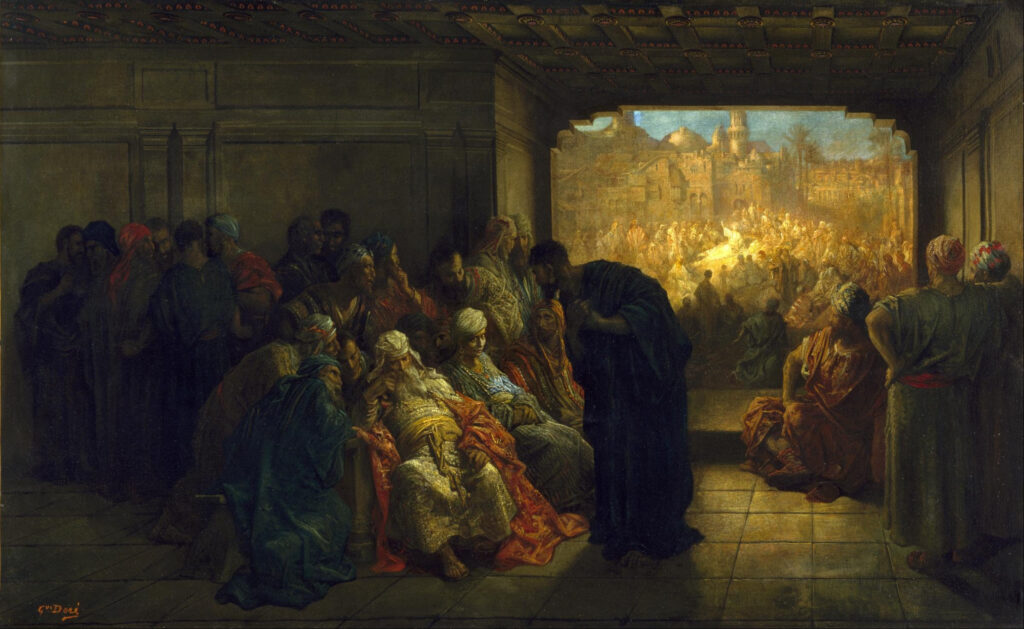
But certain ones among them went to the Pharisees and told them the things that Jesus had done. And so, the high priests and the Pharisees gathered a council, and they were saying: “What can we do? For this man accomplishes many signs. If we leave him alone, in this way all will believe in him. And then the Romans will come and take away our place and our nation.”
Then one of them, named Caiaphas, since he was the high priest that year, said to them: “You do not understand anything.
Nor do you realize that it is expedient for you that one man should die for the people, and that the entire nation should not perish.”
Yet he did not say this from himself, but since he was the high priest that year, he prophesied that Jesus would die for the nation. And not only for the nation, but in order to gather together as one the children of God who had been dispersed.
Therefore, from that day, they planned to put him to death. And so, Jesus no longer walked in public with the Jews. But he went into a region near the desert, to a city which is called Ephraim. And he lodged there with his disciples.
Now the Passover of the Jews was near. And many from the countryside ascended to Jerusalem before the Passover, so that they might sanctify themselves.
Therefore, they were seeking Jesus. And they conferred with one another, while standing in the temple: “What do you think? Will he come to the feast day?”
And the high priests and Pharisees had given an order, so that if anyone would know where he may be, he should reveal it, so that they might apprehend him.
What do the Fathers say?
The Venerable BEDE. By those who went and told the Pharisees, are meant those who seeing the good works of God’s servants, hate them on that very account, persecute, and calumniate them.
St THEOPHYLACT. Such a miracle as this should have drawn forth wonder and praise. But they make it a reason of plotting against His life.
St John CHRYSOSTOM. And Him of whose divinity they had received such certain proofs, they call only a man.
ORIGEN. Caiaphas’ speech is evidence of their audacity and blindness:
of their audacity, because they testified that He had done many miracles, and yet thought that they could contend successfully against Him, and that He would have no power of withstanding their plots;
of their blindness, because they did not reflect that He who had wrought such miracles could easily escape out of their hands.
They resolved then not to let Him go; thinking that they should thus place an impediment in the way of those who wished to believe in Him, and also prevent the Romans from taking away their place and nation.
Not every one that prophesies is a prophet; as not every one that does a just action is just.
St AUGUSTINE. They were afraid that, if all believed in Christ, none would remain to defend the city of God and the temple against the Romans: since they thought that Christ’s teaching was directed against the temple, and their laws.
They were afraid of losing temporal things, and thought not of eternal life; and thus they lost both. For the Romans, after our Lord had suffered and was glorified, did come and take away their place and nation, reducing the one by siege, and dispersing the other.
St THEOPHYLACT. Although he said this with a bad intention, yet the Holy Spirit used his mouth as the vehicle of a prophecy: And this he spoke not of himself: but being high priest that year, he prophesied that Jesus should die for that nation.