
Saturday of the Second week in Lent
Luke 15:1-3, 11-32
“For this brother of yours was dead, and has revived; he was lost, and is found. ”
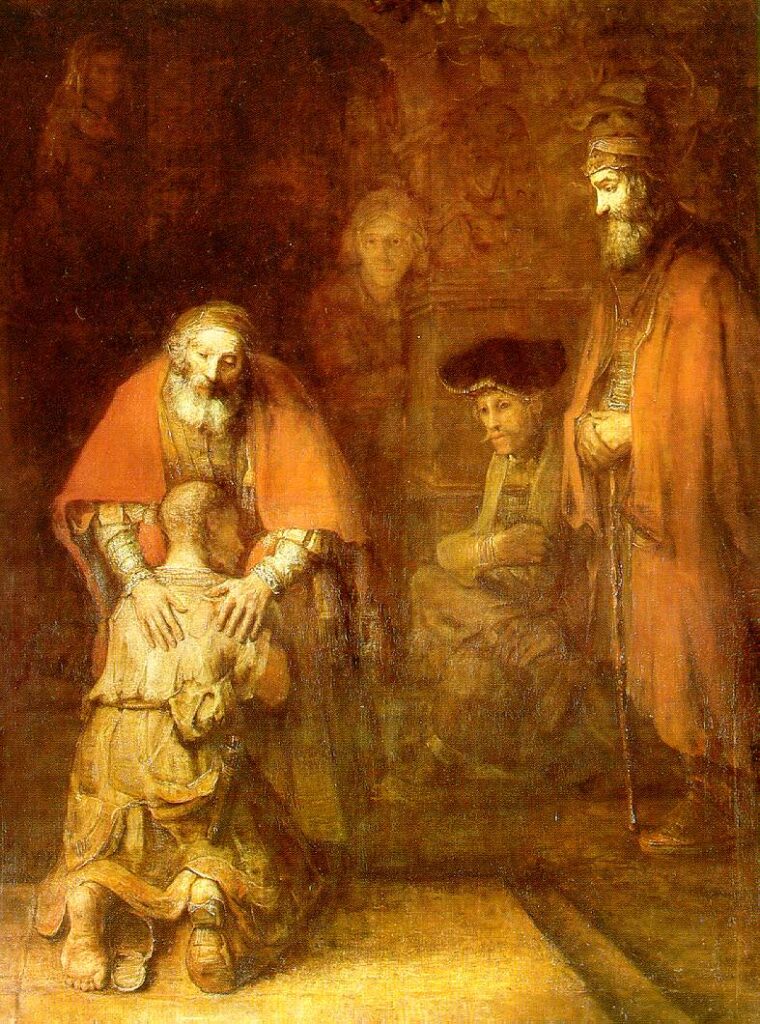
Now tax collectors and sinners were drawing near to him, so that they might listen to him. And the Pharisees and the scribes murmured, saying, “This one accepts sinners and eats with them.”
And he told this parable to them, saying
“A certain man had two sons. And the younger of them said to the father, ‘Father, give me the portion of your estate which would go to me.’ And he divided the estate between them.
And after not many days, the younger son, gathering it all together, set out on a long journey to a distant region. And there, he dissipated his substance, living in luxury. And after he had consumed it all, a great famine occurred in that region, and he began to be in need. And he went and attached himself to one of the citizens of that region. And he sent him to his farm, in order to feed the swine. And he wanted to fill his belly with the scraps that the swine ate. But no one would give it to him.
And returning to his senses, he said: ‘How many hired hands in my father’s house have abundant bread, while I perish here in famine!
I shall rise up and go to my father, and I will say to him: Father, I have sinned against heaven and before you. I am not worthy to be called your son. Make me one of your hired hands.’
And rising up, he went to his father. But while he was still at a distance, his father saw him, and he was moved with compassion, and running to him, he fell upon his neck and kissed him.
And the son said to him: ‘Father, I have sinned against heaven and before you. Now I am not worthy to be called your son.’
But the father said to his servants: ‘Quickly! Bring out the best robe, and clothe him with it. And put a ring on his hand and shoes on his feet. And bring the fatted calf here, and kill it. And let us eat and hold a feast. For this son of mine was dead, and has revived; he was lost, and is found.’ And they began to feast.
But his elder son was in the field. And when he returned and drew near to the house, he heard music and dancing. And he called one of the servants, and he questioned him as to what these things meant. And he said to him: ‘Your brother has returned, and your father has killed the fatted calf, because he has received him safely.’ Then he became indignant, and he was unwilling to enter. Therefore, his father, going out, began to plead with him.
And in response, he said to his father: ‘Behold, I have been serving you for so many years. And I have never transgressed your commandment. And yet, you have never given me even a young goat, so that I might feast with my friends.
Yet after this son of yours returned, who has devoured his substance with loose women, you have killed the fatted calf for him.’
But he said to him: ‘Son, you are with me always, and all that I have is yours. But it was necessary to feast and to rejoice. For this brother of yours was dead, and has revived; he was lost, and is found.’ ”
What do the Fathers say?
St John CHRYSOSTOM. Now the Scripture says, that the father divided equally between his two sons his substance, that is, the knowledge of good and evil, which is a true and everlasting possession to the soul that uses it well. The substance of reason which flows from God to men at their earliest birth, is given equally to all who come into this world, but after the intercourse that follows, each one is found to possess more or less of the substance; since one believing that which he has received to be from his father, preserves it as his patrimony, another abuses it as something that may be wasted away.
But the freedom of will is shown in that the father neither kept back the son who wished to depart, nor forced the other to go that desired to remain, lest he should seem rather the author of the evil that followed.
But the youngest son went afar off, not only by changing his place, but by turning aside his heart.
He who is destitute of spiritual riches, such as wisdom and understanding, is said to feed swine, that is, to nourish in his soul sordid and unclean thoughts, and he devours the material food of evil conversation, sweet indeed to him who lacks good works, because every work of carnal pleasure seems sweet to the depraved, while it inwardly unnerves and destroys the powers of the soul.
St AMBROSE. How merciful! He, who though offended, disdains not to hear the name of Father.
I have sinned; – this is the first confession of sin to the Author of nature, the Ruler of mercy, the Judge of faith. But although God knows all things. He waits for the voice of your confession; for with the mouth confession is made to salvation.
In vain would you hide from Him whom nothing escapes; and you may safely discover what you know to be already known.
Confess; so that Christ may intercede for you, the Church plead for you, the people weep over you. Do not fear that you wilt not obtain it; thy Advocate promises pardon, thy Patron favour, thy Deliverer promises thee the reconciliation of thy Father’s affection.
St John CHRYSOSTOM. After he said, I will go to my father, he tarried not, but undertook the whole journey. Let us do likewise, and not be wearied with the length of the way, for if we are willing, the return will become swift and easy, provided that we desert sin, which led us out from our father’s house. For the father pities those who return.
Now the father perceiving his penitence did not wait to receive the words of his confession, but anticipates his supplication.
For what else can it mean that he ran, but that we through the hindrance of our sins cannot by our own virtue reach to God. But because God is able to come to the weak, he fell on his neck. The mouth is kissed, as that from which has proceeded the confession of the penitent, springing from the heart, which the father gladly received.
He orders the ring to be given, which is the symbol of the seal of salvation, or rather the badge of betrothment, and pledge of the nuptials with which Christ espouses His Church. Since the soul that recovers is united by this ring of faith to Christ.
The father himself rejoices in the return of his son, and feasts on the calf, because the Creator, rejoicing in the acquisition of a believing people, feasts on the fruit of His mercy by the sacrifice of His Son.
This parable then was written to the end that sinners should not despair of returning, knowing that they shall obtain great things. Therefore he introduces others so troubled at these good things as to be consumed with envy, but those who return, are treated with such great honour as to become themselves an object of envy to others.
AMBROSE. But the younger son, that is the Gentile people, is envied by Israel as the elder brother, of the privilege of his father’s blessing.