
Third Sunday in Lent
John 4:5-42
“All who drink from this water will thirst again. But whoever shall drink from the water that I will give to him will not thirst for eternity. Instead, the water that I will give to him will become in him a fountain of water, springing up into eternal life.”
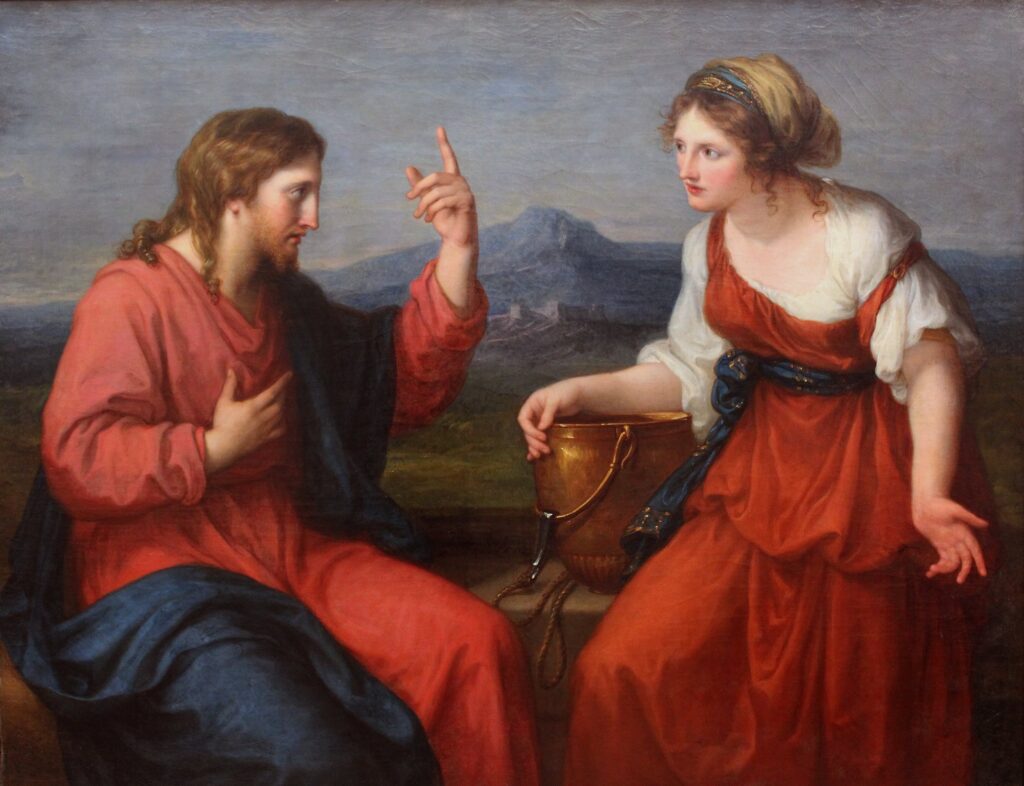
Now he needed to cross through Samaria. Therefore, he went into a city of Samaria which is called Sychar, near the estate which Jacob gave to his son Joseph.
And Jacob’s well was there. And so Jesus, being tired from the journey, was sitting in a certain way on the well. It was about the sixth hour.
A woman of Samaria arrived to draw water. Jesus said to her, “Give me to drink.” For his disciples had gone into the city in order to buy food.
And so, that Samaritan woman said to him, “How is it that you, being a Jew, are requesting a drink from me, though I am a Samaritan woman?”
For the Jews do not associate with the Samaritans.
Jesus responded and said to her: “If you knew the gift of God, and who it is who is saying to you, ‘Give me to drink,’ perhaps you would have made a request of him, and he would have given you living water.”
The woman said to him: “Lord, you do not have anything with which to draw water, and the well is deep. From where, then, do you have living water? Surely, you are not greater than our father Jacob, who gave us the well and who drank from it, with his sons and his cattle?”
Jesus responded and said to her: “All who drink from this water will thirst again. But whoever shall drink from the water that I will give to him will not thirst for eternity. Instead, the water that I will give to him will become in him a fountain of water, springing up into eternal life.”
The woman said to him, “Lord, give me this water, so that I may not thirst and may not come here to draw water.”
Jesus said to her, “Go, call your husband, and return here.” The woman responded and said, “I have no husband.” Jesus said to her: “You have spoken well, in saying, ‘I have no husband.’ For you have had five husbands, but he whom you have now is not your husband. You have spoken this in truth.”
The woman said to him: “Lord, I see that you are a Prophet. Our fathers worshipped on this mountain, but you say that Jerusalem is the place where one ought to worship.”
Jesus said to her: “Woman, believe me, the hour is coming when you shall worship the Father, neither on this mountain, nor in Jerusalem.
You worship what you do not know; we worship what we do know. For salvation is from the Jews. But the hour is coming, and it is now, when true worshippers shall worship the Father in spirit and in truth. For the Father also seeks such persons who may worship him. God is Spirit. And so, those who worship him must worship in spirit and in truth.”
The woman said to him: “I know that the Messiah is coming (who is called the Christ). And then, when he will have arrived, he will announce everything to us.” Jesus said to her: “I am he, the one who is speaking with you.”
And then his disciples arrived. And they wondered that he was speaking with the woman. Yet no one said: “What are you seeking?” or, “Why are you talking with her?”
And so the woman left behind her water jar and went into the city. And she said to the men there: “Come and see a man who has told me all the things that I have done. Is he not the Christ?” Therefore, they went out of the city and came to him.
Meanwhile, the disciples petitioned him, saying, “Rabbi, eat.” But he said to them, “I have food to eat which you do not know.”
Therefore, the disciples said to one another, “Could someone have brought him something to eat?” Jesus said to them: “My food is to do the will of the One who sent me, so that I may perfect his work.
Do you not say, ‘There are still four months, and then the harvest arrives?’ Behold, I say to you: Lift up your eyes and look at the countryside; for it is already ripe for the harvest. For he who reaps, receives wages and gathers fruit unto eternal life, so that both he who sows and he who reaps may rejoice together. For in this the word is true: that it is one who sows, and it is another who reaps. I have sent you to reap that for which you did not labour. Others have laboured, and you have entered into their labours.”
Now many of the Samaritans from that city believed in him, because of the word of the woman who was offering testimony: “For he told me all the things that I have done.” Therefore, when the Samaritans had come to him, they petitioned him to lodge there. And he lodged there for two days. And many more believed in him, because of his own word.
And they said to the woman: “Now we believe, not because of your speech, but because we ourselves have heard him, and so we know that he is truly the Saviour of the world.”
What do the Fathers say?
St THEOPHYLACT. But why does the Evangelist make mention of the parcel of ground, and the well? Firstly, to explain what the woman says, Our father Jacob gave us this well: secondly, to remind you that what the Patriarchs obtained by their faith in God, the Jews had lost by their impiety. They had been supplanted to make room for Gentiles. And therefore there is nothing new in what has now taken place, i. e. in the Gentiles succeeding to the kingdom of heaven in the place of the Jews.
The grace of the Holy Spirit then Jesus calls living water; i. e. life-giving, refreshing, stirring. For the grace of the Holy Spirit is ever stirring him who does good works, directing the risings of his heart.
For the water which I give him is ever multiplying. The saints receive through grace the seed and principle of good; but they themselves make it grow by their own cultivation.
Our Lord, knowing that the woman of Samaria was bringing the whole town out to Him, tells His disciples, I have food to eat that you do not know i. e. do you not know that I call the salvation of men food; or that the Samaritans are about to believe and be saved.
St John CHRYSOSTOM. The salvation of men He calls His food, showing His great desire that we should be saved. As food is an object of desire to us, so was the salvation of men to Him.
St THEOPHYLACT. From the question of the disciples, Has any man brought Him ought to eat, we may infer that our Lord was accustomed to receive food from others, when it was offered Him: not that He who gives food to all flesh, (Ps. 146.) needed any assistance; but He received it, that they who gave it might obtain their reward. It is proper and necessary that teachers should depend on others to provide them with food, in order that, being free from all other cares, they may attend the more to the ministry of the word.
He finished the work of God, i. e. man, He, the Son of God, finished it by exhibiting our nature in Himself without sin, perfect and uncorrupt. He finished also the work of God, i. e. the Law, (Rom. 10:4) (for Christ is the end of the Law,) by abolishing it, when every thing in it had been fulfilled, and changing a carnal into a spiritual worship.
St John CHRYSOSTOM. I sent you to reap that whereon you had bestowed no labour, i. e. I have reserved you for a favourable time, in which the labour is less, the enjoyment greater. The more laborious part of the work was laid on the Prophets, viz. the sowing of the seed: Other men laboured, and ye are entered into their labours. Christ here throws light on the meaning of the old prophecies. He shows that both the Law and the Prophets, if rightly interpreted, led men to Him; and that the Prophets were sent in fact by Himself. Thus the intimate connexion is established between the Old Testament and the New.