
Monday of the Third week in Lent
Luke 4:24-30
“No prophet is accepted in his own country.”
Then he said: “Amen I say to you, that no prophet is accepted in his own country.
In truth, I say to you, there were many widows in the days of Elijah in Israel, when the heavens were closed for three years and six months, when a great famine had occurred throughout the entire land. And to none of these was Elijah sent, except to Zarephath of Sidon, to a woman who was a widow.
And there were many lepers in Israel under the prophet Elisha. And none of these was cleansed, except Naaman the Syrian.”
And all those in the synagogue, upon hearing these things, were filled with anger.
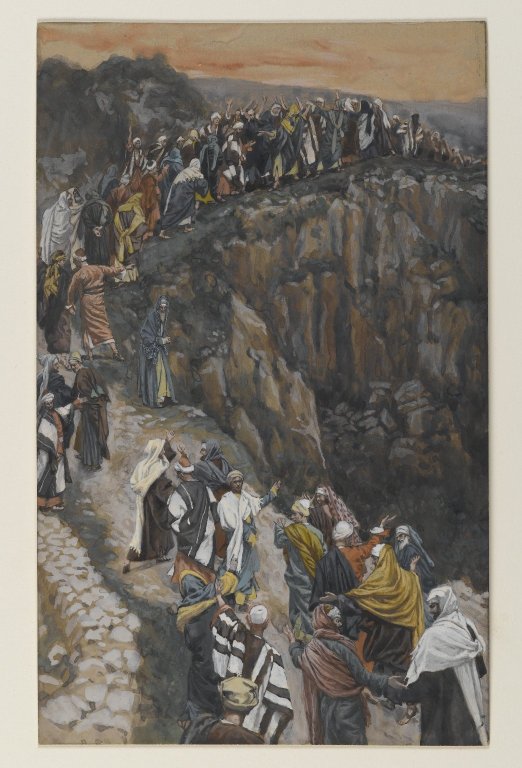
And they rose up and drove him beyond the city. And they brought him all the way to the edge of the mount, upon which their city had been built, so that they might throw him down violently. But passing through their midst, he went away.
What do the Fathers say?
St AMBROSE:
– But this is given for an example, that in vain can you expect the aid of Divine mercy, if you grudge to others the fruits of their virtue.
– The Lord despises the envious, and withdraws the miracles of His power from them that are jealous of His divine blessings in others. For our Lord’s Incarnation is evidence of His divinity, and His invisible things are proved to us by those which are visible.
– See then what evils envy produces. Because of envy a country is deemed unworthy of the works of its citizen, which was worthy of the conception of the Son of God.
– By a very apt comparison the arrogance of envious citizens is put to shame, and our Lord’s conduct shown to agree with the ancient Scriptures.
– It can not be wondered at that they lost their salvation who cast the Saviour out of their city. But the Lord who taught His Apostles by the example of Himself to be all things to all men, neither repels the willing, nor chooses the unwilling; neither struggles against those who cast Him out, nor refuses to hear those who supplicate Him. But that conduct was the result of no slight enmity, which, forgetful of the feelings of fellow citizens, converts the causes of love into the bitterest hatred. For when the Lord Himself was extending His blessings among the people, they began to inflict injuries upon Him, as it follows, And they led him unto the brow of the hill, that they might cast him down.
– At the same time we must understand that this bodily endurance was not necessary, but voluntary. When He wills, He is taken, when He wills, He escapes.