
Saturday of the Third week in Lent
Luke 18:9-14
“For everyone who exalts himself will be humbled; and whoever humbles himself will be exalted.”
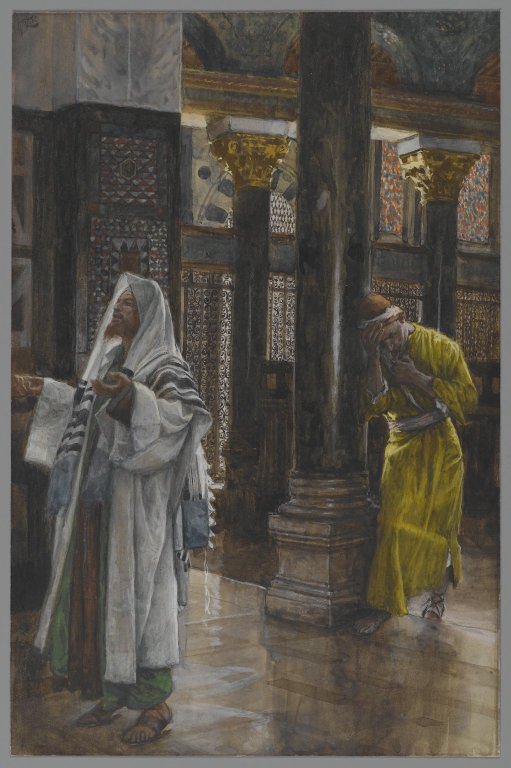
Now about certain persons who consider themselves to be just, while disdaining others, he told also this parable:
“Two men ascended to the temple, in order to pray. One was a Pharisee, and the other was a tax collector.
Standing, the Pharisee prayed within himself in this way: ‘O God, I give thanks to you that I am not like the rest of men: robbers, unjust, adulterers, even as this tax collector chooses to be. I fast twice between Sabbaths. I give tithes from all that I possess.’
And the tax collector, standing at a distance, was not willing to even lift up his eyes to heaven. But he struck his chest, saying: ‘O God, be merciful to me, a sinner.’
I say to you, this one descended to his house justified, but not the other. For everyone who exalts himself will be humbled; and whoever humbles himself will be exalted.”
What do the Fathers say?
St AUGUSTINE. Since faith is not a gift of the proud but of the humble, our Lord proceeds to add a parable concerning humility and against pride.
Let those hear who say, “God has made me man, I made myself righteous. O worse and more hateful than the Pharisee, who proudly called himself righteous, yet gave thanks to God that he was so.
St THEOPHYLACT. Pride also beyond all other passions disturbs the mind of man. And hence the very frequent warnings against it. It is moreover a contempt of God; for when a man ascribes the good he does to himself and not to God, what else is this but to deny God?
St GREGORY the Great. There are different shapes in which the pride of self-confident men presents itself; when they imagine that either the good in them is of themselves; or when believing it is given them from above, that they have received it for their own merits.
St John CHRYSOSTOM. This parable represents to us two chariots on the race course, each with two charioteers in it. In one of the chariots it places righteousness with pride, in the other sin and humility. You see the chariot of sin outstrip that of righteousness, not by its own strength but by the excellence of humility combined with it, but the other is defeated not by righteousness, but by the weight and swelling of pride.For as humility by its own elasticity rises above the weight of pride, and leaping up reaches to God, so pride by its great weight easily depresses righteousness.
If you are earnest and constant in doing good, yet think that you can boast about it , you are altogether devoid of the fruits of prayer.
But if you that bear a thousand loads of guilt on your conscience, and only think this thing of yourself – that you are the lowest of all men, you shall gain much confidence before God.
This inflation of pride can cast down even from heaven the man that does not take warning, but humility can raise a man up from the lowest depth of guilt.
The one saved the Tax Collector before the Pharisee, and brought the thief into Paradise before the Apostles. If humility added to sin has made such rapid advances, as to pass by pride united to righteousness, how much swifter will be its course when you add to it righteousness?
It will stand by the judgment-seat of God in the midst of the angels with great boldness.
Moreover if pride joined to righteousness had power to depress it, into what a hell will it thrust men when added to sin?
This I say not that we should neglect righteousness, but that we should avoid pride.