
John 18:1-19:42
When Jesus had said these things, he departed with his disciples across the Torrent of Kidron, where there was a garden, into which he entered with his disciples.
But Judas, who betrayed him, also knew the place, for Jesus had frequently met with his disciples there. Then Judas, when he had received a cohort from both the high priests and the attendants of the Pharisees, approached the place with lanterns and torches and weapons.
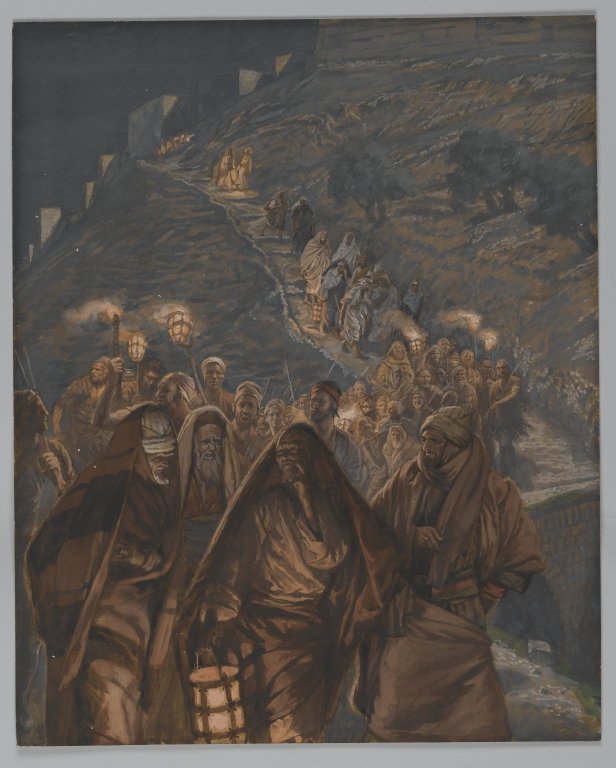
And so Jesus, knowing all that was about to happen to him, advanced and said to them, “Who are you seeking?” They answered him, “Jesus the Nazarene.” Jesus said to them, “I am he.” Now Judas, who betrayed him, was also standing with them. Then, when he said to them, “I am he,” they moved back and fell to the ground.
Then again he questioned them: “Who are you seeking?” And they said, “Jesus the Nazarene.” Jesus responded: “I told you that I am he. Therefore, if you are seeking me, permit these others to go away.” This was so that the word might be fulfilled, which he said, “Of those whom you have given to me, I have not lost any of them.”
Then Simon Peter, having a sword, drew it, and he struck the servant of the high priest, and he cut off his right ear. Now the name of the servant was Malchus.
Therefore, Jesus said to Peter: “Set your sword into the scabbard. Should I not drink the chalice which my Father has given to me?” Then the cohort, and the tribune, and the attendants of the Jews apprehended Jesus and bound him.
And they led him away, first to Annas, for he was the father-in-law of Caiaphas, who was the high priest that year. Now Caiaphas was the one who had given counsel to the Jews that it was expedient for one man to die for the people.
And Simon Peter was following Jesus with another disciple. And that disciple was known to the high priest, and so he entered with Jesus into the court of the high priest. But Peter was standing outside at the entrance. Therefore, the other disciple, who was known to the high priest, went out and spoke to the woman who was the doorkeeper, and he led in Peter. Therefore, the woman servant keeping the door said to Peter, “Are you not also among the disciples of this man?” He said, “I am not.”
Now the servants and attendants were standing before burning coals, for it was cold, and they were warming themselves. And Peter was standing with them also, warming himself.
Then the high priest questioned Jesus about his disciples and about his doctrine. Jesus responded to him: “I have spoken openly to the world. I have always taught in the synagogue and in the temple, where all the Jews meet. And I have said nothing in secret. Why do you question me? Question those who heard what I said to them. Behold, they know these things that I have said.”
Then, when he had said this, one the attendants standing nearby struck Jesus, saying: “Is this the way you answer the high priest?” Jesus answered him: “If I have spoken wrongly, offer testimony about the wrong. But if I have spoken correctly, then why do you strike me?”
And Annas sent him bound to Caiaphas, the high priest.
Now Simon Peter was standing and warming himself. Then they said to him, “Are you not also one of his disciples?” He denied it and said, “I am not.”
One of the servants of the high priest (a relative of him whose ear Peter had cut off) said to him, “Did I not see you in the garden with him?” Therefore, again, Peter denied it.
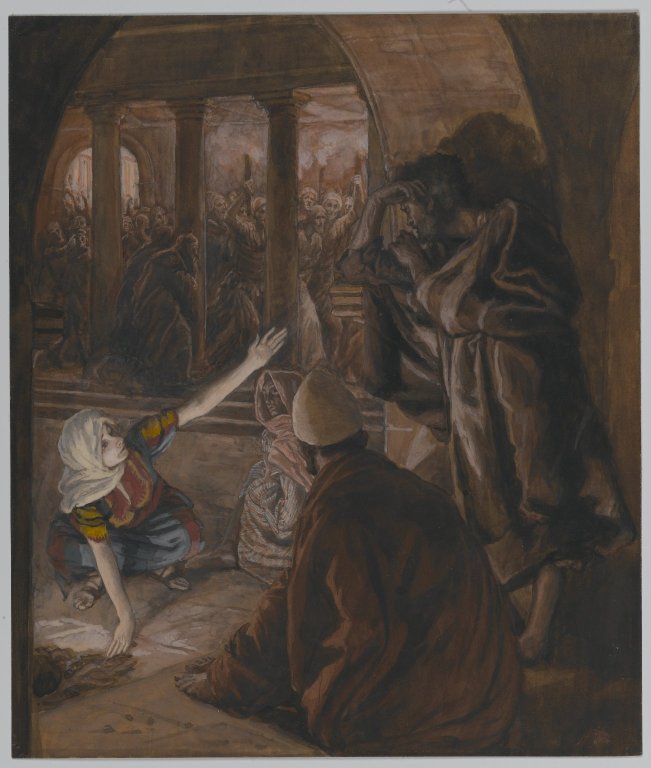
And immediately the rooster crowed.
Then they led Jesus from Caiaphas into the praetorium. Now it was morning, and so they did not enter into the praetorium, so that they would not be defiled, but might eat the Passover.
Therefore, Pilate went outside to them, and he said, “What accusation are you bringing against this man?” They responded and said to him, “If he were not an evil-doer, we would not have handed him over you.”
Therefore, Pilate said to them, “Take him yourselves and judge him according to your own law.”
Then the Jews said to him, “It is not lawful for us to execute anyone.”
This was so that the word of Jesus would be fulfilled, which he spoke signifying what kind of death he would die.
Then Pilate entered the praetorium again, and he called Jesus and said to him, “You are the king of the Jews?” Jesus responded, “Are you saying this of yourself, or have others spoken to you about me?”
Pilate responded: “Am I a Jew? Your own nation and the high priests have handed you over to me. What have you done?” Jesus responded: “My kingdom is not of this world. If my kingdom were of this world, my ministers would certainly strive so that I would not be handed over to the Jews. But my kingdom is not now from here.”
And so Pilate said to him, “You are a king, then?” Jesus answered, “You are saying that I am a king. For this I was born, and for this I came into the world: so that I may offer testimony to the truth. Everyone who is of the truth hears my voice.”
Pilate said to him, “What is truth?” And when he had said this, he went out again to the Jews, and he said to them, “I find no case against him. But you have a custom, that I should release someone to you at the Passover. Therefore, do you want me to release to you the king of the Jews?”
Then they all cried out repeatedly, saying: “Not this one, but Barabbas.” Now Barabbas was a robber.
Therefore, Pilate then took Jesus into custody and scourged him. And the soldiers, plaiting a crown of thorns, imposed it on his head. And they put a purple garment around him. And they were approaching him and saying, “Hail, king of the Jews!” And they struck him repeatedly.
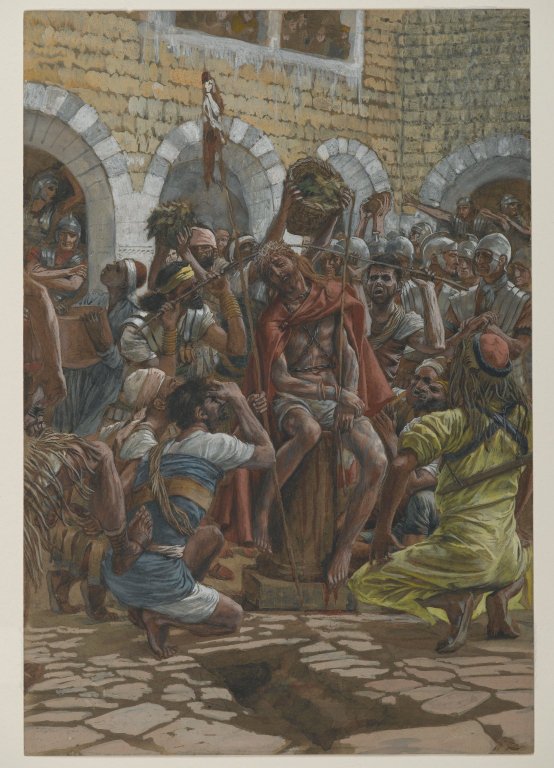
Then Pilate went outside again, and he said to them: “Behold, I am bringing him out to you, so that you may realize that I find no case against him.”
(Then Jesus went out, bearing the crown of thorns and the purple garment.) And he said to them, “Behold the man.”
Therefore, when the high priests and the attendants had seen him, they cried out, saying: “Crucify him! Crucify him!” Pilate said to them: “Take him yourselves and crucify him. For I find no case against him.”
The Jews answered him, “We have a law, and according to the law, he ought to die, for he has made himself the Son of God.”
Therefore, when Pilate had heard this word, he was more fearful. And he entered into the praetorium again. And he said to Jesus. “Where are you from?” But Jesus gave him no response.
Therefore, Pilate said to him: “Will you not speak to me? Do you not know that I have authority to crucify you, and I have authority to release you?” Jesus responded, “You would not have any authority over me, unless it were given to you from above. For this reason, he who has handed me over to you has the greater sin.”
And from then on, Pilate was seeking to release him. But the Jews were crying out, saying: “If you release this man, you are no friend of Caesar. For anyone who makes himself a king contradicts Caesar.”
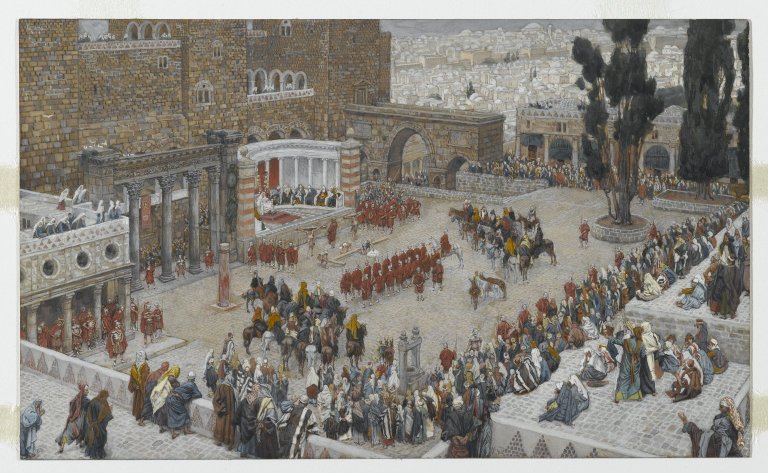
Now when Pilate had heard these words, he brought Jesus outside, and he sat down in the seat of judgment, in a place which is called the Pavement, but in Hebrew, it is called the Elevation.
Now it was the preparation day of the Passover, about the sixth hour. And he said to the Jews, “Behold your king.” But they were crying out: “Take him away! Take him away! Crucify him!”
Pilate said to them, “Shall I crucify your king?” The high priests responded, “We have no king except Caesar.”
Therefore, he then handed him over to them to be crucified. And they took Jesus and led him away. And carrying his own cross, he went forth to the place which is called Calvary, but in Hebrew it is called the Place of the Skull.
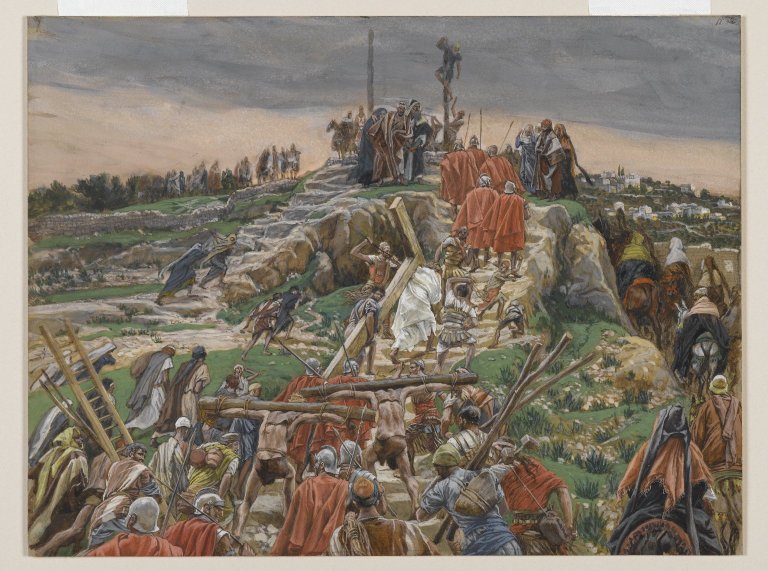
There they crucified him, and with him two others, one on each side, with Jesus in the middle. Then Pilate also wrote a title, and he set it above the cross. And it was written: JESUS THE NAZARENE, KING OF THE JEWS. Therefore, many of the Jews read this title, for the place where Jesus was crucified was close to the city. And it was written in Hebrew, in Greek, and in Latin.
Then the high priests of the Jews said to Pilate: Do not write, ‘King of the Jews,’ but that he said, ‘I am King of the Jews.’ Pilate responded, “What I have written, I have written.”
Then the soldiers, when they had crucified him, took his garments, and they made four parts, one part to each soldier, and the tunic. But the tunic was seamless, woven from above throughout the whole. Then they said to one another, “Let us not cut it, but instead let us cast lots over it, to see whose it will be.” This was so that the Scripture would be fulfilled, saying: “They have distributed my garments among themselves, and for my vesture they have cast lots.” And indeed, the soldiers did these things.
And standing beside the cross of Jesus were his mother, and his mother’s sister, and Mary of Cleophas, and Mary Magdalene.
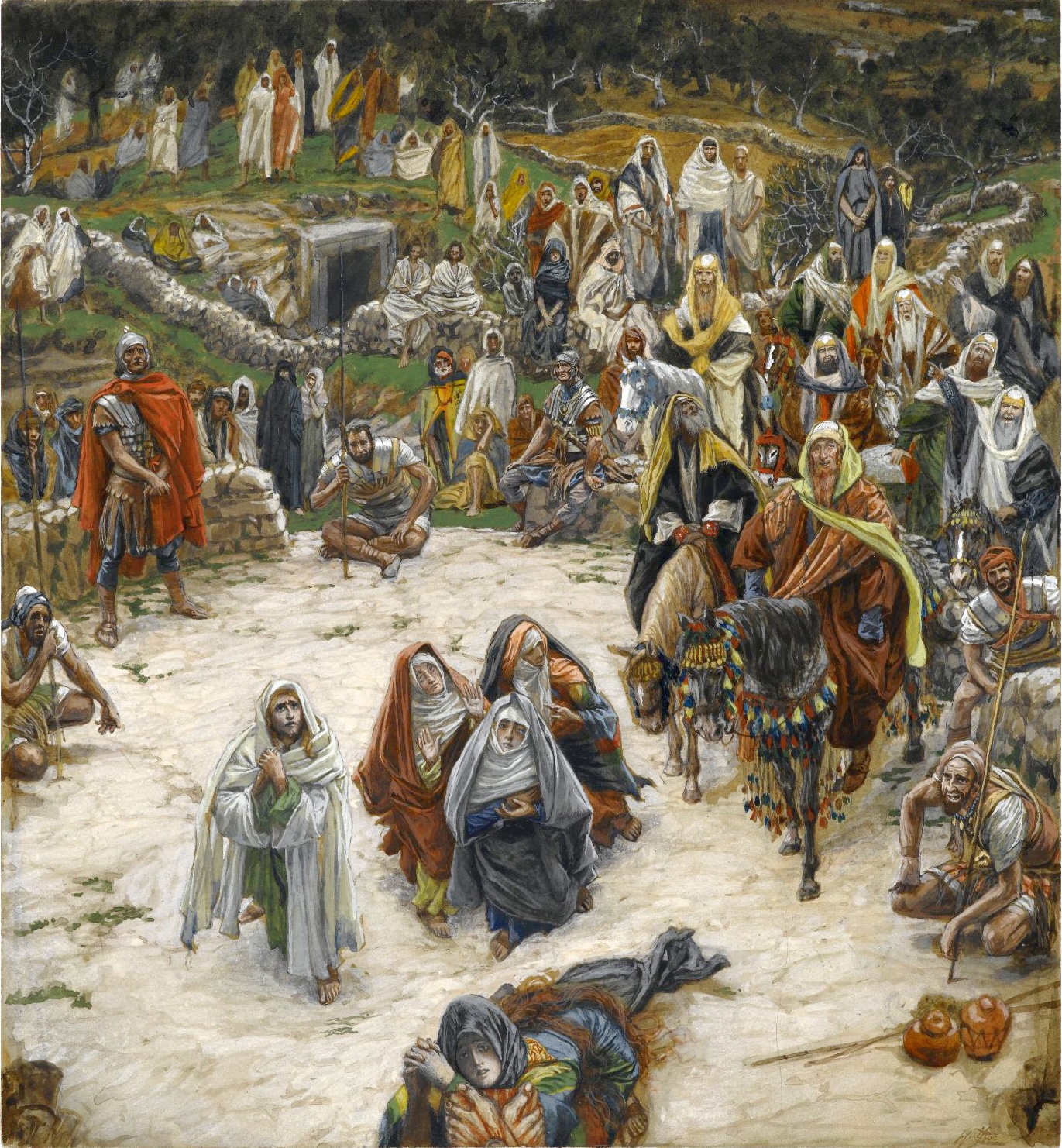
Therefore, when Jesus had seen his mother and the disciple whom he loved standing near, he said to his mother, “Woman, behold your son.” Next, he said to the disciple, “Behold your mother.” And from that hour, the disciple accepted her as his own.
After this, Jesus knew that all had been accomplished, so in order that the Scripture might be completed, he said, “I thirst.” And there was a container placed there, full of vinegar. Then, placing a sponge full of vinegar around hyssop, they brought it to his mouth.
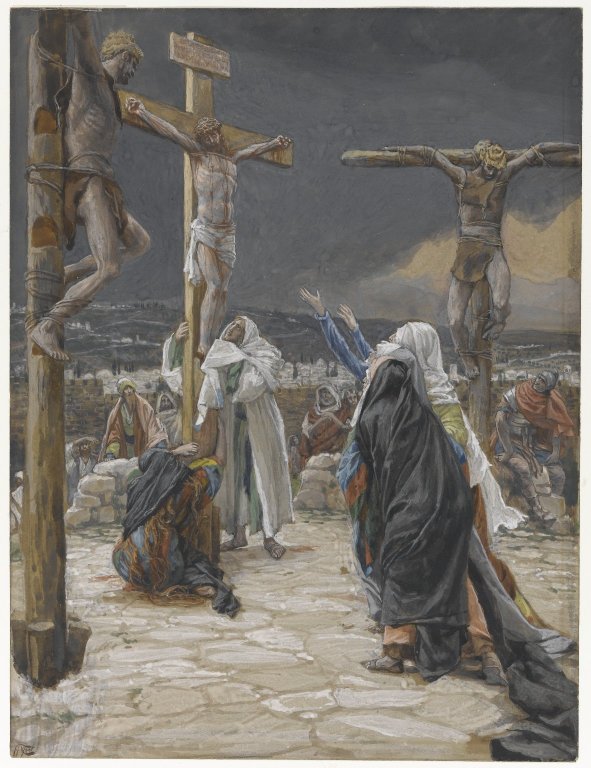
Then Jesus, when he had received the vinegar, said: “It is consummated.” And bowing down his head, he surrendered his spirit. Then the Jews, because it was the preparation day, so that the bodies would not remain upon the cross on the Sabbath (for that Sabbath was a great day), they petitioned Pilate in order that their legs might be broken, and they might be taken away.
Therefore, the soldiers approached, and, indeed, they broke the legs of the first one, and of the other who was crucified with him. But after they had approached Jesus, when they saw that he was already dead, they did not break his legs.
Instead, one of the soldiers opened his side with a lance, and immediately there went out blood and water. And he who saw this has offered testimony, and his testimony is true. And he knows that he speaks the truth, so that you also may believe.
For these things happened so that the Scripture would be fulfilled: “You shall not break a bone of him.” And again, another Scripture says: “They shall look upon him, whom they have pierced.”
Then, after these things, Joseph from Arimathea, (because he was a disciple of Jesus, but a secret one for fear of the Jews) petitioned Pilate so that he might take away the body of Jesus. And Pilate gave permission. Therefore, he went and took away the body of Jesus.
Now Nicodemus also arrived, (who had gone to Jesus at first by night) bringing a mixture of myrrh and aloe, weighing about seventy pounds.
Therefore, they took the body of Jesus, and they bound it with linen cloths and the aromatic spices, just as it is the manner of the Jews to bury.
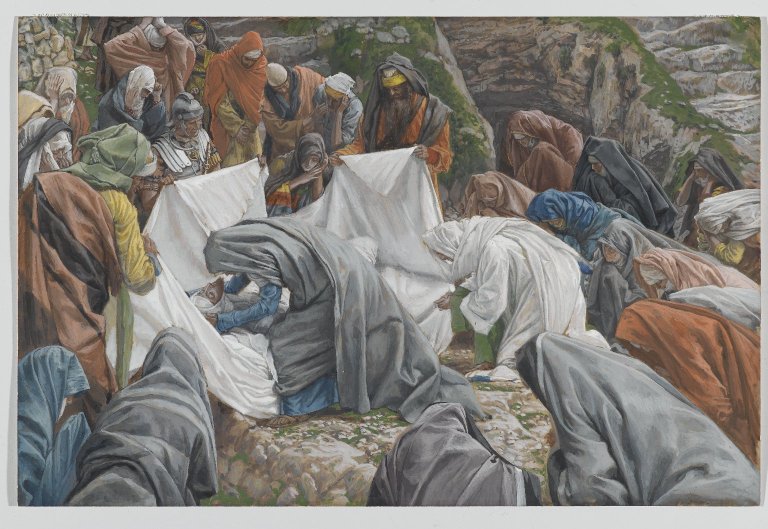
Now in the place where he was crucified there was a garden, and in the garden there was a new tomb, in which no one had yet been laid. Therefore, because of the preparation day of the Jews, since the tomb was nearby, they placed Jesus there
What do the Fathers say?
Excerpts from St Augustine’s Pascal Homily
But Judas, who betrayed him, also knew the place, for Jesus had frequently met with his disciples there.
There, the wolf in sheep’s clothing, permitted by the Master of the flock to go among the sheep, learned in what way to disperse the flock, and ensnare the Shepherd.
Then Judas, when he had received a cohort from both the high priests and the attendants of the Pharisees, approached the place with lanterns and torches and weapons.
It was a band not of Jews, but of soldiers, granted, we must understand, by the Governor, with legal authority to take the criminal, as He was considered, and crush any opposition that might be made.
As soon then as He said to them, I am He, they went backtward. Where now is the band of soldiers, where the terror and defence of arms? Without a blow, one word struck, drove back, prostrated a crowd fierce with hatred, terrible with arms. For God was hid in the flesh, and the eternal day was so obscured by His human body, that He was sought for with lanterns and torches, to be slain in the darkness. What shall He do when He comes to judge, Who acted thus when He was going to be judged?
Had He never permitted Himself to be taken by them, they would not have done indeed what they came to do; but neither would He have accomplished what He came to do. So now having shown His power to them when they wished to take Him and could not, He lets them seize Him, that they might be unconscious agents of His will.
Respecting the denial of Peter we should remark, that Christ is not only denied by him, who denies that He is Christ, but by him also who denies himself to be a Christian. For the Lord did not say to Peter, you shall deny that you are My disciple, but, you shall deny Me.
Lo, the prophecy of the Physician is fulfilled. That which Peter had said he would do, he had not done. I will lay down my life for Your sake; but what our Lord had foretold had come to pass, you shall deny Me three times.
How many afterwards, even boys and girls, were able to despise death, confess Christ, and enter courageously into the kingdom of heaven; which he who received the keys of the kingdom, was now unable to do? If Peter had gone out of this world immediately after denying Christ, He would have been lost.
Then the high priest questioned Jesus about his disciples and about his doctrine.
For what they had heard and not understood, was not of such a kind, as that they could justly turn it against Him. And as often as they tried by questioning to find out some charge against Him, He so replied as to blunt all their stratagems, and refute their calumnies.
In the morning, they did not enter into the praetorium, so that they would not be defiled, but might eat the Passover.
O impious blindness! They feared to be defiled by the judgment hall of a foreign prefect, to shed the blood of an innocent brother they feared not. That He Whom they killed was the Lord and Giver of life, their blindness prevented them from knowing.
The Jews tell Pilate “If he were not an evil-doer, we would not have handed him over you.”
Ask those freed from unclean spirits, the blind who saw, the dead who came to life again, and, what is greater than all, the fools who were made wise, and let them answer, whether Jesus was an evil-doer.
According to John, the Jews seem to have been unwilling to bring actual charges, in order that Pilate might condemn Him simply on their authority, asking no questions, but taking it for granted that if He was delivered up to him, He was certainly guilty.
The Jews therefore said unto him, It is not lawful for us to put any man to death.
Have you then so lost your understanding by your wickedness, that you think yourselves free from the pollution of innocent blood, because you deliver it to be shed by another?
Everyone who is of the truth hears My voice: hears, that is, with the inward ear; obeys My voice, believes Me.
A man then is not of the truth, because he hears His voice, but hears His voice because he is of the truth. This grace is conferred upon him by the truth.
They cried out: Not this man, but Barabbas.We blame you not, O Jews, for releasing a guilty man at the passover, but for killing an innocent one. Yet unless this were done, it would not be the true passover.
Thus was fulfilled what Christ had prophesied of Himself; thus were martyrs taught to suffer all that the malice of persecutors could inflict; thus that kingdom which was not of this world conquered the proud world, not by fierce fighting, but by patient suffering.
It is apparent that these things (the scourging, the mockery and the crowning with thorns) were not done without Pilate’s knowledge, whether he commanded, or only permitted them, for the reason we have mentioned, viz. that His (Jesus’) enemies seeing the insults heaped upon Him, might not thirst any longer for His blood: Then came Jesus forth, wearing the crown of thorns, and the purple robe: not the insignia of empire, but the marks of ridicule. And Pilate said to them, Behold the man! as if to say, If you envy the King, spare the outcast. Ignominy overflows, let envy subside.
The envy of the Jews does not subside at Christ’s disgraces. When the chief priests therefore and officers saw Him, they cried out, saying, Crucify Him. crucify Him.
He that , through envy delivers an innocent person to the higher power, who puts to death from fear of a greater power, still sins more than that higher power itself. God had given such power to Pilate, but he was still under Cæsar’s power: therefore our Lord says, you could have no power at all against Me, i. e. no power however small, unless it, whatever it was, was given to you from above. And as that is not so great as to give you complete liberty of action, therefore he that delivered Me to you has the greater sin.
He delivered Me into your power from envy, but you will exercise that power from fear. And though a man ought not to kill another even from fear, especially an innocent man, yet to do so from envy is much worse. Therefore our Lord does not say, He that delivered Me to you has sinned, as if the other had not, but, has the greater sin, implying that the other also had some.
Pilate said to them, Shall I crucify your King? He tries to shame them into doing what he had not been able to soften them into by putting Christ to shame.
But Pilate is at last overcome by fear: Therefore, he then handed Him over to them to be crucified.. For it would be taking part openly against Cæsar, if when the Jews declared that they had no king but Cæsar, he wished to put another king over them, as he would appear to do if he let go unpunished a Man whom they had delivered to him for punishment on this very ground. It is not however, delivered Him to them to crucify Him, but, to be crucified, i. e. by the sentence and authority of the governor. The Evangelist says, delivered to them, to show that they were implicated in the guilt from which they tried to escape. For Pilate would not have done this except to please them.
Great spectacle,- to the profane a laughing-stock, to the pious a mystery. Profaneness sees a King bearing a cross instead of a sceptre; piety sees a King bearing a cross, thereon to nail Himself, and afterwards to nail it on the foreheads of kings.
Yes, even the cross, if you consider it, was a judgment seat: for the Judge being the middle, one thief, who believed, was pardoned, the other, who mocked, was damned: a sign of what He would once do to the quick and dead, place the one on His right hand, the other on His left.
All artwork by James Tissot (1836-1902) ex Wikimedia Commons. Read a short biography of the artist here.
Watch the video of Our Lord’s Passion through the art of James Tissot on Youtube.