
John 20:11-18
Then the disciples went away again, each by himself.
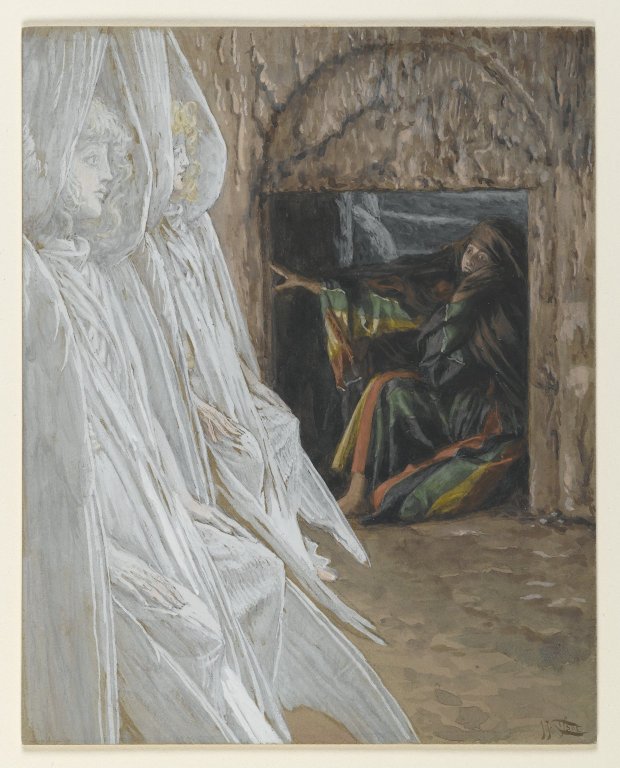
Mary was standing outside the tomb, weeping. Then, while she was weeping, she bowed down and gazed into the tomb. And she saw two Angels in white, sitting where the body of Jesus had been placed, one at the head, and one at the feet.
They say to her, “Woman, why are you weeping?” She said to them, “Because they have taken away my Lord, and I do not know where they have placed him.”
When she had said this, she turned around and saw Jesus standing there, but she did not know that it was Jesus. Jesus said to her: “Woman, why are you weeping? Who are you seeking?”
Considering that it was the gardener, she said to him, “Sir, if you have moved him, tell me where you have placed him, and I will take him away.” Jesus said to her, “Mary!” And turning, she said to him, “Rabboni!” (which means, Teacher).
Jesus said to her: “Do not touch me. For I have not yet ascended to my Father. But go to my brothers and tell them: ‘I am ascending to my Father and to your Father, to my God and to your God.’ ”
Mary Magdalene went, announcing to the disciples, “I have seen the Lord, and these are the things that he said to me.”
What do the Fathers say?
John Chrysostom
Portion of Homily 86 on the Gospel of John
John 20:10-11
Then the disciples went away again unto their own home. But Mary stood without at the sepulchre, weeping.
1. Full of feeling somehow is the female sex, and more inclined to pity. I say this, lest you should wonder how it could be that Mary wept bitterly at the tomb, while Peter was in no way so affected. For, The disciples, it says, went away unto their own home; but she stood shedding tears. Because hers was a feeble nature, and she as yet knew not accurately the account of the Resurrection; whereas they having seen the linen clothes and believed, departed to their own homes in astonishment. And wherefore went they not straightway to Galilee, as had been commanded them before the Passion? They waited for the others, perhaps, and besides they were yet at the height of their amazement.
These then went their way: but she stood at the place, for, as I have said, even the sight of the tomb tended greatly to comfort her. At any rate, you see her, the more to ease her grief, stooping down, and desiring to behold the place where the body lay. And therefore she received no small reward for this her great zeal. For what the disciples saw not, this saw the woman first, Angels sitting, the one at the feet, the other at the head, in white; even the dress was full of much radiance and joy.
Since the mind of the woman was not sufficiently elevated to accept the Resurrection from the proof of the napkins, something more takes place, she beholds something more; Angels sitting in shining garments, so as to raise her thus awhile from her passionate sorrow, and to comfort her.
But they said nothing to her concerning the Resurrection, yet is she gently led forward in this doctrine. She saw countenances bright and unusual; she saw shining garments, she heard a sympathizing voice. For what says (the Angel)?
John 20:13
Woman, why do you weep?
By all these circumstances, as though a door was being opened for her, she was led little by little to the knowledge of the Resurrection. And the manner of their sitting invited her to question them, for they showed that they knew what had taken place; on which account they did not sit together either, but apart from one another. For because it was not likely that she would dare at once to question them, both by questioning her, and by the manner of their sitting, they bring her to converse. What then says she? She speaks very warmly and affectionately;
They have taken away my Lord, and I know not where they have laid Him.
What do you say? Do you not know yet anything concerning the Resurrection, but do you still form fancies about His being laid ? Do you see how she had not yet received the sublime doctrine?
John 20:14
And when she had thus said, she turned herself back.
And by what kind of consequence is it, that she having spoken to them, and not having yet heard anything from them, turned back? Methinks that while she was speaking, Christ suddenly appearing behind her, struck the Angels with awe; and that they having beheld their Ruler, showed immediately by their bearing, their look, their movements, that they saw the Lord; and this drew the woman’s attention, and caused her to turn herself backwards. To them then He appeared on this wise, but not so to the woman, in order not at the first sight to terrify her, but in a meaner and ordinary form, as is clear from her supposing that He was the gardener. It was meet to lead one of so lowly a mind to high matters, not all at once, but gently. He therefore in turn asks her,
John 20:15
Woman, why do you weep? Whom do you seek?
This showed that He knew what she wished to ask, and led her to make answer. And the woman, understanding this, does not again mention the name of Jesus, but as though her questioner knew the subject of her enquiry replies,
Sir, if you have borne him hence, tell me where you have laid him, and I will take him away.
Again she speaks of laying down, and taking away, and carrying, as though speaking of a corpse. But her meaning is this; If you have borne him hence for fear of the Jews, tell me, and I will take him. Great is the kindness and loving affection of the woman, but as yet there is nothing lofty with her. Wherefore He now sets the matter before her, not by appearance, but by Voice. For as He was at one time known to the Jews, and at another time unperceived though present; so too in speaking, He, when He chose, then made Himself known; as also when He said to the Jews, Whom do you seek? they knew neither the Countenance nor the Voice until He chose. And this was the case here. And He named her name only, reproaching and blaming her that she entertained such fancies concerning One who lived. But how was it that,
John 20:16
She turned herself, and says, if so be that He was speaking to her? It seems to me, that after having said, Where have ye laid him? she turned to the Angels to ask why they were astonished, and that then Christ, by calling her by name, turned her to Himself from them, and revealed Himself by His Voice; for when He called her Mary, then she knew Him; so that the recognition was not by His appearance, but by His Voice. And if any say, Whence is it clear that the Angels were awestruck, and that on this account the woman turned herself, they will in this place say, whence is it clear that she would have touched Him, and fallen at His feet? Now as this is clear from His saying, Touch Me not, so is the other clear from its saying, that she turned herself. But wherefore, said He,
John 20:17
Touch Me not?
2. Some assert, that she asked for spiritual grace, because she had heard Him when with the disciples say, If I go to the Father, ‘I will ask Him, and He shall give you another Comforter.’ c. xiv. 3, 16 But how could she who was not present with the disciples have heard this? Besides, such an imagination is far from the meaning here. And how should she ask, when He had not yet gone to the Father? What then is the sense? Methinks that she wished still to converse with Him as before, and that in her joy she perceived nothing great in Him, although He had become far more excellent in the Flesh. To lead her therefore from this idea, and that she might speak to Him with much awe, (for neither with the disciples does He henceforth appear so familiar as before,) He raises her thoughts, that she should give more reverent heed to Him. To have said, Approach Me not as you did before, for matters are not in the same state, nor shall I henceforth be with you in the same way, would have been harsh and high-sounding; but the saying,
I am not yet ascended to the Father, though not painful to hear, was the saying of One declaring the same thing. For by saying, I am not yet ascended, He shows that He hastes and presses there; and that it was not meet that One about to depart there, and no longer to converse with men, should be looked on with the same feelings as before. And the sequel shows that this is the case.
Go and say unto the brethren, that I go unto My Father, and your Father, unto My God and your God.
Yet He was not about to do so immediately, but after forty days. How then says He this? With a desire to raise their minds, and to persuade them that He departs into the heavens. But the, To My Father and your Father, to My God, and your God, belongs to the Dispensation, since the ascending also belongs to His Flesh. For He speaks these words to one who had no high thoughts. Is then the Father His in one way, and ours in another? Assuredly then He is. For if He is God of the righteous in a manner different from that in which He is God of other men, much more in the case of the Son and us. For because He had said, Say to the brethren, in order that they might not imagine any equality from this, He showed the difference. He was about to sit on His Father’s throne, but they to stand by. So that albeit in His Subsistence according to the Flesh He became our Brother, yet in Honour He greatly differed from us, it cannot even be told how much.
John 20:18
She therefore departs, bearing these tidings to the disciples.
So great a good is perseverance and endurance. But how was it that they did not any more grieve when He was about to depart, nor speak as they had done before? At that time they were affected in such a way, as supposing that He was about to die; but now that He was risen again, what reason had they to grieve? Moreover, Mary reported His appearance and His words, which were enough to comfort them. Since then it was likely that the disciples on hearing these things would either not believe the woman, or, believing, would grieve that He had not deemed them worthy of the vision, though He promised to meet them in Galilee; in order that they might not by dwelling on this be unsettled, He let not a single day pass, but having brought them to a state of longing, by their knowledge that He was risen, and by what they heard from the woman, when they were thirsting to see Him, and were greatly afraid, (which thing itself especially made their yearning greater,) He then, when it was evening, presented Himself before them, and that very marvelously.