St Alcuin of York
(c. 735–804 AD) was the “Master Architect” of the Carolingian Renaissance and the man who effectively saved Western literacy.
Childhood and Education
Alcuin’s childhood was defined almost entirely by the Cathedral School of York, which he entered as a small child (possibly as an orphan, according to some later medieval accounts).
- He was “handed over” to the community at York Minster around the early 740s. However, unlike many children of his time, he was not an “oblate” (a child dedicated to a monastery for life). He never took full monastic vows and remained a deacon throughout his career.
- From his later letters, we get a glimpse of a child who was “eager and bright,” thriving in a literary paradise. He spoke of his youth at York with deep nostalgia, often referring to the school as his “mother” and expressing a lifelong homesickness for the Northumbrian landscape even while serving at the highest levels of Charlemagne’s court.
- Mentorship: His childhood was shaped by two giants of the English Church:
- Archbishop Ecgbert: A former student of the Venerable Bede. Ecgbert transformed York into the premier intellectual center of Europe.
- Æthelberht (Albert): Alcuin’s primary teacher and predecessor as headmaster. Æthelberht was a world-class scholar who traveled widely to collect the books that formed the Great Library of York—the library Alcuin later called “the flower of Britain.”
- Alcuin spent his youth mastering the “Logic of the Fathers” by physically guarding and copying their manuscripts.
Cathedral School of York,
- After completing his initial studies under Archbishop Ecgbert and Æthelberht, Alcuin stayed on as a teacher. When Æthelberht became Archbishop in 767, he promoted Alcuin to Headmaster (Magister) of the York School. During this time, he wasn’t just teaching; he was also the Librarian, managing what was then the most significant collection of books in Western Europe.
- Alcuin traveled to mainland Europe on behalf of the school and the Archbishop several times: to Gaul (modern-day France) and Italy, to acquire rare manuscripts to bring back to the York library.
Charlemagne
- The Turning Point: The most critical moment of his life occurred far from York. In 781, Alcuin was sent to Rome by the new Archbishop of York, Eanbald I, to receive the pallium (a symbol of office) from the Pope.
On his return journey, he stopped in Parma, Italy, where he happened to meet Charlemagne (the first Holy Roman Emperor).. - Charlemagne was King of the Franks from 768, King of the Lombards from 774, and Emperor of what is now known as the Carolingian Empire from 800. He united most of Western and Central Europe and was the first recognised emperor to rule from the west after the fall of the Western Roman Empire approximately three centuries earlier.
Charlemagne’s reign was marked by political and social changes that had lasting influence on Europe throughout the Middle Ages. - The King of the Franks was a brilliant warrior but knew his empire lacked Education. He was so impressed by Alcuin’s reputation and intellect that he invited him to his court at Aachen in modern-day Germany.
- Alcuin became The Master of the Palace School: and became Charlemagne’s personal tutor and “Minister of Education.” He taught the King, the Queen, and the royal children.
The Abbot of Tours (796–804)
In his final years, Alcuin retired to the Abbey of St. Martin in Tours, France. He was appointed Abbot by Charlemagne after he had asked for permission to retire to a quieter life of prayer
A “Retirement” that Changed History
Alcuin didn’t exactly “retire.” Instead, he turned Tours into the intellectual powerhouse of Europe.
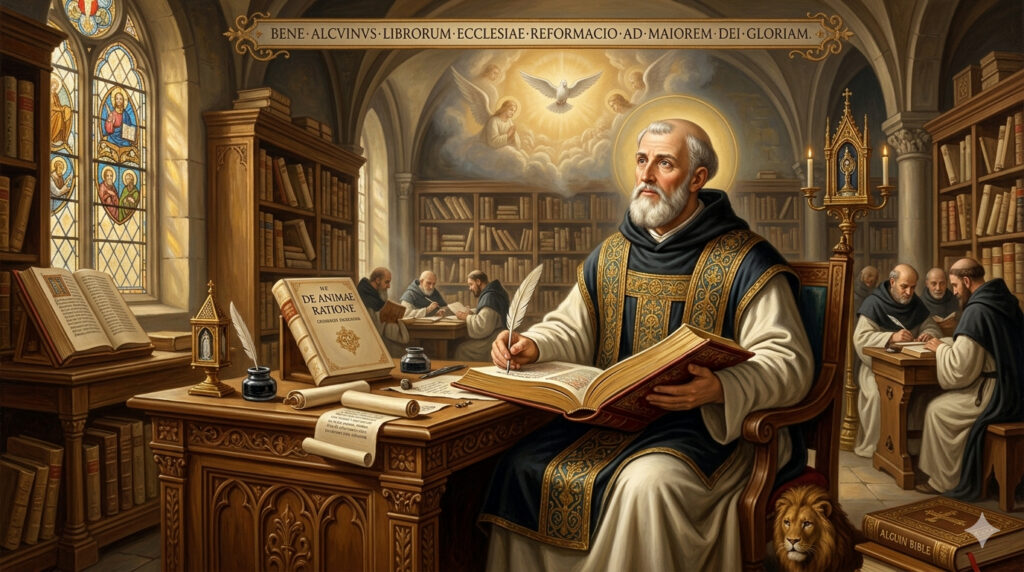
- Before Alcuin, Latin manuscripts were a mess of local dialects and bad grammar. Alcuin standardized the Vulgate Bible and developed Carolingian Minuscule—the clear, readable script that is the direct ancestor of the fonts we use today This was the first script to use lowercase letters, spaces between words, and standardized punctuation..
- He turned Tours into a massive scriptorium, producing accurate copies of the Bible and the works of the Fathers.
- This “Authorized Version” of the Fathers became the primary source material for the School of Laon 300 years later.
- The Vulgate – His goal was to produce a single, corrected version of the Latin Bible (the Vulgate).
These “Tours Bibles” were then sent out across the empire to ensure that every priest was reading the same, accurate text.
- The Teacher of the Teachers: It was here that he taught Rabanus Maurus and others ensuring that his “Chain of Logic” would survive the collapse of the Carolingian Empire.
Before he died Alcuin had the satisfaction of seeing the young men whom he had trained engaged all over Europe in the work of teaching.
Death and Burial
Alcuin died in 804 and is buried at the Church of St. Martin in Tours.
The epitaph on his grave – composed by Alcuin, himself reads:
Hic rogo pauxillum veniens subsiste viator,
Et mea scrutare pectore dicta tuo.
Ut tua sive mea relegas secreta viator,
Quid sis, quid fueris, quid citius eris.
Quod nunc es, fueram; quod sum, tu posthac eris.
Hic ego iam iaceo, sed tunc ego pulvis et umbra,
Et mundi fragiles despicio vanitates.
The English Translation:
“Stay here a little while, traveler, as you pass by,
And search my words within your heart.
As you read my secrets or your own, traveler,
Consider what you are, what you were, and what you will soon be.
What you are now, I once was; what I am now, you shall be.
Here I lie now, but then I am dust and shadow,
And I look down upon the fragile vanities of the world.”