
Monday of the Fifth week in Lent
John 8:1-11
“Let whoever is without sin among you be the first to cast a stone at her.”
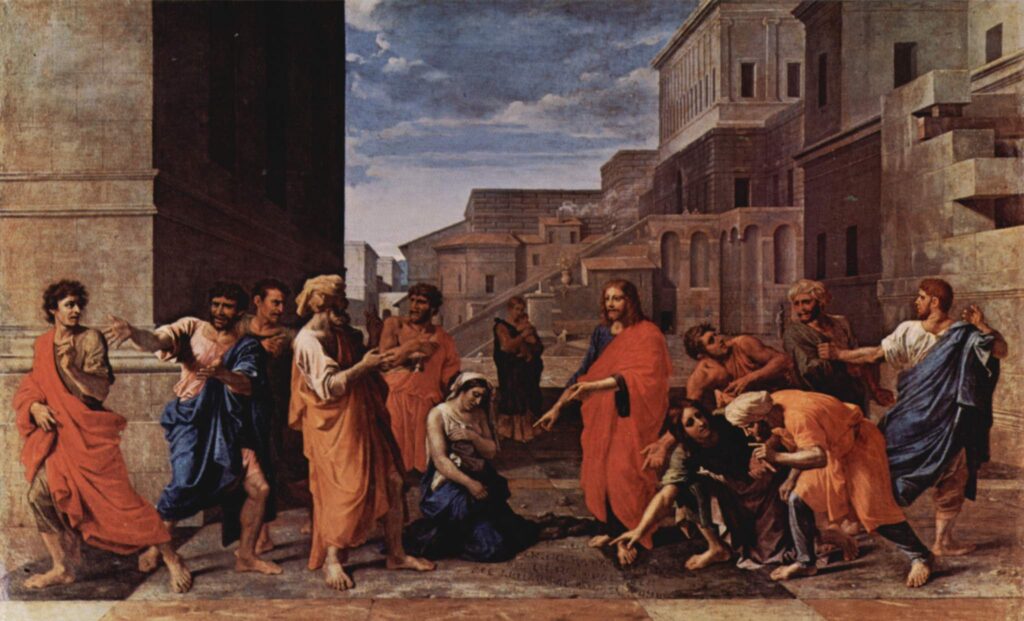
But Jesus continued on to the Mount of Olives. And early in the morning, he went again to the temple; and all the people came to him. And sitting down, he taught them.
Now the scribes and Pharisees brought forward a woman caught in adultery, and they stood her in front of them. And they said to him: “Teacher, this woman was just now caught in adultery. And in the law, Moses commanded us to stone such a one. Therefore, what do you say?”
But they were saying this to test him, so that they might be able to accuse him. Then Jesus bent down and wrote with his finger on the earth.
And then, when they persevered in questioning him, he stood upright and said to them, “Let whoever is without sin among you be the first to cast a stone at her.” And bending down again, he wrote on the earth.
But upon hearing this, they went away, one by one, beginning with the eldest. And Jesus alone remained, with the woman standing in front of him.
Then Jesus, raising himself up, said to her: “Woman, where are those who accused you? Has no one condemned you?” And she said, “No one, Lord.” Then Jesus said: “Neither will I condemn you. Go, and now do not choose to sin anymore.”
What do the Fathers say?
St ALCUIN. Our Lord at the time of His passion used to spend the day in Jerusalem, preaching in the temple, and performing miracles, and return in the evening to Bethany, where He lodged with the sisters of Lazarus. Thus on the last day of the feast, having, according to His wont, preached the whole day in the temple, in the evening He went to the mount of Olives.
The mount of Olives also denotes the height of our Lord’s pity, olive in the Greek signifying pity. The qualities of oil are such as to fit in to this mystical meaning. For it floats above all other liquids: and the Psalmist says, Thy mercy is over all Thy works. And early in the morning, He came again into the temple: (Ps. 144) i. e. to denote the giving and unfolding of His mercy.
His returning early in the morning, signifies the new rise of grace.
The sitting down, represents the humility of His incarnation. And the people came to Him, when He sat down, i. e. after taking up human nature, and thereby becoming visible, many began to hear and believe on Him, only knowing Him as their friend and neighbour. But while these kind and simple persons are full of admiration at our Lord’s discourse, the Scribes and Pharisees put questions to Him, not for the sake of instruction, but only to entangle the truth in their nets:
St AUGUSTINE. They had remarked already, that He was over lenient.
As a teacher He exhibited truth, as a deliverer meekness, as a judge righteousness.
So they raised the scandal on the score of justice. For they said among themselves, If He decides to let her go, He will not do justice; for the law cannot command what is unjust:
Now Moses in the law commanded us, that such should be stoned: but to maintain His meekness, which has made Him already so acceptable to the people, He must decide to let her go. Therefore they demand His opinion:
And what do You say? hoping to find an occasion to accuse Him, as a transgressor of the law:
But our Lord in His answer both maintained His justice, and departed not from meekness.
He did not say, Stone her not, lest He should seem to speak contrary to the law. But God forbid that He should say, Stone her; for He came not to destroy that which He found, but to seek that which was lost. What then did He answer? “Let whoever is without sin among you be the first to cast a stone at her.”
This is the voice of justice. Let the sinner be punished, but not by sinners; the law carried into effect, but not by transgressors of the law.
St ALCUIN. The ground denotes the human heart, which yields the fruit either of good or of bad actions: the finger jointed and flexible, denotes discretion. He instructs us then, when we see any faults in our neighbours, not immediately and rashly to condemn them, but after searching our own hearts to begin with, to examine them attentively with the finger of discretion.
This is like our Lord; while His eyes are fixed, and He seems attending to something else, He gives the bystanders an opportunity of retiring: -a tacit admonition to us to consider always both before we condemn a brother for a sin, and after we have punished him, whether we are not guilty ourselves of the same fault, or others as bad.
Pope St GREGORY the Great. For he who judges not himself first, cannot know how to judge correctly in the case of another. For though He know what the offence is, from being told, yet He cannot judge of another’s deserts, who supposing himself innocent, will not apply the rule of justice to himself.
St AUGUSTINE. Thus smitten then with the voice of justice, as with a weapon, they examine themselves, find themselves guilty, and one by one retire:
And Jesus was left alone, and the woman standing in the midst: the woman, you may suppose, in great alarm, expecting punishment from one in whom no sin could be found. But He who had repelled her adversaries with the word of justice, lifted on her the eyes of mercy,. Go, and sin no more. So then our Lord condemned sin, but not the sinner. For if He favoured sin, He would have said, Go, and live as you want: depend on my deliverance: howsoever great your sins may be, it matters not: I will deliver you from hell, and its tormentors. But He did not say this.
Truly, Gracious and righteous is the Lord.