
The Venerable Bede (c. 672 – 735 AD)
The Venerable Bede (Beda Venerabilis) was an English monk, historian, theologian, and scholar who lived in the Kingdom of Northumbria. He is widely considered the greatest Anglo-Saxon scholar and is often called the “Father of English History.” His works laid the foundation for historical writing and dating in the West.
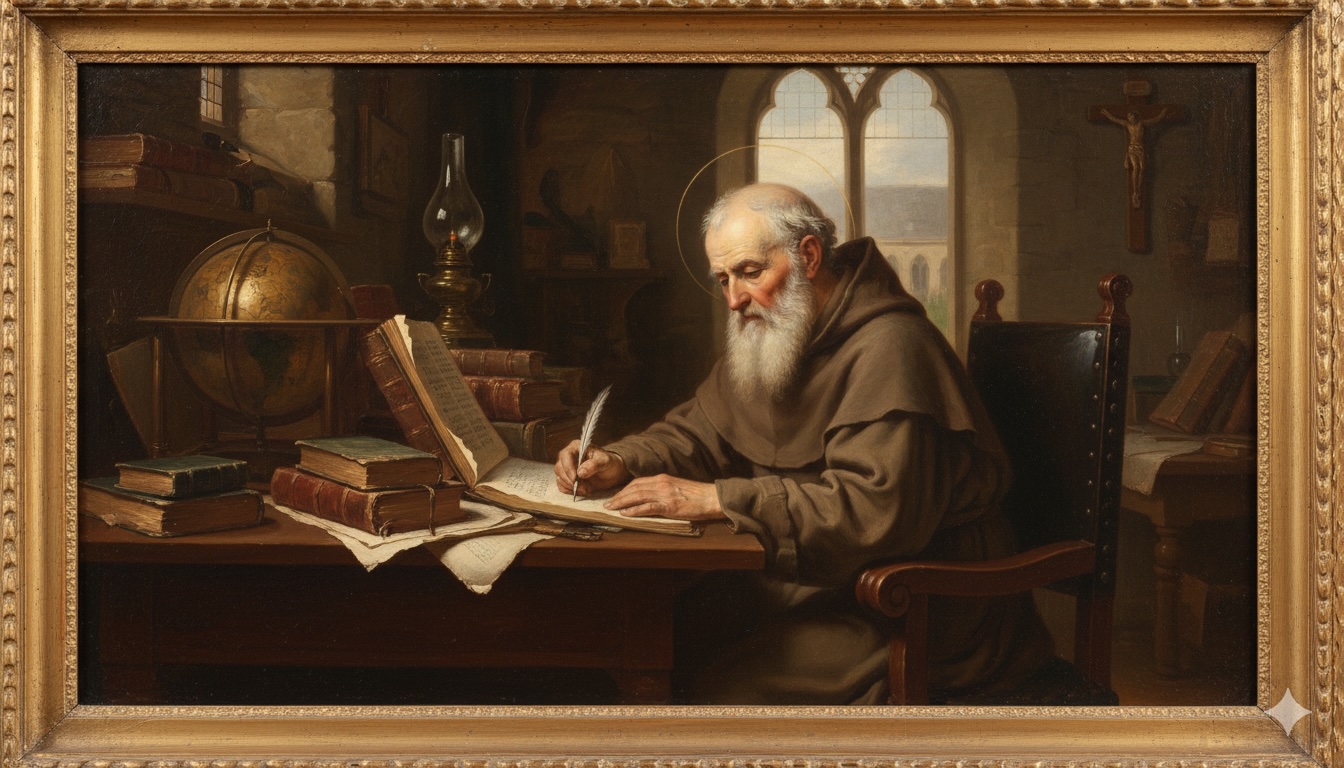
Early Life and Monastic Vocation
- Birth and Name: Bede was born around 672 AD in the area of Jarrow (modern Tyne and Wear) in Northumbria. Very little is known about his family. What we do know comes primarily from the brief, autobiographical note he included at the end of his masterpiece, the Ecclesiastical History of the English People:
- Pledge to the Monastery: At the age of seven, his parents committed him to the care of the newly founded monastery of Wearmouth and to its founder and first abbot, Benedict Biscop. He writes:
“Having been born in the territory of that same monastery, I was handed over by the care of my relatives to the most reverend Abbot Benedict [Biscop], to be educated, when I was seven years old.” - Implied Faith and Status: This suggests a few things about his family:
- Christian Faith: His parents were clearly Christians to entrust their son to a monastery at such a young age.
- Local Status: They likely lived nearby, on land associated with the monastery of Wearmouth, in the region of Northumbria (modern North East England).
- Means: Entrusting a child to a monastery could imply a certain level of social status or commitment, as it involved giving up a potential heir or worker.
- Bede never names his parents or discusses their lives, activities, or his memories of them after he entered the monastery. Once dedicated to the monastic life, his ties to his biological family were essentially severed, and his focus was entirely on his spiritual family (his abbots and brethren) and his academic work.
In summary, while Bede confirms that he had relatives (cura propinquorum) who were responsible for placing him in the monastery, we know nothing concrete about who his parents were, their names, or their livelihood. His life was defined by the monastery, not his birthplace or family lineage.
- Jarrow: In 685 AD, he moved to the newly established sister monastery at Jarrow, where he spent the rest of his life. He was ordained a deacon around 692 AD and a priest around 703 AD.
- The Scholar’s Life: Bede’s life was centered entirely around the monastery. As he stated, his great pleasure was “always learning, teaching, and writing.” His exceptional access to books came from the impressive library that Benedict Biscop had collected during his many trips to Rome and continental Europe.
Major Works and Contributions
Bede wrote over 40 books, covering topics from grammar and science to theology and history.
1. Historia Ecclesiastica Gentis Anglorum (Ecclesiastical History of the English People)
This is Bede’s masterpiece and the work for which he is most famous.
- Content: Completed in 731 AD, the five-volume work chronicles the history of the Christian Church in England, starting with Caesar’s invasions and concluding in his own time.
- Historical Method: Bede employed a remarkably modern historical methodology. He cited his sources (oral testimony, archives, letters) and often evaluated their reliability.
- The Anno Domini (A.D.) System: Bede was the first historian to make widespread use of the Dionysian dating system (dating events from the Incarnation of Christ, or the A.D. system), which was crucial for establishing this dating convention throughout Europe.
2. Theological and Scientific Works
Bede wrote extensively on Scripture, producing commentaries on nearly every book of the Bible. He saw history as a tool to reveal God’s work in the world.
- Chronology and Computus: He was an expert in computus—the science of calculating calendar dates, especially the date of Easter. His work helped standardize the celebration of Easter throughout the Anglo-Saxon Church.
- Scientific Texts: He wrote treatises on astronomy, tides, and natural phenomena, showing a surprisingly sophisticated grasp of cosmology for the 8th century.
Legacy and Veneration
- Death: Bede died peacefully in his cell at Jarrow on May 26, 735 AD.
- Title: The title “Venerable” (Venerabilis) was first applied to him shortly after his death, recognizing his immense piety and learning. It was formally confirmed centuries later.
- Doctor of the Church: In 1899, Pope Leo XIII declared him a Doctor of the Church (And until the recent declaration of John Henry Newman as a doctor of the Church, the only native of Great Britain to hold this title), cementing his status as one of the most important Christian theologians and thinkers of the early Middle Ages.