Acts 1:1-11
In the first book, O Theoph′ilus, I have dealt with all that Jesus began to do and teach, until the day when he was taken up, after he had given commandment through the Holy Spirit to the apostles whom he had chosen. To them he presented himself alive after his passion by many proofs, appearing to them during forty days, and speaking of the kingdom of God. And while staying with them he charged them not to depart from Jerusalem, but to wait for the promise of the Father, which, he said, “you heard from me, for John baptized with water, but before many days you shall be baptized with the Holy Spirit.”
So when they had come together, they asked him, “Lord, will you at this time restore the kingdom to Israel?”
He said to them, “It is not for you to know times or seasons which the Father has fixed by his own authority. But you shall receive power when the Holy Spirit has come upon you; and you shall be my witnesses in Jerusalem and in all Judea and Samar′ia and to the end of the earth.”
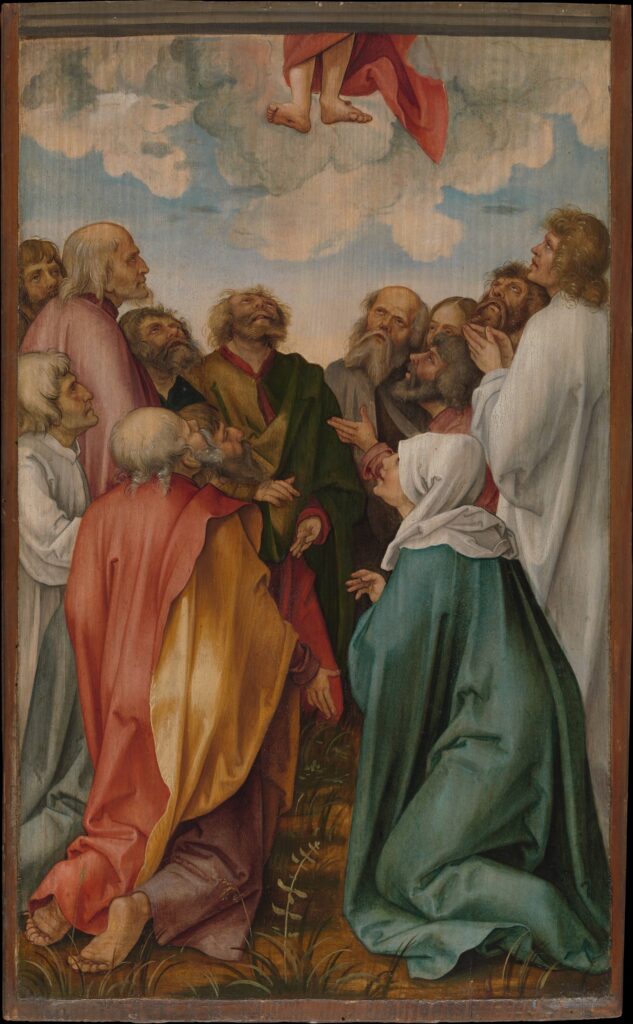
And when he had said this, as they were looking on, he was lifted up, and a cloud took him out of their sight.
And while they were gazing into heaven as he went, behold, two men stood by them in white robes, and said, “Men of Galilee, why do you stand looking into heaven? This Jesus, who was taken up from you into heaven, will come in the same way as you saw him go into heaven.”
What do the Fathers say?
Saint John Chrysostom
Homily 2 on the Acts of the Apostles
When they therefore had come together, they asked of Him, saying, Lord, will You at this time restore again the kingdom to Israel? Acts I. 6
When the disciples intend to ask anything, they approach Him together, that by dint of numbers they may abash Him into compliance. They well knew that in what He had said previously, Of that day knows no man Matthew 24:36, He had merely declined telling them: therefore they again drew near, and put the question. They would not have put it had they been truly satisfied with that answer. For having heard that they were about to receive the Holy Ghost, they, as being now worthy of instruction, desired to learn. Also they were quite ready for freedom: for they had no mind to address themselves to danger; what they wished was to breathe freely again; for they were no light matters that had happened to them, but the utmost peril had impended over them. And without saying anything to Him of the Holy Ghost, they put this question: Lord, will You at this time restore the kingdom to Israel? They did not ask, when? But whether at this time. So eager were they for that day. Indeed, to me it appears that they had not any clear notion of the nature of that kingdom; for the Spirit had not yet instructed them. And they do not say, When shall these things be? But they approach Him with greater honour, saying, Will You at this time restore again the kingdom, as being now already fallen. For there they were still affected towards sensible objects, seeing they were not yet become better than those who were before them; here they have henceforth high conceptions concerning Christ. Since then their minds are elevated, He also speaks to them in a higher strain. For He no longer tells them, Of that day not even the Son of Man knows Mark 13:32; but He says, It is not for you to know the times or the seasons which the Father has put in His own power
Acts 1:7 You ask things greater than your capacity, He would say. And yet even now they learned things that were much greater than this. And that you may see that this is strictly the case, look how many things I shall enumerate. What, I pray you, was greater than their having learned what they did learn? Thus, they learned that there is a Son of God, and that God has a Son equal with Himself in dignity John 5:17-20; they learned that there will be a resurrection Matthew 17:9; that when He ascended He sat on the right hand of God Luke 22:69; and what is still more stupendous, that Flesh is seated in heaven, and adored by Angels, and that He will come again Mark 16:19; they learned what is to take place in the judgment Matthew 16:27; learned that they shall then sit and judge the twelve tribes of Israel Luke 21:27; learned that the Jews would be cast out, and in their stead the Gentiles should come in Matthew 19:28. For, tell me, which is greater? To learn that a person will reign, or to learn the time when? Luke 21:24. Paul learned things which it is not lawful for a man to utter 2 Corinthians 12:4; things that were before the world was made, he learned them all. Which is the more difficult, the beginning or the end? Clearly to learn the beginning. This, Moses learned, and the time when, and how long ago: and he enumerates the years. And the wise Solomon says, I will make mention of things from the beginning of the world. And that the time is at hand, they do know: as Paul says, The Lord is at hand, be careful for nothing. Philippians 4:5. These things they knew not [then], and yet He mentions many signs Matthew 24. But, as He has just said, Not many days hence, wishing them to be vigilant, and did not openly declare the precise moment, so is it here also. However, it is not about the general Consummation that they now ask Him, but, Will You at this time, say they, restore the kingdom to Israel? And not even this did He reveal to them. They also asked this [about the end of the world] before: and as on that occasion He answered by leading them away from thinking that their deliverance was near and, on the contrary, cast them into the midst of perils, so likewise on this occasion but more mildly. For, that they may not imagine themselves to be wronged, and these things to be mere pretences, hear what He says: He immediately gives them that at which they rejoiced: for He adds: But you shall receive power, after that the Holy Ghost has come upon you; and you shall be witnesses unto Me both in Jerusalem, and in all Judea, and in Samaria, and unto the uttermost part of the earth. Acts 1:8 Then, that they may make no more enquiries, straightway He was received up. Thus, just as on the former occasion He had darkened their minds by awe, and by saying, I know not; here also He does so by being taken up. For great was their eagerness on the subject, and they would not have desisted; and yet it was very necessary that they should not learn this. For tell me, which do the Gentiles most disbelieve? That there will be a consummation of the world, or that God has become man, and issued from the Virgin? But I am ashamed of dwelling on this point, as if it were about some difficult matter. Then again, that the disciples might not say, Why do you leave the matter in suspense? He adds, Which the Father has put in His own power. And yet He declared the Father’s power and His to be one: as in the saying, For as the Father raises up the dead and quickens them, even so the Son quickens whom He will. John 5:21 If where need is to work, Thou actest with the same power as the Father; where it behooves to know, dost Thou not know with the same power? Yet certainly to raise up the dead is much greater than to learn the day. If the greater be with power, much more the other.
But just as when we see a child crying, and pertinaciously wishing to get something from us that is not expedient for him, we hide the thing, and show him our empty hands, and say, See, we have it not: the like has Christ here done with the Apostles. But as the child, even when we show him [our empty hands], persists with his crying, conscious he has been deceived, and then we leave him, and depart, saying, Such an one calls me: and we give him something else instead, in order to divert him from his desire, telling him it is a much finer thing than the other, and then hasten away; in like manner Christ acted. The disciples asked to have something, and He said He had it not. And on the first occasion he frightened them. Then again they asked to have it now: He said He had it not; and He did not frighten them now, but after having shown [the empty hands], He has done this, and gives them a plausible reason: Which the Father, He says, has put in his own power.
What? Thou not know the things of the Father! You know Him, and not what belongs to Him! And yet You have said, None knows the Father but the Son Luke 10:25; and, The Spirit searches all things, yea, the deep things of God 1 Corinthians 2:10; and Thou not know this! But they feared to ask Him again, lest they should hear Him say, Are you also without understanding? Matthew 15:26 For they feared Him now much more than before. But you shall receive power, after that the Holy Ghost has come upon you. As in the former instance He had not answered their question (for it is the part of a teacher to teach not what the disciple chooses, but what is expedient for him to learn), so in this, He tells them beforehand, for this reason, what they ought to know, that they may not be troubled. In truth, they were yet weak. But to inspire them with confidence, He raised up their souls, and concealed what was grievous.
Since he was about to leave them very shortly, therefore in this discourse He says nothing painful. But how? He extols as great the things which would be painful: all but saying, ‘Fear not’: for you shall receive power, after that the Holy Ghost has come upon you; and you shall be witnesses unto Me both in Jerusalem, and in all Judea, and in Samaria. For since he had said, Go not into the way of the Gentiles, and into any city of the Samaritans enter ye not Matthew 10:5, what there He left unsaid, He here adds, And to the uttermost part of the earth; and having spoken this, which was more fearful than all the rest, then that they may not again question Him, He held His peace.
And having this said, while they beheld, He was taken up; and a cloud received Him out of their sight Acts 1:9. Do you see that they did preach and fulfil the Gospel? For great was the gift He had bestowed on them. In the very place, He says, where you are afraid, that is, in Jerusalem, there preach ye first, and afterwards unto the uttermost part of the earth. Then for assurance of what He had said, While they beheld, He was taken up.
Not while they beheld did He rise from the dead, but while they beheld, He was taken up. Inasmuch, however, as the sight of their eyes even here was not all-sufficient; for in the Resurrection they saw the end, but not the beginning, and in the Ascension they saw the beginning, but not the end: because in the former it had been superfluous to have seen the beginning, the Lord Himself Who spoke these things being present, and the sepulchre showing clearly that He is not there; but in the latter, they needed to be informed of the sequel by word of others: inasmuch then as their eyes do not suffice to show them the height above, nor to inform them whether He is actually gone up into heaven, or only seemingly into heaven, see then what follows.
That it was Jesus Himself they knew from the fact that He had been conversing with them (for had they seen only from a distance, they could not have recognized Him by sight), but that He is taken up into Heaven the Angels themselves inform them. Observe how it is ordered, that not all is done by the Spirit, but the eyes also do their part. But why did a cloud receive Him? This too was a sure sign that He went up to Heaven. Not fire, as in the case of Elijah, nor fiery chariot, but a cloud received Him; which was a symbol of Heaven, as the Prophet says; Who makes the clouds His chariot Psalm 104:3; it is of the Father Himself that this is said. Therefore he says, on a cloud; in the symbol, he would say, of the Divine power, for no other Power is seen to appear on a cloud. For hear again what another Prophet says: The Lord sits upon a light cloud Isaiah 19:1. For it was while they were listening with great attention to what He was saying, and this in answer to a very interesting question, and with their minds fully aroused and quite awake, that this thing took place.
Also on the mount [Sinai] the cloud was because of Him: since Moses also entered into the darkness, but the cloud there was not because of Moses. And He did not merely say, I go, lest they should again grieve, but He said, I send the Spirit John 16:5-7; and that He was going away into heaven they saw with their eyes. O what a sight they were granted! And while they looked steadfastly, it is said, toward heaven, as he went up, behold, two men stood by them in white apparel; which also said, You men of Galilee, why stand ye gazing up into heaven? This same Jesus, which is taken up from you into heaven — they used the expression This demonstratively, saying, this Jesus, which is taken up from you into heaven, shall thus— demonstratively, in this way — come in like manner as you have seen Him going into heaven. (v. 10-11.) Again, the outward appearance is cheering [in white apparel]. They were Angels, in the form of men. And they say, You men of Galilee: they showed themselves to be trusted by the disciples, by saying, You men of Galilee. For this was the meaning: else, what needed they to be told of their country, who knew it well enough? By their appearance also they attracted their regard, and showed that they were from heaven. But wherefore does not Christ Himself tell them these things, instead of the Angels? He had beforehand told them all things; [What if you shall see the Son of Man] going up where He was before? John 6:62.
Moreover the Angels did not say, ‘whom you have seen taken up,’ but, going into heaven: ascension is the word, not assumption; the expression taken up, belongs to the flesh. For the same reason they say, He which is taken up from you shall thus come, not, shall be sent, but, shall come. He that ascended, the same is he also that descended Ephesians 4:10. So again the expression, a cloud received Him: for He Himself mounted upon the cloud.
Of the expressions, some are adapted to the conceptions of the disciples, some agreeable with the Divine Majesty. Now, as they behold, their conceptions are elevated: He has given them no slight hint of the nature of His second coming. For this, Shall thus come, means, with the body; which thing they desired to hear; and, that he shall come again to judgment thus upon a cloud. And, behold, two men stood by them. Why is it said, men? Because they had fashioned themselves completely as such, that the beholders might not be overpowered. Which also said: their words moreover were calculated for soothing: Why stand ye gazing up into heaven? They would not let them any longer wait there for Him. Here again, these tell what is greater, and leave the less unsaid. That He will thus come, they say, and that ye must look for Him from heaven. For the rest, they called them off from that spectacle to their saying, that they might not, because they could not see Him, imagine that He was not ascended, but even while they are conversing, would be present ere they were aware. For if they said on a former occasion, Where are You going? John 13:36 much more would they have said it now.
Will You at this time, say they, restore the kingdom to Israel? (Recapitulation). They so well knew his mildness, that after His Passion also they ask Him, Will you restore? And yet He had before said to them, You shall hear of wars and rumors of wars, but the end is not yet, nor shall Jerusalem be taken. But now they ask Him about the kingdom, not about the end. And besides, He does not speak at great length with them after the Resurrection. They address then this question, as thinking that they themselves would be in high honor, if this should come to pass. But He (for as touching this restoration, that it was not to be, He did not openly declare; for what needed they to learn this? Hence they do not again ask, What is the sign of Your coming, and of the end of the world? for they are afraid to say that: but, Will You restore the kingdom to Israel? for they thought there was such a kingdom), but He, I say, both in parables had shown that the time was not near, and here where they asked, and He answered thereto, You shall receive power, says He, when the Holy Ghost has come upon you. Is come upon you, not, is sent, [to show the Spirit’s coequal Majesty. How then do you dare, O opponent of the Spirit, to call Him a creature ?]. And you shall be witnesses to Me. He hinted at the Ascension. [And when he had spoken these things. ] Which they had heard before, and He now reminds them of. [He was taken up.] Already it has been shown, that He went up into heaven. [And a cloud, etc.] Clouds and darkness are under His feet, Psalm 18:9; 97:2 says the Scripture: for this is declared by the expression, And a cloud received Him: the Lord of heaven, it means. For as a king is shown by the royal chariot, so was the royal chariot sent for Him. [Behold, two men, etc.] That they may vent no sorrowful exclamations, and that it might not be with them as it was with Elisha, 2 Kings 2:12 who, when his master was taken up, rent his mantle. And what say they? This Jesus, which is taken up from you into heaven, shall thus come. And, Behold, two men stood by them. Matthew 18:16 With good reason: for in the mouth of two witnesses shall every word be established Deuteronomy 17:6: and these utter the same things. And it is said, that they were in white apparel. In the same manner as they had already seen an Angel at the sepulchre, who had even told them their own thoughts; so here also an Angel is the preacher of His Ascension; although indeed the Prophets had frequently foretold it, as well as the Resurrection.
Everywhere it is Angels as at the Nativity, for that which is conceived in her, says one, is by the Holy Ghost Matthew 1:20: and again to Mary, Fear not, Mary. Luke 1:30 And at the Resurrection: He is not here; He is risen, and goes before you. Luke 24:6 Come, and see! Matthew 28:6 And at the Second Coming. For that they may not be utterly in amazement, therefore it is added, Shall thus come. Matthew 25:31 They recover their breath a little; if indeed He shall come again, if also thus come, and not be unapproachable! And that expression also, that it is from them He is taken up, is not idly added. And of the Resurrection indeed Christ Himself bears witness (because of all things this is, next to the Nativity, nay even above the Nativity, the most wonderful: His raising Himself to life again): for, Destroy, He says, this Temple, and in three days I will raise it up. John 2:19 Shall thus come, say they. If any therefore desires to see Christ; if any grieves that he has not seen Him: having this heard, let him show forth an admirable life, and certainly he shall see Him, and shall not be disappointed. For Christ will come with greater glory, though thus, in this manner, with a body ; and much more wondrous will it be to see Him descending from heaven. But for what He will come, they do not add.
[Shall thus come, etc.] This is a confirmation of the Resurrection; for if he was taken up with a body, much rather must He have risen again with a body.
For there is a resurrection of bodies. This the sepulchre which is at Jerusalem declares, this the pillar to which He was bound, when He was scourged. For, We ate and drank with Him, it is said. Let us then believe in the Resurrection, and do things worthy of it, that we may attain to the good things which are to come, through Christ Jesus our Lord, with Whom to the Father, and the Holy Ghost together, be power, honour, now and for ever, world without end. Amen.
Sources:
Bible readings from the Revised Standard Version of the Bible, Second Catholic Edition, copyright © 2006 National Council of the Churches of Christ in the USA
St John Chrysostom’s Homily on Acts ex Newadvent.org
Artwork ex Wikimedia Commons