Saint of the day : 11 July
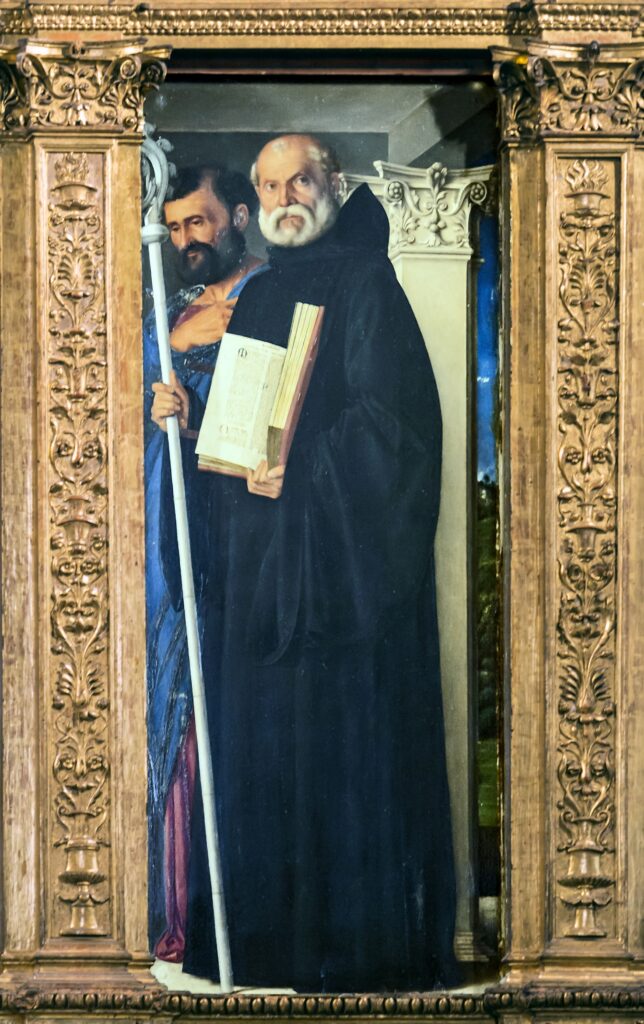
THE LIFE of Our Most Holy Father Saint Benedict Being the Second Book of the Dialogues of St. Gregory the Great.
CHRONOLOGY OF THE LIFE OF THE MOST HOLY PATRIARCH SAINT BENEDICT\
“His memory shall not depart away; and his Name shall be in request from generation to generation.” (Ecclus. 39)
(The figures in parenthesis denote the age of St. Benedict.)
YEAR.
480. (—) St. Benedict and his twin-sister St. Scholastica are born in Nursia, a town in the south of Italy: their Father, Anicius Eupropius: their Mother, Abundantia.
487. (7.) St; Benedict is sent to Rome to study, his nurse Cyrilla accompanies him.
493. (13.) God, calling him to higher things, and the dangers of the world prompting him to leave it, he quits Rome to seek salvation and perfection in solitude. On their way in a little village, 30 miles from Rome, he works a miracle to console Cyrilla.
[His nurse borrowed of a neighbour a sieve to cleanse wheat, which being left carelessly upon the table was found broken in two pieces. Therefore on her return finding it broke, she began to weep bitterly because it was only lent her. But the religious and pious boy, Benedict, seeing his nurse lament was moved with compassion, and taking with him the two pieces of the broken sieve, with tears he gave himself to prayer, which no sooner ended, but he found the sieve whole, and found not any sign that it had been broken. ]
494. (14.) He leaves Cyrilla and goes alone to Subiaco, a mountainous district, 40 miles distant from Rome: meets a holy Hermit named Romanus, from whom he asks and receives the Religious Habit: then going into a little Cave amidst the rocks, dwells there in union with his God in prayer, unknown to all, excepting St. Romanus who brought him food.
497. (17.) On the Easter Sunday of this year, a Priest receives a command from God to visit this Cave, and honour the youthful hermit.
Some neighbouring Shepherds discover the Saint.
He gains the noble victory over the spirit of impurity and placing the lily of his Chastity amidst thorns and nettles, he secures it against every temptation for the remainder of his life.
[When presently so great a carnal temptation assailed him, that before the holy man had never felt the like. For the remembrance of a woman which some time he had seen, was so lively represented to his fancy by the wicked spirit, and so vehemently did her image inflame his breast with lustful desires, that almost overcome by pleasure, he was determining to leave the wilderness. But suddenly assisted with divine grace he came to himself, and, seeing near him a thicket full of nettles and briars, he threw off his garments and cast himself naked into the midst of those sharp thorns and nettles, where he rolled himself so long, that, when he rose up, all his body was pitifully rent; thus by the wounds of his flesh he cured those of his soul, by turning pleasure into pain; and by the vehemence of outward torments he extinguished the unlawful flame which burnt within overcoming sin by changing the fire. After which time, as he himself related to his disciples, he was so free from the like temptation, that he never felt any such motion.]
509. (29.) His sanctity becoming noised abroad many men leave the world, and put themselves under his spiritual guidance.
510. (30.) After frequent refusals he, at last, yields to the request of the Monks of Vico-Varro, who besought him to become their Abbot. As he had foretold them they grew angry at his corrections: they seek to poison him: he returns to his dear solitude of Subiaco.
[They poisoned his wine. So when the glass which contained the empoisoned drink was, according to the custom of the Monastery, presented at table to be blessed by the Abbot, Benedict putting forth his hand and making the sign of the Cross, the glass which was held far off brake in pieces, as if instead of blessing the vase of death, he had thrown a stone against it. ]
St. Maurus is born.
511. (31.) During the next 19 years St. Benedict builds 12 monasteries on the Subiaco mountains.
515. (35.) St Placid is born.
522. (42.) Sts. Maurus and Placid are brought to Subiaco by their Parents, and receive from St. Benedict the Monastic Habit.
523. (43.) St. Maurus in obedience to St. Benedict walks on the waters of the lake, into which St. Placid had fallen, and saves him from being drowned.
529. (49.) St. Benedict leaves Subiaco, and goes to Mount Cassino (about 50 miles south of Subiaco).
530. (50.) He begins to build the Monastery of Mount Cassino.
536. (56.) He sends St. Placid into Sicily.
St. Benedict has the mysterious vision, in which God grants him the sight of the whole world, brought together in one ray of the sun.
537. (57.) St. Placid begins the Monastery at Messina in Sicily: he finishes it in 4 years.
539. (59.) During a famine St. Benedict distributes to the poor all the corn of the Monastery: on the following day he receives from Heaven, in return, 200 bushels of flour.
In hatred of Disobedience and out of love for Charity he works the miracle of the glass oil-jar.
Whilst he is at prayer with some of his Brethren, an empty vessel which was in the room is miraculously filled with oil, even to over-flowing.
541. (61.) St. Placid is martyred (probably in this year).
543. (63.) King Totila the Barbarian visits St. Benedict: receives his paternal reproach and prophecy.
On the 10th of January, St. Benedict sends St. Maurus into France.
On the 6th of February he has the last conference with his sister St. Scholastica.
[His sister Scholastica, who was consecrated to God from her very childhood, used to come once a year to see him; unto whom the man of God was wont to go to a house not far from the gate, within the possession of the Monastery. Thither she came one day according to her custom, and her venerable brother likewise with his disciples: where, after they had spent the whole day in the praise of God and pious discourses, the night drawing on, they took their refection together. As they were yet sitting at table, and protracting the time with holy conference, the religious woman, his sister, entreated him saying: “I beseech you, leave me not this night, that we may talk until morning of the joys of the heavenly life.” To whom he answered: “What is this you say, sister? By no means can I stay out of my Monastery.” At this time the sky was serene, and not a cloud was to be seen in the air. The holy woman, therefore, hearing her brother’s refusal, clasped her hands together upon the table, and bowing her head upon them she prayed to Almighty God. As she raised up her head from the table, there began such vehement lightning and thunder, with such abundance of rain, that neither venerable Benedict nor his Brethren were able to put foot out of doors. For the holy woman when she leaned her head upon her hands, poured forth a flood of tears upon the table by which she changed the fair weather into foul and rainy. For, immediately after her prayers, followed the inundation, and the two did so concur that, as she lifted up her head, the crack of thunder was heard, so that in one and the same instant she lifted up her head and brought down the rain. Then the man of God perceiving that, by reason of thunder and lightening with continual showers of rain, he could not possibly return to his monastery, was sad and began to complain, saying: “God Almighty forgive you, sister, what is this you have done?” To whom she made answer: “I prayed you to stay and you would not hear me; I prayed to Almighty God and He heard me! Now, therefore, if you can, go forth to the Monastery and leave me.” But he not able to go forth, was forced to stay against his will.]
On the 10th of February, he sees the soul of his Sister, St. Scholastica, ascending to heaven under the form of a Dove.
On the 16th of March, knowing that the hour of his Death is near he orders his grave to be opened.
On the 21st of March at 3 o’clock in the morning, standing in the chapel of his Monastery of Mount Cassino, supported by his Religious, he dies, in the 63rd year of his age.
From the Rule of Saint Benedict
(CHAPTER IV.)
What are the instruments of good works.
1. First of all, to love the Lord God with all our heart, with all our soul, with all our strength.36
2. Then our neighbour as ourself.37
3. Then not to kill.38
4. Not to commit adultery.39
5. Not to steal.40
6. Not to covet.41
7. Not to bear false witness.42
8. To honour all men.43
9. Not to do to another what we would not have done to ourselves.44
10. To deny ourselves, in order to follow Christ.45
11. To chastise the body.46
12. Not seek after delights.47
13. To love fasting.48
14. To relieve the poor.49
15. To clothe the naked.50
16. To visit the sick.51
17. To bury the dead.52
18. To help those that are in tribulation.53
19. To comfort the sad.54
20. To withdraw ourselves from worldly ways.55
21. To prefer nothing to the love of Christ.56
22. Not to give way to anger.57
23. Not to harbour revenge in our mind.58
24. Not to foster guile or deceit in our heart.59
25. Not to make a feigned peace.60
26. Not to forsake charity.61
27. Not to swear at all, lest we forswear ourselves.62
28. To speak the truth with heart and mouth.63
29. Not to render evil for evil.64
30. Not to do any injury; yea, and patiently to bear an injury done to us.65
31. To love our enemies.66
32. Not to speak ill of such as speak ill of us, but rather to speak well of them.67
33. To suffer persecution for justice sake.68
34. Not to be proud.69
35. Not given to wine.70
36. Not a great eater.71
37. Not drowsy.72
38. Not slothful.73
39. Not a murmurer.74
40. Not a detractor.75
41. To put our trust in God.76
42. When we see any good in ourselves let us attribute it to God and not to ourselves.77
43. But let us always know that evil is done by ourselves, therefore let us attribute it to ourselves.78
44. To fear the day of judgment.79
45. To be afraid of hell.80
46. To desire life everlasting with spiritual thirst.81
47. To have death always before our eyes.82
48. To observe at every hour the actions of our life.83
49. To know for certain that God beholdeth us in every place.84
50. To dash at once against Christ the evil thoughts that rise in the mind.85
51. To reveal all such to our spiritual Father.86
52. To keep our mouth from evil and wicked words.87
53. Not to love much talking.88
54. Not to speak vain words, nor such as move to laughter.89
55. Not to love much and boisterous laughter.90
56. Willingly to hear holy readings.91
57. To pray often devoutly.92
58. With tears and sighs, daily to confess our past evils to God in prayer and to amend them for the time to come.93
59. Not to fulfil the desires of the flesh, and to hate self-will.94
60. To obey in all things the commands of the Abbot, though he himself (which God forbid) should do otherwise, being mindful of that precept of our Lord: “What they say, do ye; but what they do, do ye not.”95
61. Not to desire to be called holy, before we be so, and first to be holy, that we may truly be called so.96
62. Daily to fulfil in deeds the commandments of God.97
63. To love chastity.98
64. To hate no man.99
65. To flee envy and emulation.100
66. Not to love contention.101
67. To flee Haughtiness.102
68. To reverence the Elders.103
69. To love inferiors.104
70. For Christ’s sake to pray for our enemies.105
71. To make peace with adversaries before the setting of the sun.106
72. Never to despair of God’s mercy.107
Behold these are the tools or instruments of our spiritual profession: if we constantly employ them day and night, and have them signed with approval in the day of judgment, that reward shall be given us by our Lord as a recompense “Which eye hath not seen, nor ear heard, nor hath it entered into the heart of man to conceive what God hath prepared for those that love Him.”108 The workshop where all these things are to be done is the cloister of the monastery, and steadfast abiding in the Congregation.
Footnotes:
36Deut. vi. 5.
37Luc. x. 27.
38Luc. xviii. 20.
39Matth. xix. 18.
40Exod. xx. 15.
41Deut. vi. 21.
42Marc. x. 19.
43I. Petr. ii. 17.
44Tob. iv. 16.
45Luc. ix. 23.
46I Cor. ix. 27.
47II. Petr. ii. 13.
48Joel i. 14; ii, 12, 15.
49Tob. iv. 7..
50Is. lviii. 7.
51Matth. xxv. 36.
52Tob. i. 21, ii. 4, 7–9.
53Is. i. 17.
54I. Thes. v. 14.
55Jac. i. 27.
56Matth. x. 37, 38.
57Matth. v. 22.
58Ephes. iv. 26.
59Ps. xiv. 3.
60Rom. xii. 18.
61I. Petr. iv. 8.
62Matth. v. 33–37.
63Ps. xiv. 3.
64I. Thes. v. 15.
65I. Cor. vi. 7.
66Luc. vi. 27–35.
67I. Petr. iii. 9.
68Matth. v. 10.
69Tob. iv. 14.
70I. Tim. iii. 3.
71Eccli. xxxi. 17.
72Prov. xx. 13.
73Rom. xii. 11.
74I Cor. x. 10.
75Sap. i. 11.
76Ps. lxxii. 28.
77I Cor. iv. 7.
78Ose. xii. 9.
79Job. xxxi. 14.
80Matth. x. 28.
81Phil. i. 23.
82Matth. xxiv. 42 et seq..
83Deut. iv. 9.
84Prov. v. 21.
85Ps. cxxxvi. 9.
86Eccli. viii. ii.
87Ps. xxxiii. 13, 14.
88Prov. x. 19.
89Matth. xii. 35.
90Eccli. xxi. 23.
91Luc. xi. 28.
92Col. iv. 2.
93Ps. vi. 7.
94Gal. v. 16.
95Eccli. xviii. 30.
96Matth. xxiii. 3.
97Matth. vi. i.
98Eccli. vi. 37.
99I. Tim. v. 22.
100Levit. xix. 17.
101Jacob. iii. 14, 16.
102II. Tim. ii. 24.
103Ps. cxxx. 1.
104Levit. xix. 32.
105I Tim. v. i..
106Matth. v. 44.
107Ephes. iv. 26.
108Ps. li. 10.