
Saint Bonaventure (c. 1221 – 1274), known as the “Seraphic Doctor” (Doctor Seraphicus), is one of the monumental pillars of medieval Scholastic theology. He was a contemporary and close friend of Saint Thomas Aquinas.
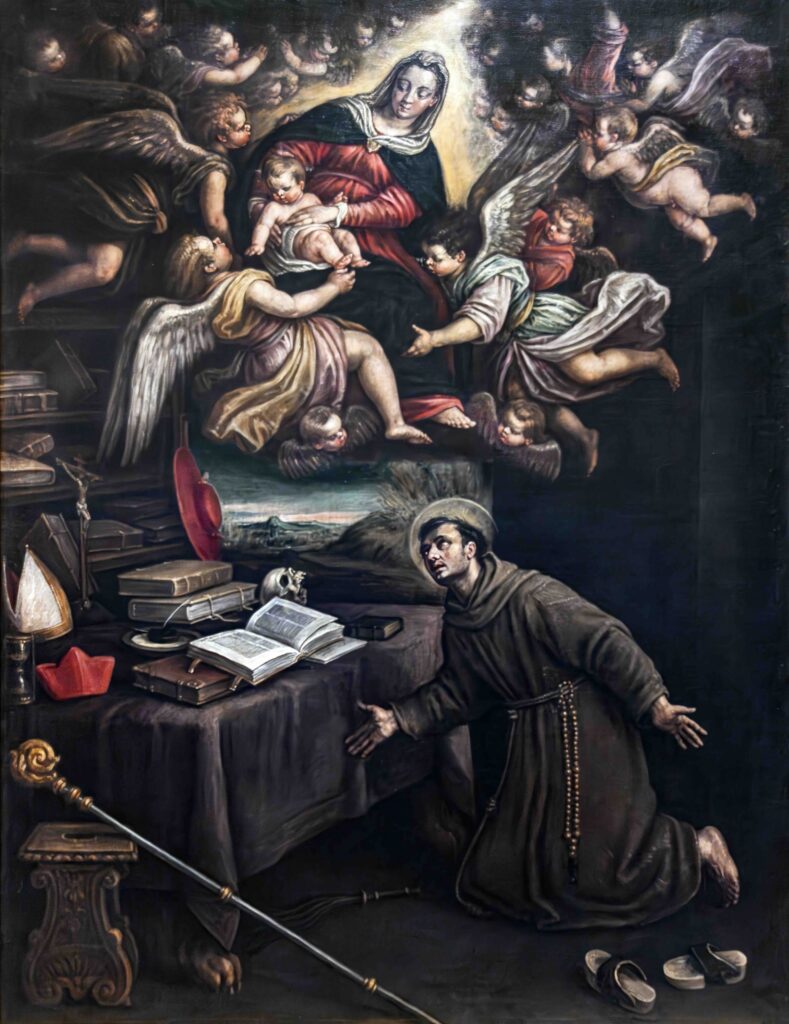
While Thomas Aquinas approached the divine through a highly systematic, Aristotelian synthesis of faith and reason, Bonaventure approached God through a deeply mystical, Neo-Platonic framework heavily influenced by Saint Augustine, focusing on how the intellect illuminates a path toward an ecstatic union of love with God.
1. Early Life and the Miracle of St. Francis
Born Giovanni di Fidanza in Bagnoregio, Italy, he was the son of a physician. Very little is recorded about his childhood, save for a watershed moment he documents in his own writings: as a young boy, he fell dangerously ill and was saved from an untimely death through the intercession of Saint Francis of Assisi.
A popular 15th-century pious legend claims that when the infant Giovanni was brought to St. Francis, the saint prophetically exclaimed, “O buona ventura!” (“Oh, good fortune!”), giving the boy his future name.
Bonaventure entered the University of Paris in 1235, received his Master of Arts, and formally joined the Franciscan Order (the Friars Minor) around 1243.
2. The Great University Feud
At the University of Paris, Bonaventure studied under the great Franciscan master Alexander of Hales. He quickly rose to academic prominence, lecturing on the standard theological texts of the medieval world.
However, his formal reception as a Master (Doctor) of Theology was aggressively blocked for years due to a bitter, violent feud between the university’s “secular” faculty (diocesan priests and lay professors) and the “mendicant” orders (the Franciscans and Dominicans). The secular professors resented the intellectual dominance of the friars and accused mendicants of defaming the Gospel by begging for a living. Bonaventure penned brilliant treatises defending Christian evangelical poverty, and once the papal court quieted the controversy, he and Thomas Aquinas were triumphantly installed as Regent Masters together in 1257.
3. The “Second Founder” of the Franciscans
Bonaventure’s academic career was abruptly cut short when, at just 36 years old, he was elected Minister General of the Franciscan Order.
He took over an order on the brink of an existential schism. The friars were bitterly divided into two factions:
- A radical group demanding absolute, uncompromising poverty, some of whom fell into Joachimite heresies, claiming that St. Francis had inaugurated a new “Age of the Holy Spirit” meant to replace the institutional Church and its sacraments.
- A faction pushing for laxity, wanting to abandon structural rigours to live more comfortable lives.
Operating with profound diplomatic prudence, Bonaventure preserved the unity of the order. He systematically codified the Franciscan Rule at the Chapter of Narbonne in 1260 to allow for practical, intellectual ministry while strictly protecting Franciscan poverty. He also wrote the Major Legend of Saint Francis, which became the definitive, official biography of the founder. For saving the order from self-destruction, church history remembers him as the Second Founder of the Franciscans.
4. Masterpieces of Mystical Theology
Bonaventure’s writings consistently argue that theology is an act of love, and that intellect without prayer is completely blind. His most famous work is The Soul’s Journey into God (Itinerarium Mentis in Deum), a mystical masterpiece written while he was on a spiritual retreat on Mount La Verna (the mountain where St. Francis received the stigmata).
In it, he outlines a six-stage ladder of contemplation by which the human soul uses the created cosmos, human consciousness, and divine grace to transcend itself, culminating in an ecstatic, mystical crucifixion where all intellectual operations cease and the heart passes entirely into God.
5. The Angelus
Bonaventure’s practical legacy also shapes daily Catholic life. At a Franciscan chapter meeting in 1263, he mandated that at nightfall, bells should be rung in honour of the Annunciation of Mary—a pious monastic directive that directly birthed the widespread Catholic practice of the Angelus prayer.
6. Later Years, and Death
In 1273, Pope Gregory X forced a highly reluctant Bonaventure to accept the title of Cardinal-Bishop of Albano.
According to traditional lore, when the papal envoys arrived to hand him his cardinal’s hat, they found him washing dishes outside a monastery; he calmly asked them to hang the red hat on a nearby tree branch until his hands were clean and dry.
He was tasked with managing the agenda for the Second Council of Lyon in 1274, successfully negotiating a brief, historic reunion between the Western Catholic Church and the Eastern Byzantine-Greek Orthodox Church.
Tragically, during the height of the council, Bonaventure fell suddenly ill and died on July 15, 1274.
The official records of the council noted a profound, universal mourning at his passing, beautifully summarizing his character:
“At the funeral there were many tears, for the Lord had given him this grace, that all who met him were filled with an immense love for him.”
Sources:
Catholic Encyclopedia
Pope Benedict XVI General Audience 3 March 2010
Wikipedia
Artwork ex Wikimedia Commons