
Saints of the day 9 July
The collective feast of Saint Augustine Zhao Rhong and Companions honours 120 martyrs who shed their blood for the Catholic faith in China between 1648 and 1930.
This group represents a vast cross-section of the human family—comprising 87 native Chinese Catholics and 33 foreign missionaries (mostly French, Spanish, and Italian priests and religious)—all caught in periodic waves of intense political and anti-Western persecution, culminating in the Boxer Rebellion of 1900.
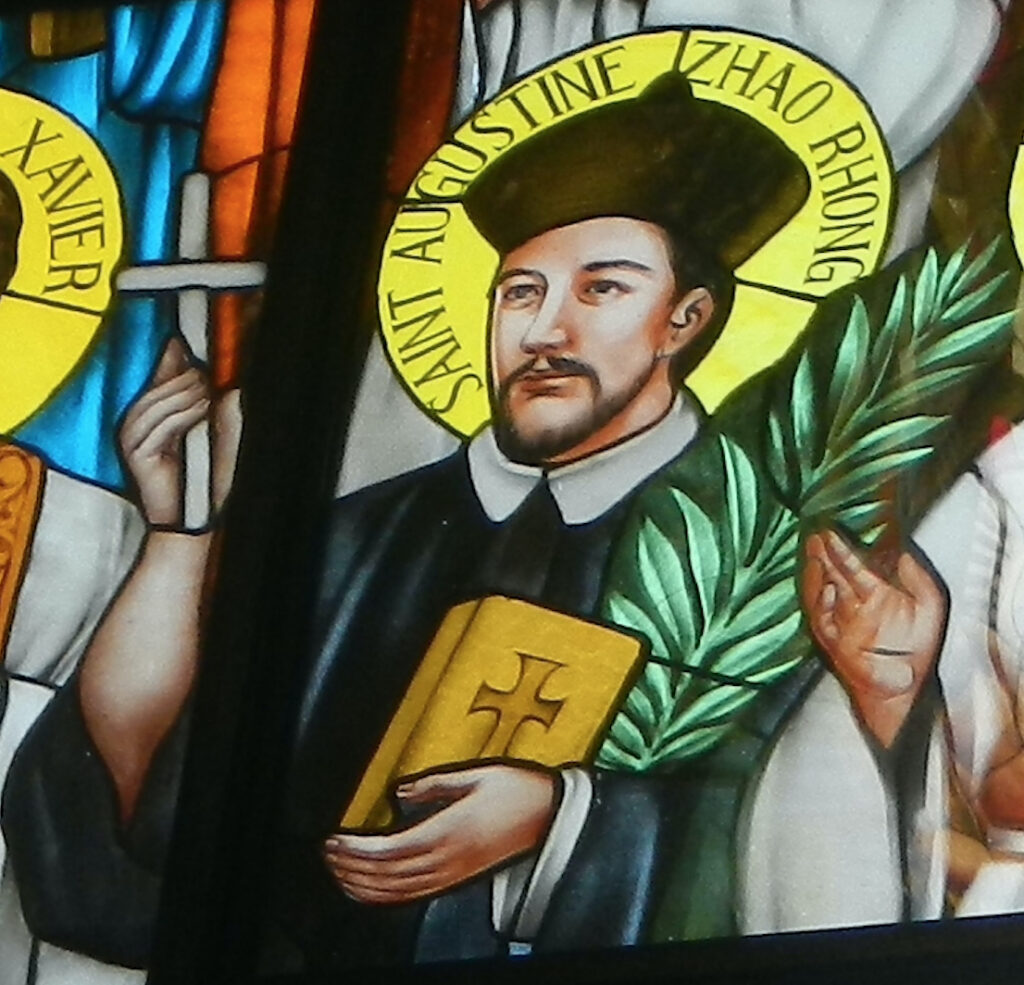
The Story of Saint Augustine Zhao Rhong (1746–1815)
Zhao Rhong was initially a soldier in the Chinese imperial army. In 1785, during a period of imperial crackdowns on Christianity, he was assigned to serve as a prison guard overseeing captured European missionaries, including a French priest named Father Gabriel-Taurin Dufresse (who would also later be martyred).
While guarding the prison, Zhao Rhong was deeply moved by Father Dufresse’s radical patience, joy, and peaceful demeanour despite his impending execution. Intrigued, Zhao Rhong began staying near the prison cells during his off-hours, quietly listening as Father Dufresse instructed his fellow inmates and preached the Gospel. The beauty of the Christian message, coupled with the radiant moral witness of the priest, deeply moved the soldier.
Zhao Rhong left the military, sought out baptism, and took the Christian name Augustine.
Augustine Zhao Rhong did not merely intend to be a passive believer. He possessed a sharp mind and a deep zeal to share his newfound faith with his countrymen. Recognizing his devotion and leadership capabilities, the underground clergy sent him to the seminary.
In 1795, at the age of 49, Augustine was ordained as a diocesan priest—becoming one of the earliest native secular Chinese priests in the history of the Church.
Because of his background as a soldier, Father Augustine was highly resilient and familiar with navigating the rugged terrain and tight imperial security of southwestern China. He was dispatched to the countryside of Sichuan, where he spent two decades secretly traveling from village to village.
He baptized newborns, celebrated the sacraments in hidden barns, and successfully converted hundreds of native Chinese to the Catholic faith.
Martyrdom
In 1815, a violent wave of anti-Christian persecution swept through the Sichuan province. While administering the Last Rites to a dying Christian in a remote village, Father Augustine was recognized by an imperial informant, arrested, and placed in heavy iron chains.
Because he was a former imperial soldier who had deserted to preach a banned religion, the local magistrates treated him with extreme severity. He was subjected to brutal torture in prison, commanded to stamp on a crucifix, and ordered to denounce Jesus Christ. He steadfastly refused, using his trial as a final opportunity to preach the Gospel to his judges.
Broken by weeks of beatings and starvation, Father Augustine Zhao Rhong succumbed to his injuries and died in his prison cell in Chengdu on July 6, 1815, at the age of 69.
The Story of Saint Gabriel-Taurin Dufresse, Bishop (1750–1815)
Alongside his spiritual student, Augustine Zhao Rong, Bishop Dufresse was beatified in 1900 and officially canonized as a saint by Pope John Paul II on October 1, 2000.
After the 1785 prison stint during which Augustine Zhao Rong witnessed his peaceful demeanour, Father Dufresse was released from Peking but forbidden to remain in Sichuan. He was exiled to Macao and spent time in the Philippines. However, his devotion to his flock was so strong that he secretly smuggled himself back into the Sichuan province in 1789 to resume his underground missionary work under very difficult conditions.
His pastoral leadership was highly successful, and in 1800, he was consecrated as an auxiliary bishop, later becoming the Apostolic Vicar of Sichuan. In 1803, during a brief window of relative peace, Bishop Dufresse remarkably organized and presided over the first diocesan synod in China, which established crucial pastoral guidelines for the future growth of the local church.
Final Betrayal and Execution
The peace did not last. An imperial decree in 1811 specifically condemned all foreign religious leaders to death. Bishop Dufresse was forced to live on the run, constantly changing his hiding location almost daily to evade authorities.
In May 1815, he was betrayed by a coerced convert and captured by imperial forces for the final time. True to the character that had originally inspired St. Augustine Zhao Rong decades earlier, he steadfastly refused to renounce his faith during intense interrogations.
On September 14, 1815, by order of the emperor, Bishop Dufresse was executed by beheading in Chengdu. As a harsh warning to local Christians, executioners attached his severed head to a pole and left his body exposed to the elements for three days before local believers bravely gathered his remains for burial.
In his preface to the book The Red Book of Chinese Martyrs: Testimonies and Autobiographical Accounts (published by Ignatius Press). Cardinal Zen writes that the testimonies of the Chinese martyrs do not belong to China alone: “The confessors and martyrs of the Church of China belong to Christianity as a whole, and it is our duty,…, to present their testimonies so that they might nourish the faith of Christians throughout the world.”
While the historical feast of St. Augustine Zhao Rhong and Companions focuses on those who died up until 1930, Cardinal Zen’s writings purposefully bridge the gap between those early historical martyrs and the 20th-century underground Catholics who suffered under Maoism. He frequently highlights that the era of martyrdom in China did not end in 1930, but rather shifted into a systemic campaign against “enemies without guns”—meaning intellectuals, lay catechists, and faithful believers.
Sources:
The Red Book of Chinese Martyrs: Testimonies and Autobiographical Accounts
The Holy See Canonization documents
Wikipedia