
Gospel Reading :Matthew 13:1-23
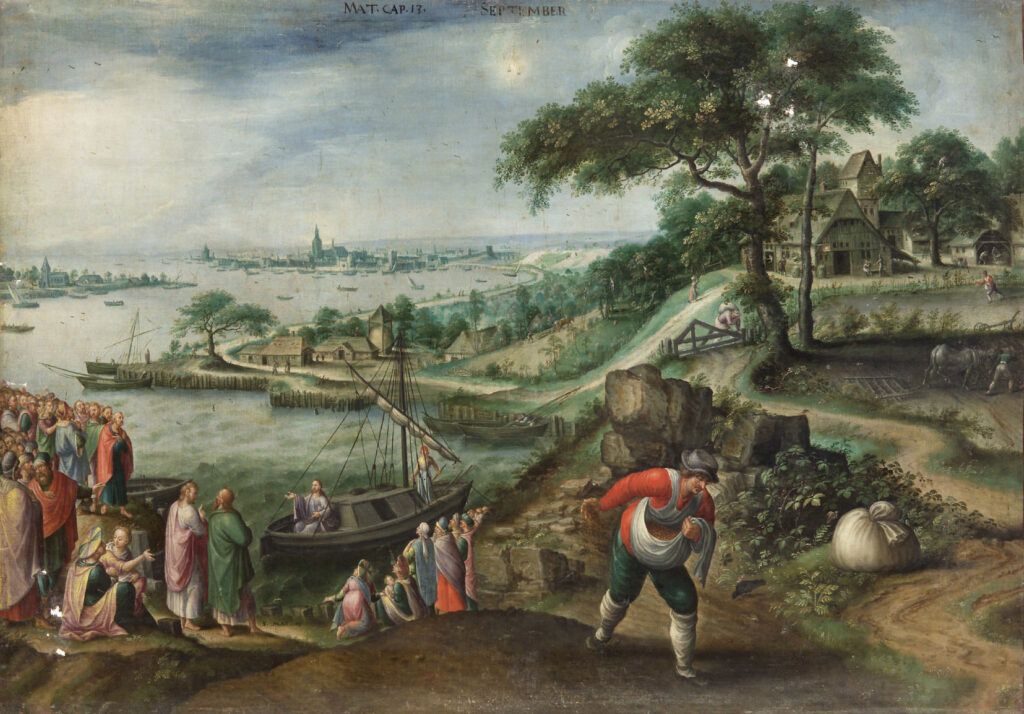
That same day Jesus went out of the house and sat beside the sea. And great crowds gathered about him, so that he got into a boat and sat there; and the whole crowd stood on the beach.
And he told them many things in parables, saying: “A sower went out to sow. And as he sowed, some seeds fell along the path, and the birds came and devoured them.
Other seeds fell on rocky ground, where they had not much soil, and immediately they sprang up, since they had no depth of soil, but when the sun rose they were scorched; and since they had no root they withered away.
Other seeds fell upon thorns, and the thorns grew up and choked them.
Other seeds fell on good soil and brought forth grain, some a hundredfold, some sixty, some thirty.
He who has ears, let him hear.”
Then the disciples came and said to him, “Why do you speak to them in parables?”
And he answered them, “To you it has been given to know the secrets of the kingdom of heaven, but to them it has not been given.
For to him who has will more be given, and he will have abundance; but from him who has not, even what he has will be taken away.
This is why I speak to them in parables, because seeing they do not see, and hearing they do not hear, nor do they understand.
With them indeed is fulfilled the prophecy of Isaiah which says:
‘You shall indeed hear but never understand,
and you shall indeed see but never perceive.
For this people’s heart has grown dull,
and their ears are heavy of hearing,
and their eyes they have closed,
lest they should perceive with their eyes,
and hear with their ears,
and understand with their heart,
and turn for me to heal them.’
But blessed are your eyes, for they see, and your ears, for they hear. Truly, I say to you, many prophets and righteous men longed to see what you see, and did not see it, and to hear what you hear, and did not hear it.
“Hear then the parable of the sower.
When any one hears the word of the kingdom and does not understand it, the evil one comes and snatches away what is sown in his heart; this is what was sown along the path.
As for what was sown on rocky ground, this is he who hears the word and immediately receives it with joy; yet he has no root in himself, but endures for a while, and when tribulation or persecution arises on account of the word, immediately he falls away.
As for what was sown among thorns, this is he who hears the word, but the cares of the world and the delight in riches choke the word, and it proves unfruitful.
As for what was sown on good soil, this is he who hears the word and understands it; he indeed bears fruit, and yields, in one case a hundredfold, in another sixty, and in another thirty.”
What do the Fathers say?
St HILARY. There is a reason why the Lord should sit in the ship, and the multitude stand on the shore. For He was about to speak in parables, and by this action signifies that they who were without the Church could have no understanding of the Divine Word. The ship offers a type of the Church, within which the word of life is placed, and is preached to those without, and who as being barren sand cannot understand it.
St JEROME. Jesus is in the midst of the waves; He is beaten to and fro by the waves, and, secure in His majesty, causes His vessel to come nigh the land, that the people not being in danger, not being surrounded by temptations which they could not endure, might stand on the shore with a firm step, to hear what was said.
St John CHRYSOSTOM. He had not done thus on the mount; He had not framed His discourse by parables. For there were the multitudes only, and a mixed crowd, but here the Scribes and Pharisees. But He speaks in parables not for this reason only, but to make His sayings plainer, and fix them more fully in the memory, by bringing things before the eyes.
St JEROME. And it is to be noted, that He spake not all things to them in parables, but many things, for had He spoken all things in parables, the people would have departed without benefit. He mingles things plain with things dark, that by those things which they understand they may be incited to get knowledge of the things they understand not. The multitude also is not of one opinion, but of diverse wills in diverse matters, whence He speaks to them in many parables, that each according to their several dispositions may receive some portion of His teaching.
St John CHRYSOSTOM. how is it according to reason to sow seed among thorns, or on stony ground, or by the wayside? Indeed in the material world it would not be reasonable; for it is impossible that rock should become soil, or that the way should not be the way, or that thorns should not be thorns.
But with minds and doctrines it is otherwise; there it is possible that the rock be made rich soil, that the way should be no more trodden upon, and that the thorns should be extirpated.
That the most part of the seed then perished, was not the fault of him that sowed, but of the soil that received it, that is the mind.
For He that sowed put no difference between rich and poor, wise or foolish, but spoke to all alike; filling up his own part, though foreseeing all things that should come to pass,
He does not pronounce sentence upon them openly and say, this the indolent received and have lost it, this the rich and have choked it, this the careless and have lost it, because He would not harshly reprove them, that He might not alienate them altogether.
By this parable also He instructs His disciples, that though the greater part of those that heard them were such as perished, yet that they should not therefore be remiss; for the Lord Himself who foresaw all things, did not on this account desist from sowing.
St JEROME. Note that this is the first parable that has been given with its interpretation, and we must beware where the Lord expounds His own teachings, that we do not presume to understand any thing either more or less, or any way otherwise than as so expounded by Him.
St RABANUS. But those things which He silently left to our understanding, should be shortly noticed. The wayside is the mind trodden and hardened by the continual passage of evil thoughts; the rock, the hardness of the self-willed mind; the good soil, the gentleness of the obedient mind, the sun, the heat of a raging persecution. The depth of soil, is the honesty of a mind trained by heavenly discipline.
Sources:
Bible readings from the Revised Standard Version of the Bible, Second Catholic Edition, copyright © 2006 National Council of the Churches of Christ in the USA
Quotes of the Fathers from :
Thomas Aquinas’ Catena Aurea Translated by St John Henry Newman
Artwork ex Wikimedia Commons