
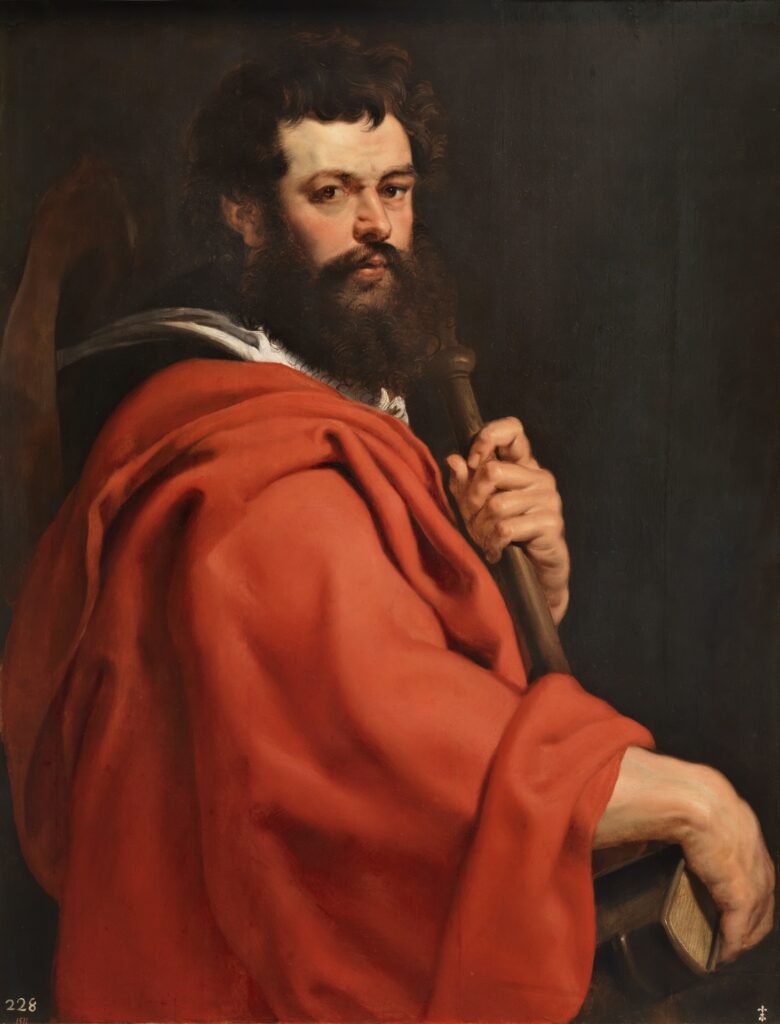
Gospel Reading :Matthew 20:20-28
Then the mother of the sons of Zebedee approached him, with her sons, adoring him, and petitioning something from him. And he said to her, “What do you want?”
She said to him, “Declare that these, my two sons, may sit, one at your right hand, and the other at your left, in your kingdom.”
But Jesus, responding, said: “You do not know what you are asking. Are you able to drink from the chalice, from which I will drink?” They said to him, “We are able.”
He said to them: “From my chalice, indeed, you shall drink. But to sit at my right or my left is not mine to give to you, but it is for those for whom it has been prepared by my Father.”
And the ten, upon hearing this, became indignant with the two brothers. But Jesus called them to himself and said: “You know that the first ones among the Gentiles are their rulers, and that those who are greater exercise power among them.
It shall not be this way among you. But whoever will want to be greater among you, let him be your minister. And whoever will want to be first among you, he shall be your servant, even as the Son of man has not come to be served, but to serve, and to give his life as a redemption for many.”
What do the Fathers say?
Pseudo-Chrysostom on the Gospel
Eusebius on the Martyrdom of Saint James
PSEUDO-CHRYSOSTOM. This mother of the sons of Zebedee is Salome, as her name is given by another Evangelist (Mark 15:40; 16:1.), herself truly peaceful, and the mother of sons of peace. From this place we learn the eminent merit of this woman; not only had her sons left their father, but she had left her husband, and had followed Christ; for He could live without her, but she could not be saved without Christ. Except any will say that between the time of the Apostle’s calling, and the suffering of Christ, Zebedee was dead, and that thus her sex helpless, her age advanced, she was following Christ’s steps; for faith never grows old, and religion feels never weary. Her maternal affection made her bold to ask, whence it is said, She worshipped Him, and desired a certain thing of Him; i. e. she did Him reverence, requesting that what she should ask, should be granted her. It follows, He said unto her, What do you want? He asks not because He knows not, but that by its very statement, the unreasonableness of her petition might be shown.
This woman’s request was not for earthly things, but it was heavenly things that she requested for her sons. For she felt not as ordinary mothers, whose affection is to the bodies of their children, while they neglect their minds; they desire that they should prosper in this world, not caring what they shall suffer in the next, thereby showing themselves to be mothers of their bodies only, but not of their souls.
He that gave Himself to man, how shall He not give them the fellowship of His kingdom?
Let us therefore put forward our mother, that she may make her petition for us in her own person. For though she be blamed therein, yet she will readily obtain forgiveness. For the Lord Himself, who has filled the souls of mothers with affection to their offspring, will more readily listen to their desires.
Then the Lord, who knows secrets, makes answer not to the words of the mother’s petition, but to the design of the sons who suggested it. Their wish was commendable, but their request inconsiderate; therefore, though it was not right that it should be granted to them, yet the simplicity of their petition did not deserve a harsh rebuke, forasmuch as it proceeded of love of the Lord.
Wherefore it is their ignorance that the Lord finds fault with; Jesus answered and said unto them, “You do not know what you are asking..
For oftentimes the Lord suffers His disciples either to do or to think somewhat amiss, so that from their error He may take occasion to set forth a rule of piety; knowing that their error does no harm while the Master is present, and His doctrine edifies them not for the present only, but for the future.
The Lord knew that they were able to follow His passion, but He puts the question to them that we may all hear, that no man can reign with Christ, unless he is conformed to Christ in His passion, for that which is precious is only to be purchased at a costly price. The Lord’s passion we may call not only the persecution of the Gentiles, but all the hardships we go through in struggling against our sins.
But as the two had asked carnally, so now the ten are grieved carnally. For as to seek to be above all is blame-worthy, so to have another above us is mortifying to our vanity.
EUSEBIUS of Caesarea. History of the Church Book II
Chapter XXIII
The Martyrdom of James, who was called the Brother of the Lord
1. But after Paul, in consequence of his appeal to Caesar, had been sent to Rome by Festus, the Jews, being frustrated in their hope of entrapping him by the snares which they had laid for him, turned against James, the brother of the Lord, to whom the episcopal seat at Jerusalem had been entrusted by the apostles. The following daring measures were undertaken by them against him.
2. Leading him into their midst they demanded of him that he should renounce faith in Christ in the presence of all the people. But, contrary to the opinion of all, with a clear voice, and with greater boldness than they had anticipated, he spoke out before the whole multitude and confessed that our Saviour and Lord Jesus is the Son of God. But they were unable to bear longer the testimony of the man who, on account of the excellence of ascetic virtue and of piety which he exhibited in his life, was esteemed by all as the most just of men, and consequently they slew him. Opportunity for this deed of violence was furnished by the prevailing anarchy, which was caused by the fact that Festus had died just at this time in Judea, and that the province was thus without a governor and head.
3. The manner of James’ death ; Clement, records that he was thrown from the pinnacle of the temple, and was beaten to death with a club. But Hegesippus, who lived immediately after the apostles, gives the most accurate account in the fifth book of his Memoirs. He writes as follows:
4. “James, the brother of the Lord, succeeded to the government of the Church in conjunction with the apostles. He has been called the Just by all from the time of our Saviour to the present day; for there were many that bore the name of James.
5. He was holy from his mother’s womb; and he drank no wine nor strong drink, nor did he eat flesh. No razor came upon his head; he did not anoint himself with oil, and he did not use the bath.
6. He alone was permitted to enter into the holy place; for he wore not woolen but linen garments. And he was in the habit of entering alone into the temple, and was frequently found upon his knees begging forgiveness for the people, so that his knees became hard like those of a camel, in consequence of his constantly bending them in his worship of God, and asking forgiveness for the people.
7. Because of his exceeding great justice he was called the Just, and Oblias, which signifies in Greek, Bulwark of the people’ and Justice,’ in accordance with what the prophets declare concerning him.
8. Now some of the seven sects, which existed among the people and which have been mentioned by me in the Memoirs, asked him, What is the gate of Jesus?’ and he replied that he was the Saviour.
9. On account of these words some believed that Jesus is the Christ. But the sects mentioned above did not believe either in a resurrection or in one’s coming to give to every man according to his works. But as many as believed did so on account of James.
10. Therefore when many even of the rulers believed, there was a commotion among the Jews and Scribes and Pharisees, who said that there was danger that the whole people would be looking for Jesus as the Christ. Coming therefore in a body to James they said, We entreat thee, restrain the people; for they are gone astray in regard to Jesus, as if he were the Christ. We entreat thee to persuade all that have come to the feast of the Passover concerning Jesus; for we all have confidence in thee. For we bear thee witness, as do all the people, that thou art just, and dost not respect persons.
11. Do thou therefore persuade the multitude not to be led astray concerning Jesus. For the whole people, and all of us also, have confidence in thee. Stand therefore upon the pinnacle of the temple, that from that high position thou mayest be clearly seen, and that thy words may be readily heard by all the people. For all the tribes, with the Gentiles also, are come together on account of the Passover.’
12. The aforesaid Scribes and Pharisees therefore placed James upon the pinnacle of the temple, and cried out to him and said: Thou just one, in whom we ought all to have confidence, forasmuch as the people are led astray after Jesus, the crucified one, declare to us, what is the gate of Jesus.’
13. And he answered with a loud voice, Why do ye ask me concerning Jesus, the Son of Man? He himself sitteth in heaven at the right hand of the great Power, and is about to come upon the clouds of heaven.’
14. And when many were fully convinced and gloried in the testimony of James, and said, Hosanna to the Son of David,’ these same Scribes and Pharisees said again to one another, We have done badly in supplying such testimony to Jesus. But let us go up and throw him down, in order that they may be afraid to believe him.’
15. And they cried out, saying, Oh! oh! the just man is also in error.’ And they fulfilled the Scripture written in Isaiah, Let us take away the just man, because he is troublesome to us: therefore they shall eat the fruit of their doings.’
16. So they went up and threw down the just man, and said to each other, Let us stone James the Just.’ And they began to stone him, for he was not killed by the fall; but he turned and knelt down and said, I entreat thee, Lord God our Father, forgive them, for they know not what they do.’
17. And while they were thus stoning him one of the priests of the sons of Rechab, the son of the Rechabites, who are mentioned by Jeremiah the prophet, cried out, saying, Cease, what do ye? The just one prayeth for you.’
18. And one of them, who was a fuller, took the club with which he beat out clothes and struck the just man on the head. And thus he suffered martyrdom. And they buried him on the spot, by the temple, and his monument still remains by the temple. He became a true witness, both to Jews and Greeks, that Jesus is the Christ. And immediately Vespasian besieged them.”
19. These things are related at length by Hegesippus, who is in agreement with Clement. James was so admirable a man and so celebrated among all for his justice, that the more sensible even of the Jews were of the opinion that this was the cause of the siege of Jerusalem, which happened to them immediately after his martyrdom for no other reason than their daring act against him.
Sources:
BIBLE READINGS FROM THE CATHOLIC PUBLIC DOMAIN VERSION
Quotes of the Fathers from :
Thomas Aquinas’ Catena Aurea Translated by St John Henry Newman
Extract from Eusebius of Caesarea History of the Church
Artwork ex Wikimedia Commons