First Reading : Sirach 27:30—28:7
Anger and wrath, these also are abominations,
and the sinful man will possess them.
He that takes vengeance will suffer vengeance from the Lord,
and he will firmly establish his sins.
Forgive your neighbor the wrong he has done,
and then your sins will be pardoned when you pray.
Does a man harbour anger against another,
and yet seek for healing from the Lord?
Does he have no mercy toward a man like himself,
and yet pray for his own sins?
If he himself, being flesh, maintains wrath,
who will make expiation for his sins?
Remember the end of your life, and cease from enmity,
remember destruction and death, and be true to the commandments.
Remember the commandments, and do not be angry with your neighbor;
remember the covenant of the Most High, and overlook ignorance.
Gospel Reading : Matthew 18:21-35
Then Peter came up and said to him, “Lord, how often shall my brother sin against me, and I forgive him? As many as seven times?” Jesus said to him, “I do not say to you seven times, but seventy times seven.
“Therefore the kingdom of heaven may be compared to a king who wished to settle accounts with his servants. When he began the reckoning, one was brought to him who owed him ten thousand talents; and as he could not pay, his lord ordered him to be sold, with his wife and children and all that he had, and payment to be made.
So the servant fell on his knees, imploring him, ‘Lord, have patience with me, and I will pay you everything.’ And out of pity for him the lord of that servant released him and forgave him the debt.
But that same servant, as he went out, came upon one of his fellow servants who owed him a hundred denarii, and seizing him by the throat he said, ‘Pay what you owe.’ So his fellow servant fell down and besought him, ‘Have patience with me, and I will pay you.’ He refused and went and put him in prison till he should pay the debt.
When his fellow servants saw what had taken place, they were greatly distressed, and they went and reported to their lord all that had taken place.
Then his lord summoned him and said to him, ‘You wicked servant! I forgave you all that debt because you besought me; and should not you have had mercy on your fellow servant, as I had mercy on you?’ And in anger his lord delivered him to the jailers, till he should pay all his debt.
So also my heavenly Father will do to every one of you, if you do not forgive your brother from your heart.”
What do the Fathers say?
St John CHRYSOSTOM. Peter thought that he had made a large allowance; but what does Christ, the Lover of men reply?, “I do not say to you seven times, but seventy times seven.
When He says, Until seventy times seven, He does not limit a definite number within which forgiveness must be kept; but He signifies thereby something endless and ever enduring.
St RABANUS. It is one thing to give pardon to a brother when he seeks it, so that he may live with us in social charity, as Joseph to his brethren; and another to a hostile foe, that we may wish him good, and if we can do him good, as David mourning for Saul.
St REMIGIUS. By the servants of this King are signified all mankind whom He has created for His own praise, and to whom He gave the law of nature; He takes account with them, when He would look into each man’s manners, life, and deeds, that He may render to each according to what He has done.
Man who sinned of his own will and choice, has no power to rise again by his own endeavour, and has not wherewith to pay, because he finds nothing in himself by which he may free himself from his sins.
St John CHRYSOSTOM. See the exuberance of heavenly love! The servant asked only for a brief respite, but he gives him more than he had asked for; a full remittance and cancelling of the whole debt.
But he did not remit the debt till he had taken account, because he would have him know how great were the debts from which he had set him free, so that by this he should at least be made more merciful.
And there is as great a difference between sins committed against men, and sins committed against God, as between ten thousand talents and a hundred denarii.
For when we are seen of man we withhold and are loathe to sin, but we cease not daily although God can see us, to act and speak all things fearlessly. Not by this only are our sins against God shown to be more heinous, but also by reason of the benefits which we have received from Him; He gave us being, and has done all things on our behalf, has breathed into us a rational soul, has sent His Son, has opened heaven to us, and made us His sons. If then we should every day die for Him, could we make Him any worthy return?
St JEROME. That this may be made plainer, let us speak it in instances. If any one of you shall have committed an adultery, a homicide, or a sacrilege, these greater sins of ten thousand talents shall be remitted when you beg for it, if you also shall remit lesser offences to those that trespass against you.
St John CHRYSOSTOM. When he owed him ten thousand talents, he did not call him wicked, nor did he at all chide him, but had mercy on him; but now when he had been ungenerous to his fellow-servant, then he says to him, you wicked servant; Should you not to have had mercy upon your fellow-servant.
Because kindness had not mended him, it only remains that he be corrected by punishment;
And his punishment shall be increasing and eternal, and he shall never be able to repay. And however irrevocable are the graces and callings of God, yet wickedness has that force, that it seems to break even this law.
Symbolism in artwork
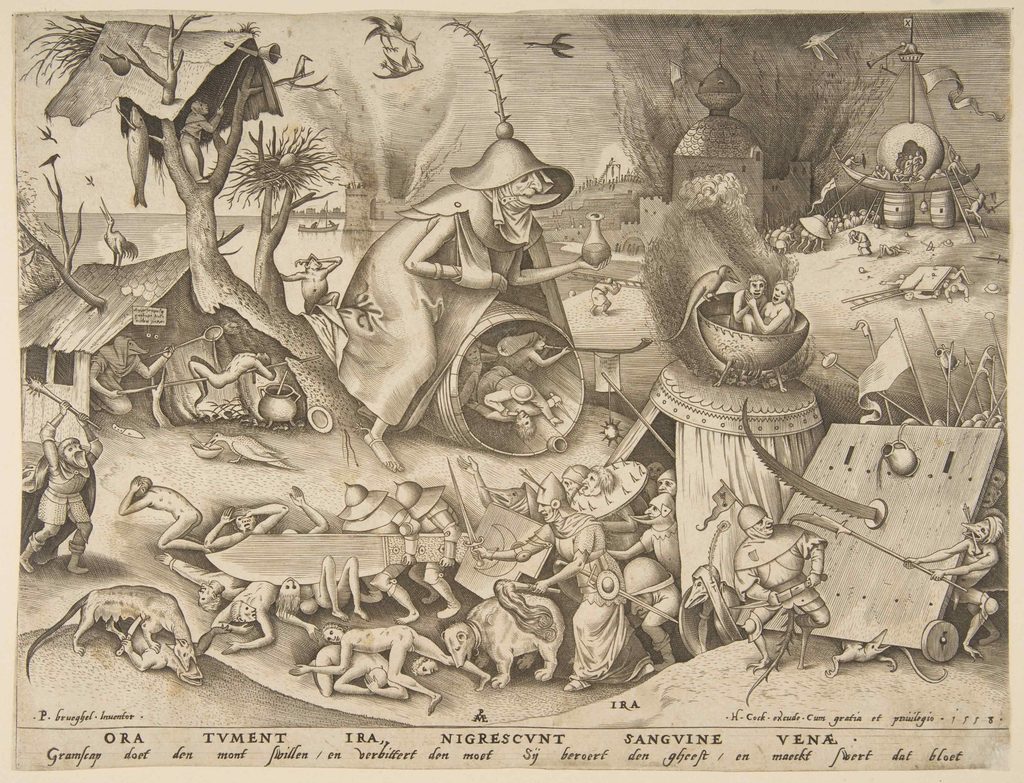
– This print is Ira (Wrath / Anger), designed by Pieter Bruegel the Elder in 1557 and engraved/published by Hieronymus Cock in 1558 as part of his famous seven-part series The Seven Deadly Sins (Septem Peccata Capitalia).
Heavily inspired by the surreal, demonic visual language of Hieronymus Bosch, Bruegel translates the abstract sin of rage into a nightmare landscape of senseless violence, self-destruction, and apocalyptic warfare.
1. The Central Personification of Ira
At the center of the composition stands the colossal personification of Wrath:
- The Armor & Cloak: She is rendered as an imposing, helmeted woman or monster clad in a hooded cloak, wearing armour underneath, with a long sharp thorn or sword blade extending from her helmet.
- The Flask: She holds a glass flask or vessel, symbolizing the volatile, explosive substance of blind fury ready to be poured out.
- The Barrel: She straddles a large wooden barrel lying on its side. Inside the barrel, a group of figures is trapped, tearing at each other in confined brawling—illustrating how anger traps the mind in enclosed, irrational conflict.
2. Foreground Details: The Mechanics of Violence
- The Oversized Blade: Below the central figure, a group of helmeted soldiers pushes a giant, unwieldy knife/blade into a crowd of helpless, fallen figures. Bruegel uses literal visual hyperbole (a knife far too large for any single warrior) to show how rage weaponizes technology beyond human control.
- Mutated Combatants: Soldiers on the right wear strange hybrid armor—shields attached directly to heads, avian beaks, and spiked visors—showing how wrath dehumanizes combatants, turning them into predatory beasts.
- Fighting Dogs: In the bottom left foreground, two dog-like creatures savage each other. In 16th-century emblem tradition, fighting dogs were a standard proverbial symbol for irrational, unprovoked quarreling (canina rabies).
- Brawling in the Ruin: To the left, inside a dilapidated shack beneath a hanging dead fish, figures attack each other with giant ladles, pots, and knives, showing that rage infects domestic, low-class life just as it infects military campaigns.
3. Midground: Punishment and War Engines
- The Boiling Cauldron: On the right, atop a draped pedestal, two naked souls are boiled alive inside a massive, tripod-mounted cauldron while a dragon-like demon watches over them—representing both the internal “boiling” of anger’s temper and its eternal punishment in Hell.
- The Siege Engine: Behind the cauldron sits a heavy, mobile war shield/mantlet fitted with a massive scythe blade and spear ports, symbolizing how personal anger escalates into organized military destruction.
4. Background: The Landscape of Destruction
In the upper horizon, the logical consequence of unchecked Ira is displayed:
- Cities and fortresses are engulfed in flames.
- Ships sink or burn in the harbor.
- A gallows stands on a distant hill, showing that lawlessness and execution are the final destination of a society consumed by wrath.
5. Margin Inscriptions and Translation
At the bottom of the plate, the Latin and Dutch inscriptions synthesize the moral and medical understanding of anger during the Northern Renaissance:
Middle Dutch Inscription:Gramschap doet den mont swillen / en verbittert den moet / Sy beroert den gheest / en maeckt swert dat bloet.Translation: “Anger swells the mouth and embitters the mind; it disturbs the spirit and turns the blood black.”Sources:
Latin Inscription:ORA TVMENT IRA, NIGRESCVNT SANGVINE VENÆ.Translation: “Faces swell with anger, veins grow black with blood.”(Adapted from Ovid’s Ars Amatoria, reflecting the humoral medical theory that rage heats the body and darkens the blood).
Bible readings from the Revised Standard Version of the Bible, Second Catholic Edition, copyright © 2006 National Council of the Churches of Christ in the USA
Quotes of the Fathers from :
Thomas Aquinas’ Catena Aurea Translated by St John Henry Newman
Artwork ex Wikimedia Commons
Artwork symbolism: AI generated