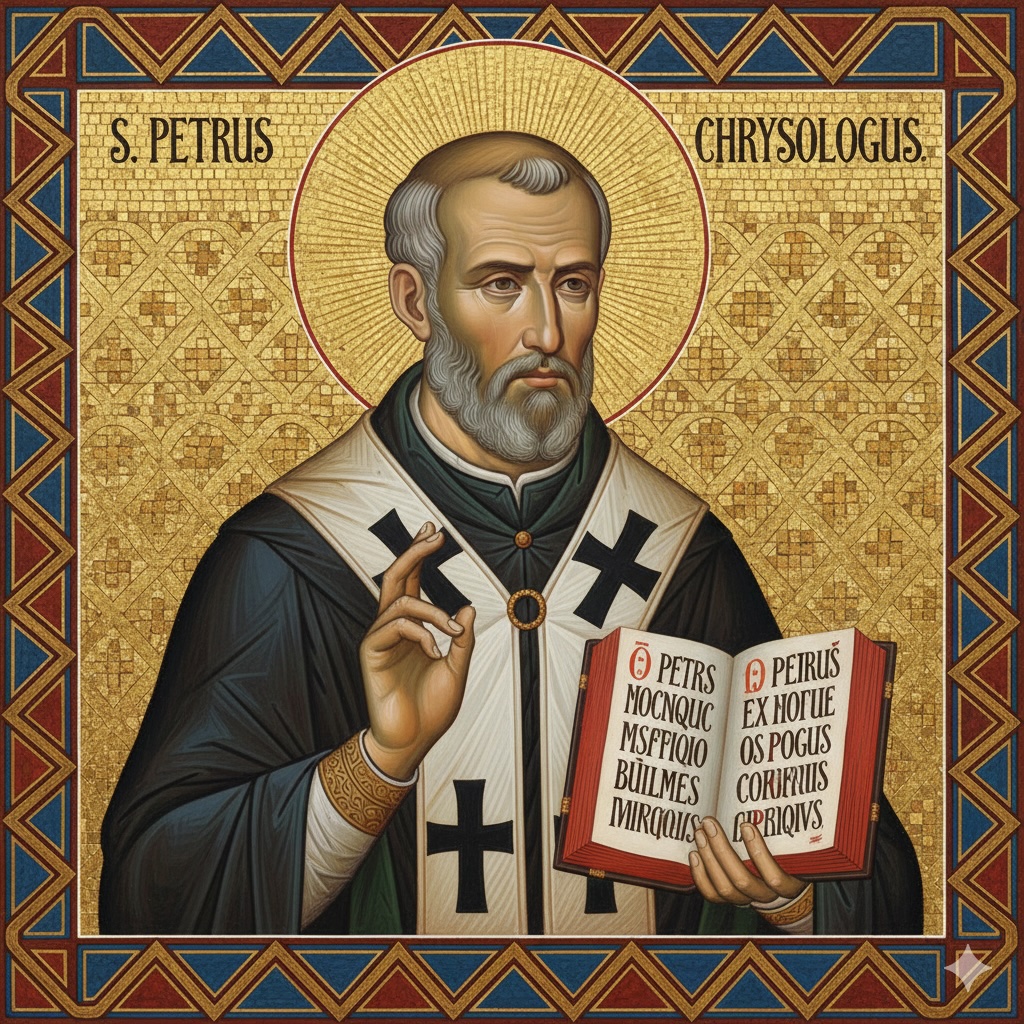
St. Peter Chrysologus (c. 406 – 450 AD)
He was the Bishop of Ravenna and is a Doctor of the Church.His name, “Chrysologus,” means “Golden-Worded,” a title he earned for his exceptional skill in preaching—specifically for his ability to deliver powerful, concise, and accessible sermons.
Early Life and Appointment
- Birth: He was born in Imola, Italy in about 406AD
- He was baptized, educated, and ordained a deacon by Bishop Cornelius of Imola, whom Peter regarded throughout his life as his spiritual father.
- Elevation to Bishop: In 433 AD, Pope Sixtus III appointed him Bishop of Ravenna, which was then the capital of the Western Roman Empire. – Tradition has it that Pope Sixtus III had a vision of St. Peter and St. Apollinaris (the first bishop of Ravenna) commanding him to appoint Peter of Imola, rather than the candidate the people of Ravenna had originally chosen.
The “Golden-Worded” Preacher
As bishop, Peter became famous for his short but brilliant homilies. During an era of long, complex theological debates, he focused on the practical and the essential.
- His sermons were designed to be brief so as not to tire the listener, but they were packed with spiritual depth and clarity.
- About 176 of his short sermons have survived. They cover a wide range of topics, including explanations of the Apostles’ Creed, the Incarnation, and the role of the Virgin Mary.
- One of his most enduring sayings is: “He who wants to play with the devil cannot rejoice with Christ.”
Defense of Orthodoxy
Peter lived during a time of intense theological conflict regarding the nature of Christ.
- Against Eutychianism: When the heretic Eutyches sought his support for the Monophysite heresy (which claimed Christ had only one divine nature), Peter famously replied that he should submit to the authority of the Pope.
- Unity with Rome: He was a staunch defender of the primacy of the Bishop of Rome. He famously wrote to Eutyches: “We exhort you, honorable brother, to submit obediently to what has been written by the blessed Pope of Rome, for blessed Peter, who lives and presides in his own see, gives the truth of faith to those who seek it.”
Death and Legacy
- Death: He died in his birthplace of Imola around the year 450 AD, shortly before the great Council of Chalcedon.
- Doctor of the Church: Because of his profound contributions to early Christian teaching and his mastery of the “sacred word,” he was declared a Doctor of the Church by Pope Benedict XIII in 1729.
- Feast Day: His feast day is celebrated on July 30.
Sources:
Catholic Encyclopædia
Wikipedia