John 6:1-15
When the people saw the sign which he had done, they said, “This is indeed the prophet who is to come into the world!”
After this Jesus went to the other side of the Sea of Galilee, which is the Sea of Tibe′rias.
And a multitude followed him, because they saw the signs which he did on those who were diseased.
Jesus went up into the hills, and there sat down with his disciples.
Now the Passover, the feast of the Jews, was at hand.
Lifting up his eyes, then, and seeing that a multitude was coming to him, Jesus said to Philip, “How are we to buy bread, so that these people may eat? This he said to test him, for he himself knew what he would do.
Philip answered him, “Two hundred denarii would not buy enough bread for each of them to get a little.”
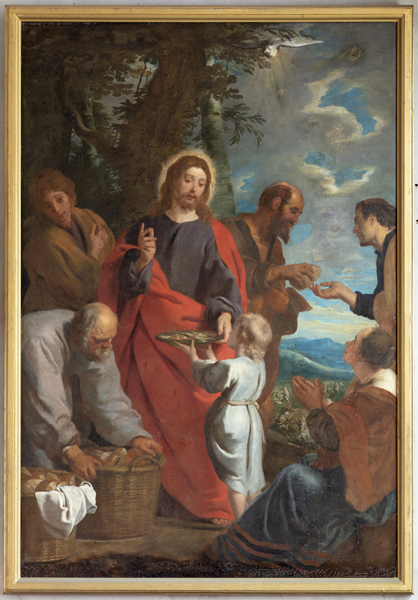
One of his disciples, Andrew, Simon Peter’s brother, said to him, “There is a lad here who has five barley loaves and two fish; but what are they among so many?”
Jesus said, “Make the people sit down.”
Now there was much grass in the place; so the men sat down, in number about five thousand.
Jesus then took the loaves, and when he had given thanks, he distributed them to those who were seated; so also the fish, as much as they wanted.
And when they had eaten their fill, he told his disciples, “Gather up the fragments left over, that nothing may be lost.”
So they gathered them up and filled twelve baskets with fragments from the five barley loaves, left by those who had eaten.
When the people saw the sign which he had done, they said, “This is indeed the prophet who is to come into the world!”
Perceiving then that they were about to come and take him by force to make him king, Jesus withdrew again to the hills by himself
What do the Fathers say?
St John CHRYSOSTOM. As missiles rebound with great force from a hard body, and fly off in all directions, whereas a softer material retains and stops them; so violent men are only excited to greater rage by violence on the side of their opponents, whereas gentleness softens them. Christ quieted the irritation of the Jews by retiring from Jerusalem. He went into Galilee, but not to Cana again, but beyond the sea.
St ALCUIN. This sea has different names, from the different places with which it is connected; the sea of Galilee, from the province; the sea of Tiberias, from the city of that name. It is called a sea, though it is not salt water, that name being applied to all large pieces of water, in Hebrew. This sea our Lord often passes over, in going to preach to the people bordering on it.
St AUGUSTINE. One kind of temptation leads to sin, with which God never tempts any one; (James 1:13.) and there is another kind by which faith is tried. (Deut. 13:3.) When it is said that our Lord proved Philip, we must understand that He knew him perfectly, but that He tried him, in order to confirm his faith.
St ALCUIN. He asks him this question, not for His own information, but in order to show His yet unformed disciple his dulness of mind, which he could not perceive of himself.
THEOPHYLACT. Andrew is in the same perplexity that Philip is; only he has rather higher notions of our Lord: There is a lad here who has five barley loaves and two small fishes.
St John CHRYSOSTOM. He did not really want any material to work from, but only made use of created things for this purpose in order to show that no part of creation was severed from His wisdom.
HILARY. Five loaves are then set before the multitude, and broken. The broken portions pass through into the hands of those who break, that from which they are broken all the time not at all diminishing. And yet there they are, the bits taken from it, in the hands of the persons breaking. There is no catching by eye or touch the miraculous operation: that is, which was not, that is seen, which is not understood. It only remains for us to believe that God can do all things.
St AUGUSTINE. He multiplied in His hands the five loaves, just as He produces harvest out of a few grains. There was a power in the hands of Christ; and those five loaves were, as it were, seeds, not indeed committed to the earth, but multiplied by Him who made the earth.
But let us reflect a little here. Forasmuch as the Divine Substance is not visible to the eye, and the miracles of the divine government of the world, and ordering of the whole creation, are overlooked in consequence of their constancy; God has reserved to Himself acts, beside the established course and order of nature, to do at suitable times; in order that those who overlooked the daily course of nature, might be roused to wonder by the sight of what was different from, though not at all greater, than what they were used to.
The government of the world is a greater miracle, than satisfying the hunger of five thousand with five loaves; and yet no one wonders at this: the former excited wonder; not from any real superiority in it, but because it was uncommon.
But it would be wrong to gather no more than this from Christ’s miracles: for, the Lord who is on the mount, and the Word of God which is on high, the same is no humble person to be lightly passed over, but we must look up to Him reverently.
By the act of breaking He multiplied the five loaves. The five books of Moses, when expounded by breaking, i. e. unfolding them, made many books.
And what are the fragments, but the parts which the people could not eat? An intimation, that those deeper truths, which the multitude cannot take in, should be entrusted to those who are capable of receiving them, and afterwards teaching them to others; as were the Apostles. For which reason twelve baskets were filled with them.