Gospel Reading : John 19:25-34
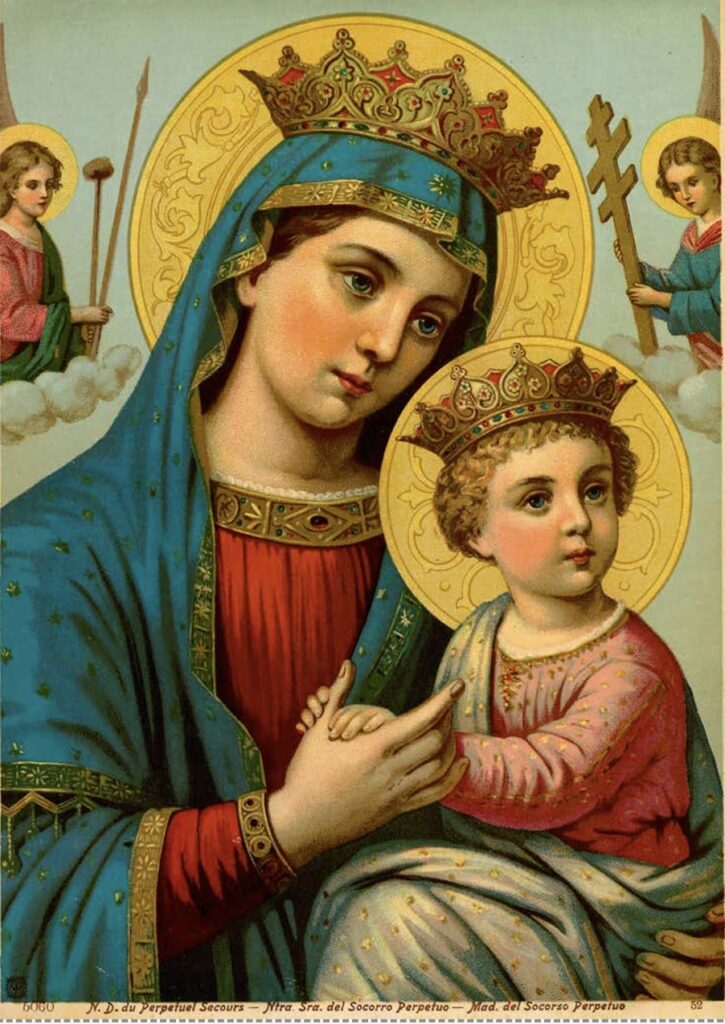
So the soldiers did this. But standing by the cross of Jesus were his mother, and his mother’s sister, Mary the wife of Clopas, and Mary Mag′dalene. When Jesus saw his mother, and the disciple whom he loved standing near, he said to his mother, “Woman, behold, your son!” Then he said to the disciple, “Behold, your mother!” And from that hour the disciple took her to his own home.
After this Jesus, knowing that all was now finished, said (to fulfil the scripture), “I thirst.” A bowl full of vinegar stood there; so they put a sponge full of the vinegar on hyssop and held it to his mouth. When Jesus had received the vinegar, he said, “It is finished”; and he bowed his head and gave up his spirit.
Since it was the day of Preparation, in order to prevent the bodies from remaining on the cross on the sabbath (for that sabbath was a high day), the Jews asked Pilate that their legs might be broken, and that they might be taken away.
So the soldiers came and broke the legs of the first, and of the other who had been crucified with him; but when they came to Jesus and saw that he was already dead, they did not break his legs. But one of the soldiers pierced his side with a spear, and at once there came out blood and water.
What do the Fathers say?
On the Gospel Reading:
St AMBROSE. Mary the mother of our Lord stood before the cross of her Son. None of the Evangelists hats told me this except John.
The others have related how that at our Lord’s Passion the earth quaked, the heaven was overspread with darkness, the sun fled, the thief was taken into paradise after confession.
John has told us, what the others have not, how that from the cross whereon He hung, He called to His mother. He thought it a greater thing to show Him victorious over punishment, fulfilling the offices of piety to His mother, than giving the kingdom of heaven and eternal life to the thief.
For if it was pious to give life to the thief, a much richer work of piety it is for a son to honour his mother with such affection. Behold, He said, your son; behold your mother. Christ made His Testament from the cross, and divided the offices of piety between the Mother and the disciples. Our Lord made not only a public, but also a domestic Testament.
And this His Testament John sealed, a witness worthy of such a Testator. A good testament it was, not of money, but of eternal life, which was not written with ink, but with the spirit of the living God: My tongue is the pen of a ready writer. (Ps. 45:1)
Mary, as became the mother of our Lord, stood before the cross, when the Apostles fled, and with pitiful eyes beheld the wounds of her Son. For she looked not on the death of the Hostage, but on the salvation of the world; and perhaps knowing that her Son’s death would bring this salvation, she who had been the habitation of the King, thought that by her death she might add to that universal gift.
On Mary, the Mother of the Church:
Saint Chromatius of Aquileia (died c. 407)
“The apostles, having returned from the Mount of Olives, stayed in the upper room, and they were persevering in prayer with one mind with the women and Mary the mother of Jesus… It was fitting that the mother of the Lord should be present at the birth of the Church, just as she was present at the birth of the Lord.”
Blessed Isaac of Stella (c. 1100–1178)
“In the inspired Scriptures, what is said universally of the Church, virgin and mother,
is said individually of Mary…
Head and members are one son, yet many sons;
in the same way,
Mary and the Church are one mother, yet more than one mother…
Each is Christ’s mother, but neither gives birth to the whole Christ without the co-operation of the other.”
Saint Bernard of Clairvaux (1090–1153)
“Consider, then, with what deeper feelings of devotion God has willed that we should honour Mary, He who has placed the fullness of all good in her; so that if there is any hope in us, if any grace, if any salvation, we know that it overflows from her.”
Catechism of the Catholic Church. “We believe that the Holy Mother of God, the new Eve, Mother of the Church, continues in heaven to exercise her maternal role on behalf of the members of Christ”
– Paragraph 975.
Pope Paul VI. “We declare Mary Most Holy Mother of the Church, that is, of all the Christian people, the faithful as well as the pastors, who call her the most loving Mother.”
– on November 21, 1964, at the conclusion of the Second Vatican Council’s third session:
Pope St John Paul II “Descending upon the apostles assembled with Mary, Christ’s mother, the Holy Spirit transforms and unites them, ‘filling them’ with the fullness of the divine life. They become ‘one,’ an apostolic community, ready to bear witness to the crucified and risen Christ. This is the new creation which flowed from the cross and was given life by the Holy Spirit, who gave the Church its historical beginning at Pentecost.”
— General Audience, August 30, 1998