
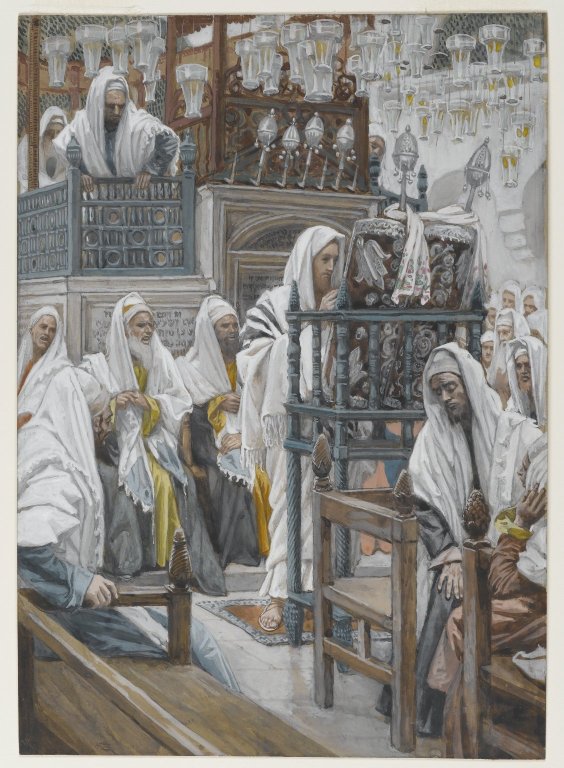
Gospel Reading: Luke 4:16-30
And he came to Nazareth, where he had been brought up; and he went to the synagogue, as his custom was, on the sabbath day. And he stood up to read; and there was given to him the book of the prophet Isaiah. He opened the book and found the place where it was written,
“The Spirit of the Lord is upon me,
because he has anointed me to preach good news to the poor.
He has sent me to proclaim release to the captives
and recovering of sight to the blind,
to set at liberty those who are oppressed
to proclaim the acceptable year of the Lord.”
And he closed the book, and gave it back to the attendant, and sat down; and the eyes of all in the synagogue were fixed on him. And he began to say to them, “Today this scripture has been fulfilled in your hearing.” And all spoke well of him, and wondered at the gracious words which proceeded out of his mouth; and they said, “Is not this Joseph’s son?”
And he said to them, “Doubtless you will quote to me this proverb, ‘Physician, heal yourself; what we have heard you did at Capernaum, do here also in your own country.’” And he said, “Truly, I say to you, no prophet is acceptable in his own country.
But in truth, I tell you, there were many widows in Israel in the days of Elijah, when the heaven was shut up three years and six months, when there came a great famine over all the land; and Elijah was sent to none of them but only to Zarephath, in the land of Sidon, to a woman who was a widow.
And there were many lepers in Israel in the time of the prophet Elisha; and none of them was cleansed, but only Naaman the Syrian.”
When they heard this, all in the synagogue were filled with wrath. And they rose up and put him out of the city, and led him to the brow of the hill on which their city was built, that they might throw him down headlong. But passing through the midst of them he went away.
What do the Fathers say?
St AMBROSE. The Lord in every thing so humbled Himself to obedience, that He did not despise even the office of a reader,and there was delivered unto him the book. He received the book indeed, that He might show Himself to be the same who spoke in the Prophets, and that He might stop the blasphemies of the wicked, who say that there is one God of the Old Testament, another of the New; or who say that Christ had His beginning from a virgin. For how did He begin from a virgin, who spoke before that virgin was?
By the acceptable year of the Lord, he means this day extended through endless ages, which knows of no return to a world of labour, and grants to men everlasting reward and rest.
But this is given for an example, that in vain can you expect the aid of Divine mercy, if you grudge to others the fruits of their virtue.
The Lord despises the envious, and withdraws the miracles of His power from them that are jealous of His divine blessings in others. For our Lord’s Incarnation is evidence of His divinity, and His invisible things are proved to us by those which are visible. See then what evils envy produces.
Because of envy a country is deemed unworthy of the works of its citizen, which was worthy of the conception of the Son of God.
By a very apt comparison the arrogance of envious citizens is put to shame, and our Lord’s conduct shown to agree with the ancient Scriptures. For it follows, But I tell you of a truth, many widows were in Israel in the days of Elijah: not that the days were his, but that he performed his works in them.
Now in a mystery the people pollute the Church, that another people might succeed, gathered together from foreigners, leprous indeed at first before it is baptized in the mystical stream, but which after the sacrament of baptism, washed from the stains of body and soul, begins to be a virgin without spot or wrinkle.
It can not be wondered at that they lost their salvation who cast the Saviour out of their city. But the Lord who taught His Apostles by the example of Himself to be all things to all men, neither repels the willing, nor chooses the unwilling; neither struggles against those who cast Him out, nor refuses to hear those who supplicate Him.
But that conduct was the result of no slight enmity, which, forgetful of the feelings of fellow citizens, converts the causes of love into the bitterest hatred. For when the Lord Himself was extending His blessings among the people, they began to inflict injuries upon Him, as it follows, And they led him unto the brow of the hill, that they might cast him down.
At the same time we must understand that this bodily endurance was not necessary, but voluntary. When He wills, He is taken, when He wills, He escapes. For how could He be held by a few who was not held by a whole people?
But He would not have the impiety to be the deed of the many, in order that by a few indeed He might be afflicted, but might die for the whole world.
Moreover, He had still rather heal the Jews than destroy them, that by the fruitless issue of their rage they might be dissuaded from wishing what they could not accomplish.
Sources:
Bible readings from the Revised Standard Version of the Bible, Second Catholic Edition, copyright © 2006 National Council of the Churches of Christ in the USA
Quotes of the Fathers from :
Thomas Aquinas’ Catena Aurea Translated by St John Henry Newman
Artwork ex Wikimedia Commons