Saint of the day – 18 May
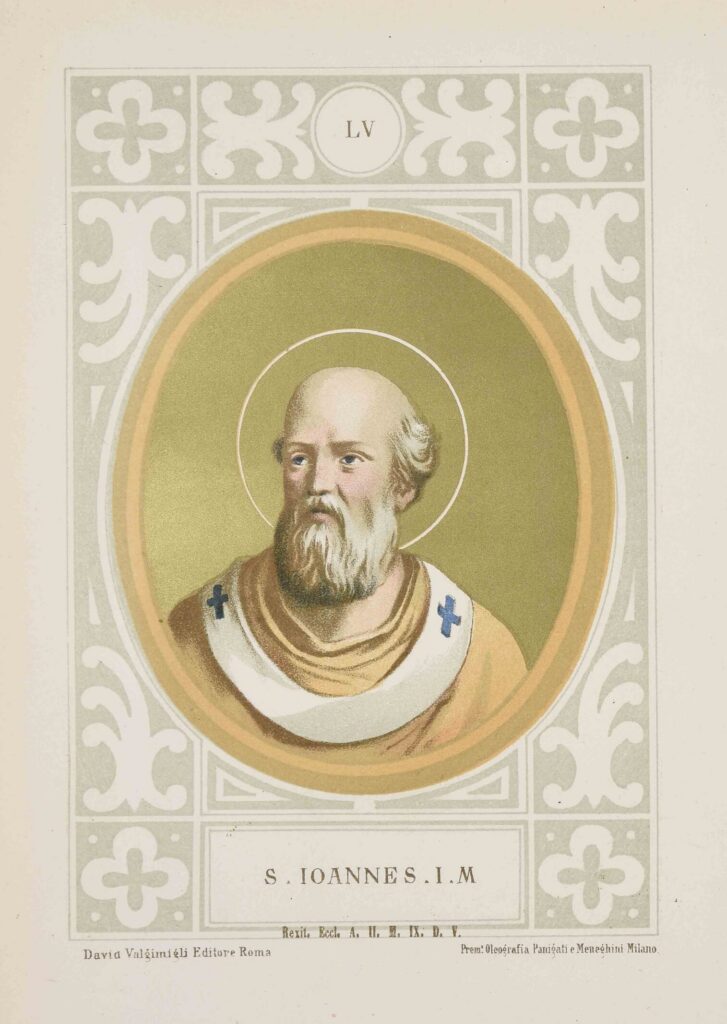
Pope Saint John I
He served as bishop of Rome from 523 to 526 AD, his brief pontificate was defined by an impossible geopolitical tightrope walk that ultimately cost him his life.
1. The Historical Setting: Two Emperors and a Heresy
To understand John I, we have to look at the tense political map of the early 6th century. The Western Roman Empire had fallen, and Rome was under the rule of Theodoric the Great, king of the Ostrogoths.
- The King (Theodoric): He ruled Italy from his capital in Ravenna. He was an Arian Christian, meaning he subscribed to the heresy that Jesus was a created being, subordinate to the Father—the exact opposite of the orthodox teaching defined at Nicaea and Chalcedon.
- The Emperor (Justin I): He ruled the Eastern Roman Empire from Constantinople. Unlike some of his predecessors, Justin I was fiercely orthodox and a defender of the Council of Chalcedon.
In 523, Emperor Justin issued a severe edict against the Eastern Arians, demanding they return all occupied churches to Catholics and stripping them of public office. The Arian King Theodoric in the West took this as a direct insult and suspected a secret, treasonous alliance brewing between the Roman Senate, the Pope, and the Byzantine Emperor.
2. The Impossible Diplomatic Mission
Terrified of a Byzantine invasion and furious over the treatment of his fellow Arians, Theodoric forced the frail, elderly Pope John to do something unprecedented: that is lead a diplomatic embassy to Constantinople. Theodoric’s demand was simple yet agonizing: Pope John had to convince Emperor Justin to rescind the anti-Arian edicts and allow converts from Arianism to return to their heretical positions. If John failed, Theodoric threatened bloody reprisals against the Catholic population in the West.
The Triumphal Welcome in Constantinople (526 AD)
Pope John I was the first reigning Pope to physically travel to Constantinople. His arrival was a massive historical event:
- The Greeting: Reports state that 15,000 citizens met him outside the city gates with crosses and candles. Emperor Justin I prostrated himself before the Pope “as if he were St. Peter in person” and requested that Pope John formally crown him again.
- The Crowning: On Easter Day (April 19, 526), Pope John solemnly celebrated mass according to the Latin Rite in the great Hagia Sophia, sitting in a seat of honour above the Patriarch of Constantinople. He then ceremonially crowned Emperor Justin.
3. Arrest, Imprisonment, and Martyrdom
While John successfully pleaded with the Emperor to treat the Arians with gentleness to protect the Western Catholics from Theodoric’s wrath, he resolutely refused to advocate for heresy itself. He defended the true Catholic faith of Chalcedon.
When King Theodoric received the news of the incredibly warm, unified relations between the Pope and the Emperor, his deep paranoia flared into rage. While the embassy was away, Theodoric had already arrested and executed the great Christian philosopher Boethius and his father-in-law Symmachus on suspicion of treason.
As soon as Pope John’s ship landed back in Italy, Theodoric had the entire delegation arrested. The frail Pope was brought to a dungeon in Ravenna, stripped of care, and subjected to severe privations. Exhausted by the grueling journey and broken by the harsh treatment, Pope John I died in prison on May 18, 526.
Because he stood fast by his theological duties and refused to bend to a tyrant king at the cost of his own life, the Church recognizes him as a Pope and Martyr. His feast day is celebrated on May 18 (the anniversary of his death).
Source:
Liber Pontificalis (Book of the Popes)