
Saint of the Day – 5 June
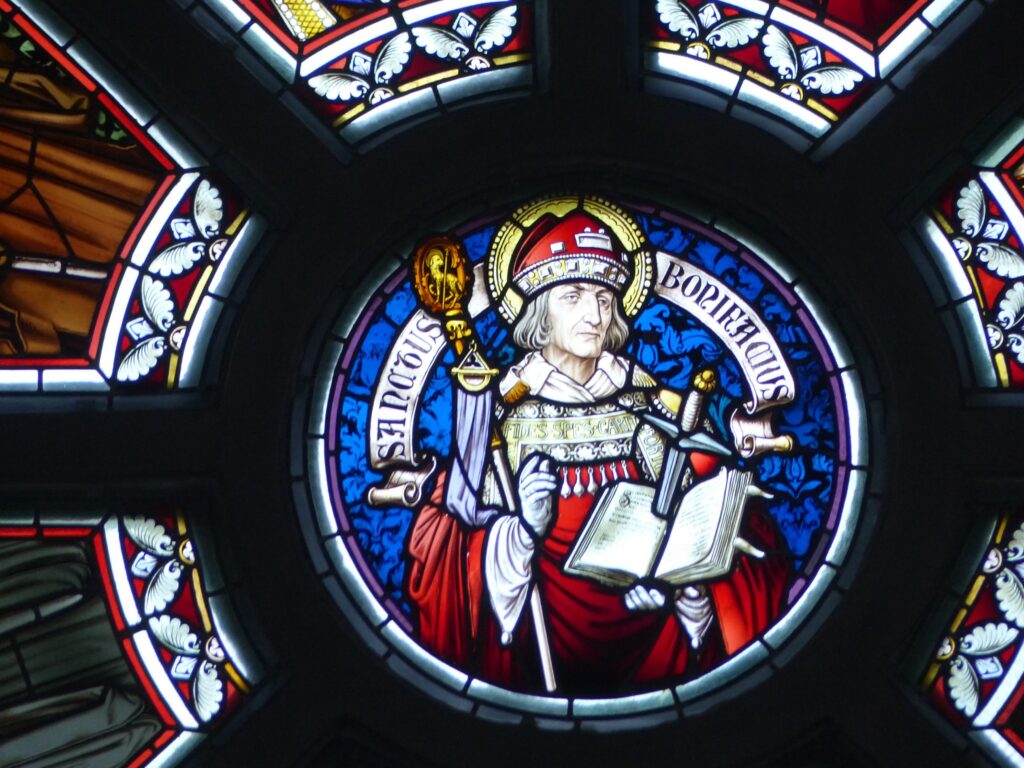
Saint Boniface (c. 675 – June 5, 754) – Known as the “Apostle of Germany,” was an Anglo-Saxon Benedictine monk who transformed the religious, cultural, and political landscape of central Europe.
Early Life
Boniface was born around 675 AD in the ancient Kingdom of Wessex (modern-day Devon, England). Local tradition strongly points to Crediton as his exact birthplace. He was given the Anglo-Saxon name Winfrid (or Wynfrith), which translates to “Friend of Peace”.
According to Willibald’s account, (The Life of Saint Boniface) , Winfrid was born into a prosperous, respected Saxon family with noble connections.
Around the age of five, traveling monks visited his family’s home. Listening to them discuss divine matters ignited a sudden, intense desire in the young boy to enter the religious life.
His father strenuously opposed the idea. As a wealthy landholder, his father intended for Winfrid to inherit the family estates and pursue a lucrative, worldly career.
The gridlock broke when his father fell dangerously ill. Viewing the sickness as a sign of divine displeasure, the softened father relented, recovered, and agreed to let his son follow his calling.
Education at Exeter and Nursling
At around age seven, Winfrid was sent to a monastery school in Adestancastre (modern-day Exeter), under the care of Abbot Wulfhard.
Seeking a more rigorous academic environment, he later transferred in his early teens to the Benedictine abbey of Nursling (located near Southampton). Under the mentorship of Abbot Winbert, Nursling was a thriving powerhouse of early medieval scholarship. Here, Winfrid deeply immersed himself in scriptural exegesis, Latin metrics, and poetry.
He excelled to a degree that earned him a sweeping reputation across England:
The First Latin Grammar: While still a relatively young monk at Nursling, Winfrid authored the Ars Grammatica—historically recognized as the very first Latin grammar textbook ever compiled in England..
Poetry and Riddles: He also wrote an advanced treatise on Latin verse and composed a collection of intricate theological riddles.
The Master of the School: Because of his towering intellect, he was quickly appointed the director and chief teacher of the abbey school at Nursling, attracting students from all over the region.
Ordination
Winfrid was ordained a priest around the age of 30. He immediately gained fame as an incredibly eloquent preacher.
Pilgrimage for Christ
By 716, Winfrid was at the absolute peak of a comfortable, prestigious academic and ecclesiastical career in England. When Abbot Winbert died, the monks of Nursling unanimously elected Winfrid to take his place as the new Abbot.
He flatly refused the position, he had no desire for human glory, for the thought of bringing the light of the Gospel to his kindred, the Old Saxons, in Germany, had taken possession of his mind. . Guided by a burning desire to engage in peregrinatio pro Christo (pilgrimage for Christ), he renounced his comfort, packed his books, and took a boat to the dangerous, pagan-dominated frontier of Frisia—setting the stage for his transformation into Saint Boniface.
Legacy
Boniface’s true historical legacy was his brilliance as an organizer and reformer. Working closely with the Papacy and the Frankish rulers (including Charles “The Hammer” Martel and Pepin the Short), he systematically built the framework of medieval Europe:
- He founded numerous monasteries, most notably the great Abbey of Fulda (744), which became the intellectual, cultural, and theological powerhouse of Germany.
- He established the diocesan hierarchy of Germany, founding major sees like Regensburg, Salzburg, and Erfurt, and eventually served as the Archbishop of Mainz.
- He cleaned up widespread corruption within the Frankish Church, convening synods to enforce clerical celibacy, eradicate simony (the selling of church offices), and standardize church practices under the direct authority of Rome.
Martyrdom on the Banks of the Borne
In 753, now an old man in his late 70s, Boniface chose to retire from his comfortable administrative duties in Mainz. His missionary heart longed to return to the rugged mission field of Frisia (modern-day Netherlands), where his evangelical work had first begun decades prior.
On June 5, 754, Boniface and a retinue of 52 Christian companions were encamped on the banks of the river Borne near Dokkum, preparing to administer the sacrament of Confirmation to a group of newly baptized converts.
Instead of the converts, a heavily armed band of hostile pagan Frisians suddenly ambushed the camp.
Boniface’s younger, armed companions immediately drew their weapons to defend their archbishop. However, echoing the ancient martyrs, Boniface forbade them from fighting, commanding:
“Cease, my sons, from combat… for the long-awaited day has come. Trust in God, and do not fear those who can kill the body but cannot harm the immortal soul.”
The pagans ruthlessly slaughtered Boniface and all 52 of his companions. According to early hagiographies, when the first sword-blow fell, Boniface instinctively raised a heavy gospel manuscript above his head to shield himself. The blade sliced straight through the holy book, cleaving his head.
The Shrine at Fulda
Following his martyrdom, his remains were triumphantly carried down the Rhine to his beloved Abbey of Fulda. His tomb inside Fulda Cathedral remains a monumental site of pilgrimage to this day, and the blood-stained, sword-slashed book—the famous Ragyndrudis Codex—is still preserved there as a priceless relic.
Sources:
Willibald; The Life of Boniface Translated into English by George W Robinson (1916)
Brittanica
Wikipedia
The Catholic Encyclopedia
Artwork ex Wikimedia Commons