Saint of the day – 9 June
Saint Ephrem the Syrian (c. 306–373 AD) is one of the most uniquely gifted theologians of the early Church, revered as a master poet, a brilliant teacher, and a passionate defender of the faith. Known historically as the “Harp of the Spirit“.
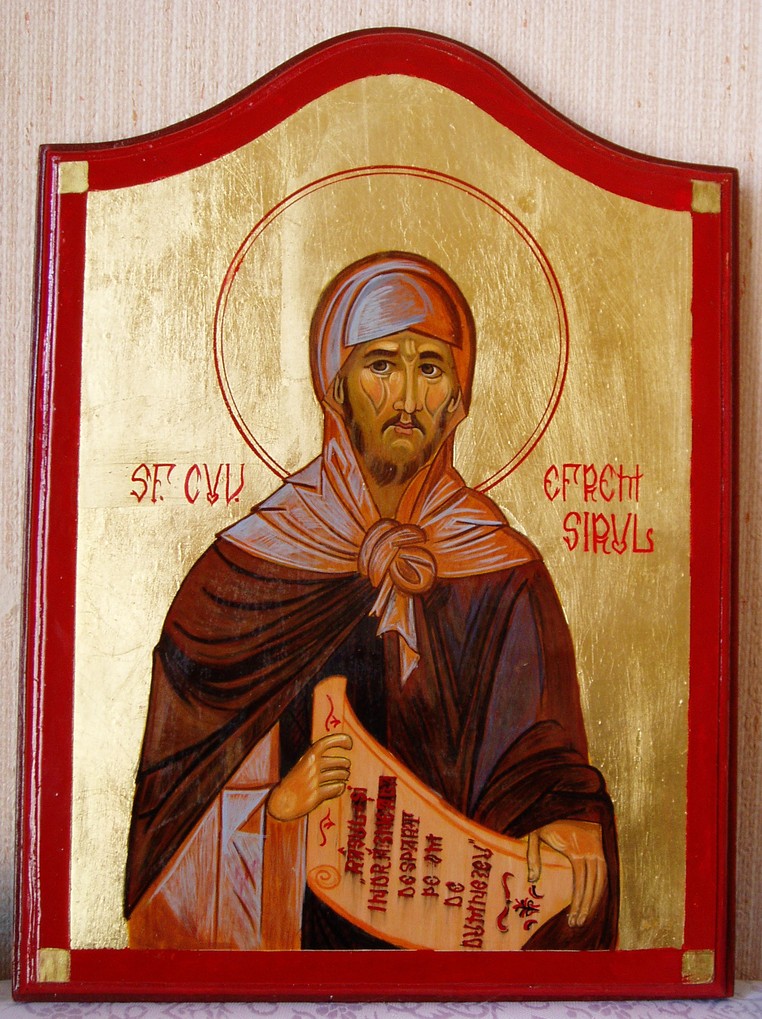
Saint Ephrem the Syrian is the premier father of the Syriac Christian tradition and was declared a Doctor of the Universal Church by Pope Benedict XV in 1920.
Unlike the Greek and Latin thinkers of his era, Ephrem did not write dry, academic prose. He composed his entire theology in exquisite, rhyming verse and hymns designed to be sung by everyday congregations.
1. Early Life in Nisibis (c. 306–363 AD)
Ephrem was born in Nisibis, a vital, multi-faith Roman fortress city on the tense border with the Persian Sassanid Empire (located in modern-day southeast Turkey).
- Early Years: According to Pope Benedict XV “In his youth Ephrem, was hot tempered, easily angered, quarrelsome, and unrestrained in mind and language. While in prison on a false charge, he began to despise human things and the empty joys of this world. Therefore, as soon as he was exonerated, Ephrem at once put on the habit of a monk and ever after devoted himself completely to the exercises of piety and to the study of the Sacred Scriptures.”
- Baptism and ordination: At the age of eighteen, Ephrem was baptized and became a close disciple of the city’s famous bishop, Saint James of Nisibis. He was ordained as a deacon, a ministry he held faithfully for the rest of his life, refusing the priesthood out of deep personal humility. He surpassed James’ expectations with his diligent and sharp-witted commentaries on the Bible. As a result, he soon became the greatest of all commentators of that school, earning the title Doctor of the Syrians
- The “Sons of the Covenant”: He belonged to an early, native Syriac movement called the Bnay qyāmā (Sons of the Covenant). These were not monks living out in isolated deserts; they were urban celibates who lived right in the heart of the city, serving the poor, teaching the illiterate, and praying liturgically.
- The Border Wars: Ephrem lived through terrifying times. Following the death of Constantine the Great, Shah Shapur II made it his life’s mission to retake northern Mesopotamia, leading to a 24-year long series of conflicts known as the Nisibis War. The Persian Empire besieged Nisibis three separate times in 338, 346 and 350 AD. During these crises, Ephrem acted as an advisor to the bishops, a relief worker managing food distributions, and a civic poet—writing gripping hymns that comforted the terrified citizens while comparing the walled city to Noah’s Ark surviving a pagan flood.
- In 338 & 346 AD: Shapur II besieged the city but was repelled both times by its incredibly robust Roman defenses and plague-ridden Persian armies.
- In 350 AD: This was Shapur II’s largest siege. The Persians diverted and dammed the local Mygdonius River to flood the city’s earthworks, attempting a naval assault with siege towers on rafts. The attack bogged down in muddy waters, resulting in disastrous Persian casualties, and Shapur was forced to retreat.
2. Exile and the School of Edessa (363–373 AD)
In 363 AD, the Roman Emperor Julian the Apostate was killed on a failed military campaign against Persia. His successor signed a humiliating peace treaty, ceding the fortress of Nisibis entirely to the Persians. The Christian population was given just days to evacuate.
Ephrem, now an aging refugee in his late fifties, fled west into Roman territory, ultimately settling in Edessa (modern-day Şanlıurfa, Turkey). Edessa was a thriving intellectual capital of the Syriac world, but it was also a hotbed of competing theological factions, Gnostics, and unorthodox sects.
- The Choir Master of Orthodoxy: To combat false teachings, Ephrem realized that people memorize music far faster than they memorize sermons. He took traditional folk melodies and wrote beautiful, orthodox theological lyrics to accompany them.
Crucially, he shattered contemporary cultural norms by forming and directing choirs composed entirely of women to sing these hymns during the public liturgy, using music to weave correct theology directly into the hearts of the laity. - The Scriptural Exegete: In Edessa, he taught at the famous “School of the Persians,” writing vast commentaries on Genesis, Exodus, and the Diatessaron (the harmonized four Gospels).
3. His Final Days and Death
In the winter of 372–373 AD, a severe famine struck Edessa. Pope Benedict XV describes Ephrem’s actions during this time:
“How great and how active was the charity he showed his brethren in a time of famine, even though by then he was worn out by age and labour! He left the house where for so many years he had lived a heavenly rather than a human life and ran to Edessa. By that eloquence which Gregory of Nyssa characterized “as a key fashioned by divinity,” to open the minds and the coffers of the wealthy, he castigated those who were hoarding grain and vehemently demanded that they feed the poor from their surplus. And they were touched not so much by the hunger of the citizens, as by the sincerity of Ephrem. With the money he begged, he himself provided beds for those tortured by starvation and spread them in the porticos of Edessa. There he nursed the sick and met the pilgrims who came to the city from round about looking for bread. Truly this man was placed there by divine providence to aid his country! And he did not return to solitude until the next harvest provided abundance.”
Exhausted by his humanitarian labours, Ephrem contracted a plague that was sweeping the city. He died on June 9, 373 AD. In his moving Testament, he begged his followers :
“I, Ephrem, am dying. With fear, but also with reverence, I entreat you, citizens of Edessa, not to bury me under the altar or elsewhere in the house of God. It is not fitting that a worm teeming with corruption be buried in the temple and sanctuary of God. But lay me out in the tunic and mantle which I used and wore daily. Accompany me with psalms and prayers. I had neither pouch nor staff, neither wallet nor silver and gold; nor did I ever acquire or possess anything else earthly. Work diligently at my precepts and doctrines; as my disciples, do not fall away from the Catholic faith. With regard to the faith, be especially constant. Guard against adversaries – I mean evildoers, boasters, and tempters to sin. And may your city be blessed; for Edessa is the city and mother of the wise.”
4. Extracts from Saint Ephrem’s beautiful writings:
“I placed (the pearl), my brothers, on the palm of my hand, to be able to examine it. I began to look at it from one side and from the other: it looked the same from all sides. (Thus) is the search for the Son inscrutable, because it is all light. In its clarity I saw the Clear One who does not grow opaque; and in his purity, the great symbol of the Body of Our Lord, which is pure. In his indivisibility I saw the truth which is indivisible”
(Hymn On the Pearl ).
“In your bread hides the Spirit who cannot be consumed; in your wine is the fire that cannot be swallowed. The Spirit in your bread, fire in your wine: behold a wonder heard from our lips.
“The seraph could not bring himself to touch the glowing coal with his fingers, it was Isaiah’s mouth alone that it touched; neither did the fingers grasp it nor the mouth swallow it; but the Lord has granted us to do both these things.
“The fire came down with anger to destroy sinners, but the fire of grace descends on the bread and settles in it. Instead of the fire that destroyed man, we have consumed the fire in the bread and have been invigorated”
(Hymn De Fide 10: 8-10).
“The Lord entered her and became a servant; the Word entered her, and became silent within her; thunder entered her and his voice was still; the Shepherd of all entered her; he became a Lamb in her, and came forth bleating.
“The belly of your Mother changed the order of things, O you who order all! Rich he went in, he came out poor: the High One went into her [Mary], he came out lowly. Brightness went into her and clothed himself, and came forth a despised form….
“He that gives food to all went in, and knew hunger. He who gives drink to all went in, and knew thirst. Naked and bare came forth from her the Clother of all things [in beauty]“
(Hymn De Nativitate 11: 6-8).
Sources:
Catholic Encyclopaedia
Principi Apostolorum Petro, Pope Benedict XV (1920) to officially declare Ephrem a Doctor of the Universal Church.
Pope BENEDICT XVI – General Audience, Wednesday, 28 November 2007