
Saint of the Day – 22 May
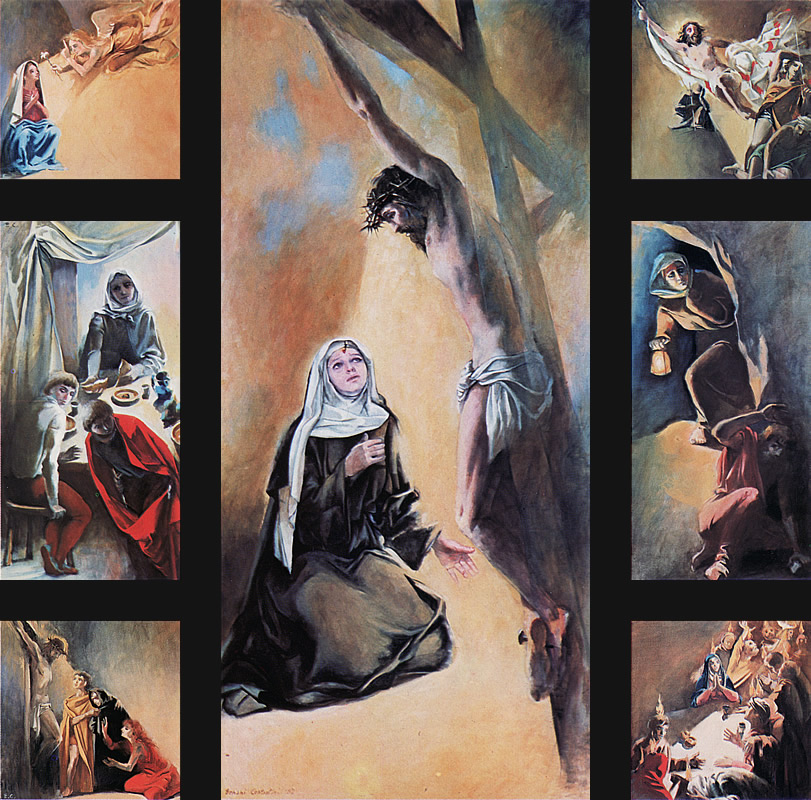
Saint Rita of Cascia (1381–1457) is one of the most beloved saints in the Catholic tradition, widely invoked as the Patron Saint of Impossible Causes, hopeless situations, and marital difficulties.
Her legacy is defined by her extraordinary capacity for forgiveness, her role as a peacemaker in a violent era, and her profound mystical experiences.
Early Life and a Turbulent Marriage
Born Margherita Lotti in Roccaporena, near Cascia, Italy, to Antonio and Amata Lotti, a couple respected locally as Pacieri di Cristo (Peace-builders of Christ). Rita desired to enter a convent from a young age. However, in keeping with the customs of the 14th century, her parents arranged her marriage at age 14. In obedience to her parents’ wishes, she married Paolo Mancini, a local nobleman involved in violent political rivalries.
Paolo was a man of fierce temperament, prone to anger, and deeply entangled in the brutal, violent political feuds that plagued medieval Umbria. For 18 years, Rita endured his verbal and physical abuse with patience, kindness, and continuous prayer. Her gentleness eventually won him over, and Paolo experienced a deep religious conversion, asking for her forgiveness and changing his ways.
Tragedy and Peacemaking
Just as their family life found peace, the shadows of Paolo’s past caught up with him. He was ambushed and stabbed to death by members of a rival faction.
The tragedy was compounded when Rita’s two teenage sons, Giangiacomo and Paolo Maria, swore to avenge their father’s murder according to the cultural laws of the vendetta. Horrified by the prospect of her sons committing a mortal sin and continuing a cycle of bloodshed, Rita prayed fervently that God would change their hearts—or take them before they could commit murder.
Within a year, both sons fell ill with the plague and died, forgiving their father’s killers on their deathbeds.
Entry to the Monastery and the Mystical Wound
Left entirely alone, Rita sought to fulfill her childhood dream of entering the Augustinian Monastery of Saint Mary Magdalene in Cascia. The nuns, however, initially refused her entry. They feared that admitting the widow of a murdered man would bring the violent local feuds inside the cloister walls.
To prove her intent and secure peace, Rita undertook the monumental task of reconciling her late husband’s family with his assassins. After she successfully brokered a public, formal peace agreement between the warring clans, the monastery accepted her at the age of 36.
For the next 40 years, Rita lived a life of intense contemplation and rigorous penance.
In 1441, while meditating deeply before a crucifix, she experienced a profound mystical grace: a single thorn from Christ’s crown of thorns appeared to pierce her forehead.
This partial stigmata left a deep, physical wound that remained open and painful for the rest of her life, emitting an odour so foul that she had to be partially isolated from the community, allowing her to spend her remaining years in deep, solitary prayer.
Death, Incorruptibility, and the Miracle of the Roses
Rita died on May 22, 1457. On her deathbed, she requested a single rose from her family’s old garden in Roccaporena. Though it was the dead of winter, her relative went to the garden and found a single, perfectly blooming red rose in the snow. This event solidified the rose as her permanent symbol.
Upon her death, the foul odour of her forehead wound reportedly transformed into a sweet, heavenly fragrance. Her body was never buried; instead, it was placed in a wooden casket where it has remained remarkably preserved for centuries.
Today, her incorrupt body is venerated in a silver-and-glass shrine inside the Basilica of Saint Rita in Cascia, Italy, where millions of pilgrims visit her. Pope Leo XIII canonized her on May 24, 1900, and her feast day is celebrated worldwide on May 22nd.
The Pilgrim Experience in Cascia Today
Today, Cascia is a major pilgrimage site nestled in the Apennine Mountains. The small medieval town centres entirely around the Basilica of Saint Rita, built in the early twentieth century to accommodate the millions of travellers who come to seek her aid.
Source:
Catholic Encyclopedia
Vita della Beata Rita da Cascia – Agostino Cavallucci