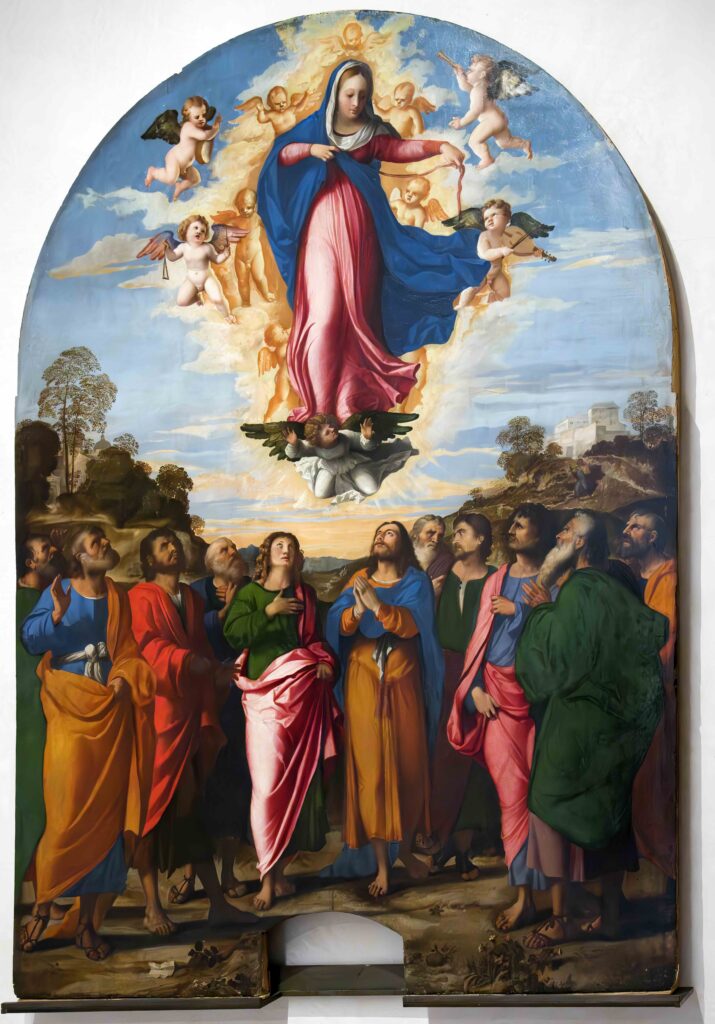
First Reading : Revelation 11:19A; 12:1-6A, 10
Then God’s temple in heaven was opened, and the ark of his covenant was seen within his temple.
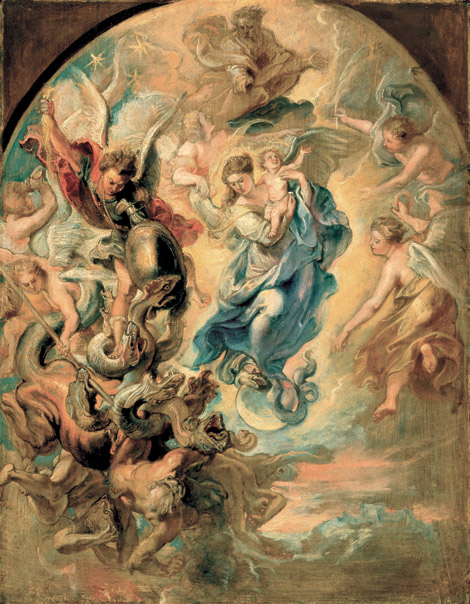
And a great sign appeared in heaven, a woman clothed with the sun, with the moon under her feet, and on her head a crown of twelve stars; she was with child and she cried out in her pangs of birth, in anguish for delivery.
And another sign appeared in heaven; behold, a great red dragon, with seven heads and ten horns, and seven diadems upon his heads. His tail swept down a third of the stars of heaven, and cast them to the earth.
And the dragon stood before the woman who was about to bear a child, that he might devour her child when she brought it forth; she brought forth a male child, one who is to rule all the nations with a rod of iron, but her child was caught up to God and to his throne, and the woman fled into the wilderness, where she has a place prepared by God.
And I heard a loud voice in heaven, saying, “Now the salvation and the power and the kingdom of our God and the authority of his Christ have come.
Gospel Reading : Luke 1:39-56
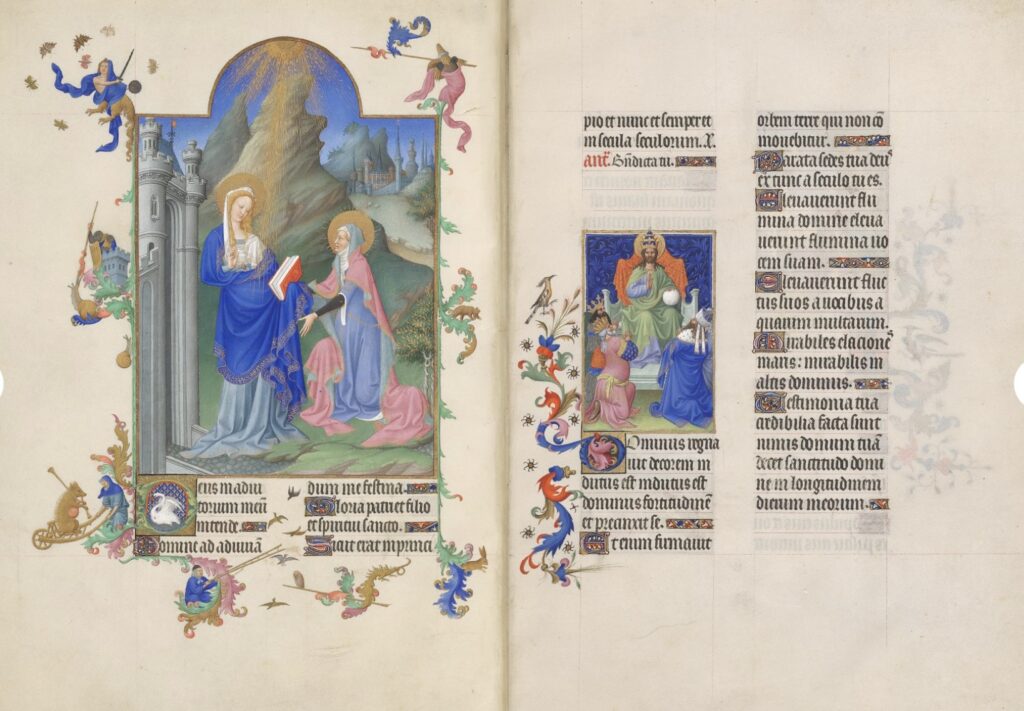
In those days Mary arose and went with haste into the hill country, to a city of Judah, and she entered the house of Zechariah and greeted Elizabeth.
And when Elizabeth heard the greeting of Mary, the babe leaped in her womb; and Elizabeth was filled with the Holy Spirit and she exclaimed with a loud cry, “Blessed are you among women, and blessed is the fruit of your womb! And why is this granted me, that the mother of my Lord should come to me?
For behold, when the voice of your greeting came to my ears, the babe in my womb leaped for joy. And blessed is she who believed that there would be a fulfilment of what was spoken to her from the Lord.”
And Mary said,
“My soul magnifies the Lord,
and my spirit rejoices in God my Saviour,
for he has regarded the lowliness of his handmaiden.
For behold, henceforth all generations will call me blessed;
for he who is mighty has done great things for me,
and holy is his name.
And his mercy is on those who fear him
from generation to generation.
He has shown strength with his arm,
he has scattered the proud in their conceit,
he has put down the mighty from their thrones,
and exalted the lowly;
he has filled the hungry with good things,
and the rich he has sent empty away.
He has helped his servant Israel,
in remembrance of his mercy,
as he spoke to our fathers,
to Abraham and to his posterity for ever.”
And Mary remained with her about three months, and returned to her home.
What do the Fathers say?
About the First Reading :
The Venerable Bede. The Church is clothed with the light of Christ, and treads upon temporal glory. “Righteousness,” he says, “will arise in his days, and abundance of peace, until the moon be taken away, or consumed.” That is, the abundance of peace will greatly increase, until it consume all the changeableness of mortality, and then death, the last enemy, will be destroyed.
The Head of the Church is adorned with the number of the Apostles, which is twelve, whether Christ is understood, or whether the first beginning of the Church itself is designated under the name of the head. “Thou hast set,” he says, “upon his head a crown of precious stone.”
The Church, in a spiritual sense, both brings forth those with whom it travails, and ceases not to travail with them when already born. As she herself says, “My little children, of whom I travail in birth again, until Christ be formed in you.”
“A woman, when she is in travail, hath sorrow because her hour is come, but when she hath brought forth a son, she remembers the anguish no more for joy.” And He Himself expounded this to His disciples, and added, “And ye now, therefore, have sorrow, but I will see you again, and your heart shall rejoice.”
The dragon is the devil, blood-stained in his cruelty, is armed against the Church with the power of an earthly king. For in the seven heads he describes all his kings, and in the ten horns every kingdom.
He intimates the power and malice of the enemy, whom the Church overcomes by the help of the Lord, for he has cast down an innumerable host of angels and men by deceptive testimony, as with a tail
The devil plots against the Church, and strives to extinguish the faith of Christ in the hearts of the faithful, that he may, as it were, kill him who has been taught, and to whom by teaching he has given birth.
Although the dragon oppose, the Church ever brings forth Christ. But he spoke of the man child as conqueror of the devil, who had conquered the woman. For who but the man child, who is “to rule all nations with a rod of iron,” rules the good with inflexible justice, breaks in pieces the bad? And this is also promised to the Church, in that it is said above, “I will give Him power over the nations, and He shall rule them with a rod of iron.” For the Church, too, daily generates the Church, which rules the world in Christ.
Therefore ungodliness cannot apprehend Christ, Who is spiritually born in the minds of the hearers, because at the same time He reigns with the Father in heaven, “Who has raised up us also together with Him, and made us sit together in heavenly places in Christ.”
The Church rejoices in her sojourning in this present wilderness, as living in hope of things eternal. For she has received power to tread upon serpents and scorpions, and upon all the power of the red dragon.
About the Gospel Reading :
St AMBROSE. The Angel, when he announced the hidden mysteries to the Virgin, that he might build up her faith by an example, related to her the conception of a barren woman. When Mary heard it, it was not that she disbelieved the oracle, or was uncertain about the messenger, or doubtful of the example, but rejoicing in the fulfilment of her wish, and consicentious in the observance of her duty, she gladly went forth into the hill country. For what could Mary now, filled with God, but ascend into the higher parts with haste!
ORIGEN. For Jesus who was in her womb hastened to sanctify John, still in the womb of his mother.
THEOPHYLACT. She went into the mountains, because Zachariah dwelt there. As it follows, To a city of Judah, and entered into the house of Zachariah. Learn, O holy women, the attention which ye ought to shew for your kinswomen with child. For Mary, who before dwelt alone in the secret of her chamber, neither virgin modesty caused to shrink from the public gaze, nor the rugged mountains from pursuing her purpose, nor the tediousness of the journey from performing her duty. Learn also, O virgins, the lowliness of Mary. She came a kinswoman to her next of kin, the younger to the elder, nor did she merely come to her, but was the first to give her salutations; as it follows, And she saluted Elisabeth. For the more chaste a virgin is, the more humble she should be, and ready to give way to her elders. Let her then be the mistress of humility, in whom is the profession of chastity. Mary is also a cause of piety, in that the higher went to the lower, that the lower might be assisted, Mary to Elisabeth, Christ to John.
St AMBROSE. But soon the blessed fruits of Mary’s coming and our Lord’s presence are made evident. For it follows, And it came to pass, that when Elisabeth heard the salutation of Mary, the babe leaped in her womb. Mark the distinction and propriety of each word. Elisabeth first heard the word, but John first experienced the grace. She heard by the order of nature, he leaped by reason of the mystery. She perceived the coming of Mary, he the coming of the Lord.
The Venerable BEDE. Nor is it to be wondered at, that our Lord, about to redeem the world, commenced His mighty works with His mother, that she, through whom the salvation of all men was prepared, should herself be the first to reap the fruit of salvation from her pledge.
ORIGEN. Now if the Lord could neither receive increase or decrease, what is this that Mary speaks of, My soul doth magnify the Lord?
But if I consider that the Lord our Saviour is the image of the invisible God, and that the soul is created according to His image, so as to be an image of an image, then I shall see plainly, that as after the manner of those who are accustomed to paint images, each one of us forming his soul after the image of Christ, makes it great or little, base or noble, after the likeness of the original; so when I have made my soul great in thought, word, and deed, the image of God is made great, and the Lord Himself, whose image it is, is magnified in my soul.
But the soul first magnifies the Lord, that it may afterwards rejoice in God; for unless we have first believed, we can not rejoice.
St BASIL the Great. The first-fruit of the Spirit is peace and joy. Because then the holy Virgin had drunk in all the graces of the Spirit, she rightly adds, And my spirit hath leaped for joy. But the frequent mention of leaping for joy in the Scriptures implies a certain bright and cheerful state of mind in those who are worthy. Hence the Virgin exults in the Lord with an unspeakable springing (and bounding) of the heart for joy, and in the breaking forth into utterance of a noble affection. It follows, in God my Saviour.
For the Virgin, with lofty thoughts and deep penetration, contemplates the boundless mystery, the further she advances, magnifying God; And Mary said, My soul doth magnify the Lord.
Sources:
Bible readings from the Revised Standard Version of the Bible, Second Catholic Edition, copyright © 2006 National Council of the Churches of Christ in the USA
Quotes of the Fathers from :
Thomas Aquinas’ Catena Aurea Translated by St John Henry Newman
The Explanation Of The Apocalypse by the Venerable Bede
Artwork ex Wikimedia Commons